This is a slightly edited text originally included in the postscript to my PhD thesis “How on Earth: Operationalizing the ecosystem service concept for sustainability”, published in 2021.

I’m lying on the grass, half of my view milky blue from a thin veil of clouds. The other half: The crown of a thirty-three-and-some-years-old linden tree, its branches spreading out from the trunk like the blood veins in a lung. The still-green leaves, tissue. There are dead leaves on the ground, but only a few. Decay has not become overpowering, the smell is still pleasant. Birds are chirping, I can almost ignore the low murmur of engines from the city streets, just down the hill. The sun is warm on my face.
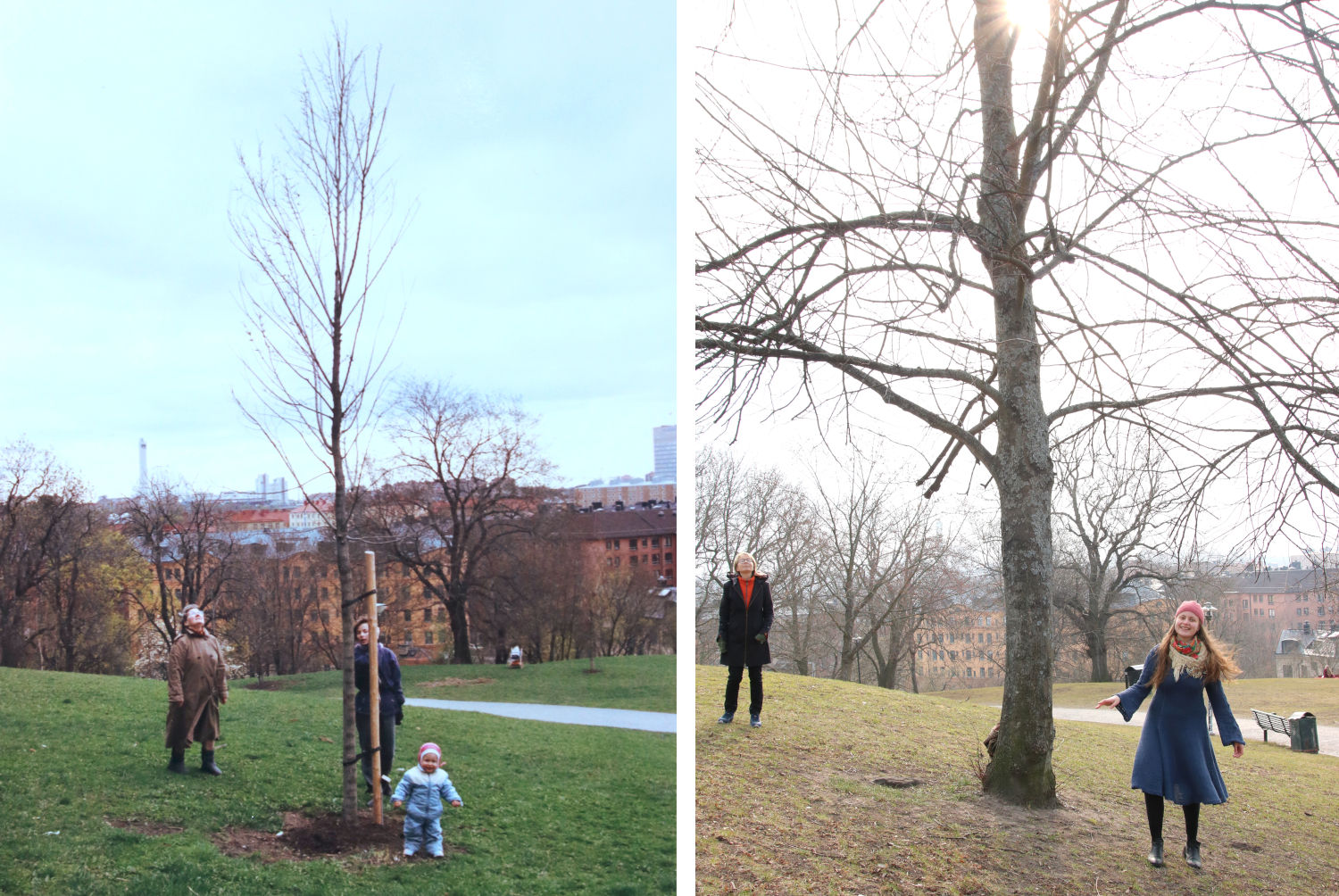
It is an old friend, the tree. On this hill, in a park in southern, inner-city Stockholm. It was planted here as part of a municipal initiative to increase trees in this part of the city. In the late 1980s, they would not have been motivating tree-planting in terms of the ecosystem services that trees provide, as ecosystem services still, at the time, would have been a relatively new academic concept. Stockholm city planners, however, have a long history of acknowledging the value of greenery in the city, both for the health and enjoyment of city-dwellers, and for the improvement of environmental conditions such as air and water quality. That is why Stockholm today is one of the European cities with the highest tree cover. But, the origin of this tree was not just any random planting campaign. To fund it, the city took donations from citizens. In return, the donors would be assigned their own, newly planted sapling. This linden tree is mine, donated by my grandparents to the city and its citizens to celebrate my birth. A gift from my mummo Anna-Liisa and farmor Lilian.
Anna-Liisa grew up on a farm relatively close to the Russian border in Finland. She rarely talked about her experiences from the Finnish Winter and Continuation Wars (1939-40 and 1941-44), but once, she told me how she would be woken up in the middle of the night by the arrival of Russian bomber planes. How she would pick up her baby brother and run out into the woods, as fast as she could through the deep snow, to hide under the heavy branches of an old spruce. Later, she would plant another spruce next to the house where she would raise seven children and host many visiting grandchildren every summer. This spruce, to celebrate the birth of her third child, my uncle Timo. Her husband, my grandfather, ran a small independent sawmill, which went well, until the global timber market turned and it went out of business. He died too early, while working far away from home, as an inspector for a big forestry company in central Finland. For me, mummo Anna-Liisa was an incredible gardener, the lushness of her vegetable patches and flower beds unparalleled. She died in that house many years ago, but Timo’s tree is still there. Enormous and wide, like only free-standing conifers can become.
Lilian’s life, as a life-long city-dweller and daughter of an army officer, was not as marked by trees. She wanted to become an architect, but grew up at a time when pursuing architecture as a career for a woman still would have required being a pioneer. She was too sensitive. Instead, she became a librarian. But she maintained an interest in form and architecture her whole life. During school breaks, when my parents were working, she would take me all over Stockholm, to museums and parks, point out all her favorite buildings and instill in me an appreciation for the timelessness of good architecture. The longevity of something that is both functional, well-crafted and beautiful. Architecture can, like few other artforms, connect us with a deeper sense of time in the midst of our everyday lives. Like rocks and trees, buildings stand, reminding us to be still, to remember times, lives past.
I think this is where they could meet, Anna-Liisa and Lilian. They did not even share a language, but they had this: An appreciation for the timeless, and an awareness of how also the timeless needs tending to. Sometimes, even someone to bring it into the world, for the benefit of nameless others. They took turns teaching me how to crochet and knit, encouraging boldness in colors and patterns. They sent me books. And they gave me this tree.
I have many fond childhood memories from picnics here. Later, the park became the place where teenagers like me would gather on Friday and Saturday evenings to listen to music and, you know, other kinds of stuff teenagers engage in. When I started interviewing forest owners in the spring of 2020, I was reminded of the tree. I had not been to the park for some time, being so busy with getting a doctorate, being an adult. All the conversations about trees that I was having, though, put a new light on this gift that I was given as a baby by my two grandmothers. The layers to it.
There are many meanings that can be attached to this tree. Different reasons why people would care. A conduit to times and people past. A symbol for a livelihood, a reminder of trauma. A provider of shadow, of beauty and peace. A place to socialize. Air-cleaner, soil-stabilizer, home. These meanings can be held by different people, but also be kept as layers within ourselves, layers that can be hard, sometimes, to connect to each other.
Like a hypothetical civil servant who loves her lunchtime walks through a small tree-covered park, but then has to return to the office to weigh the costs and benefits of protecting the park against approving development of desperately needed homes for humans.
Or, suggest that the city should invest in another tree planting campaign.
We need bridges between these layers, and between people. Translation. Points of connection. The ecosystem service concept can, if used carefully, be one such bridge. Not the only one. We need to give space to each layer, and find different ways of bridging and translating. Maintain a dialogue between the person who remembers, the person who cares, the person who has to weigh options, and the person who just wants to lie under a tree and smell the approaching autumn. Ecosystem services cannot be used in all of these dialogues, but it can in some.
Possibly. Because, even though I have written a thesis about it, I feel like I have only just started exploring the potential of this concept, as well as its pitfalls.
I need to get going, though. There is a test print that needs to be checked. Spikning and defense invitations to send. But not quite this second. The sun is warm. The breeze in the top of the linden is a soothing whisper. My cardigan is getting damp from the dewy grass, but I do not mind. I want to watch the yellow leaves leisurely fall from the branches above me. Just a moment longer.
Under this linden tree. It holds multitudes. So do we.

 Katja Malmborg