


Life, with the garden
Location: Stockholm, Sweden • • • Visits: Autumn and winter 2013
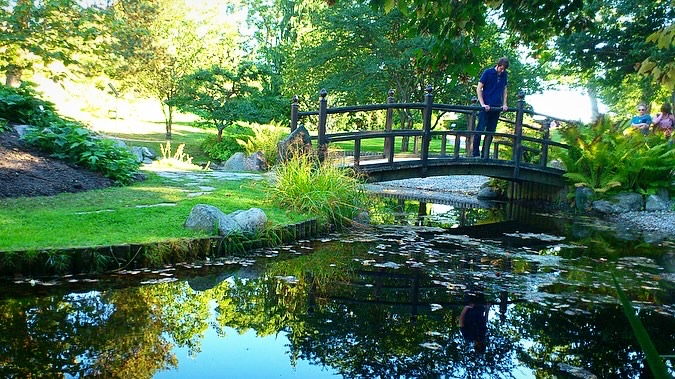
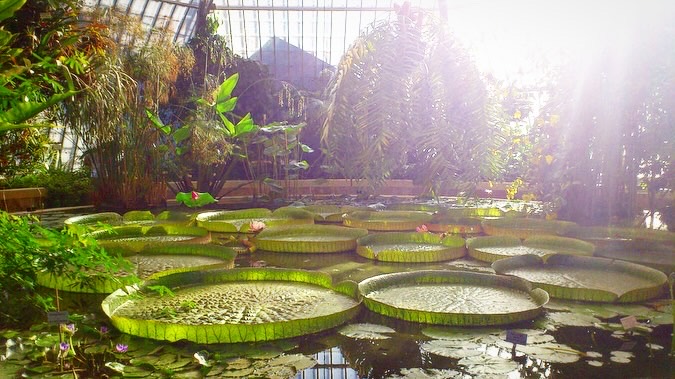
I was supposed to go to the natural history museum with a friend, but waiting by the main entrance in the still summery warm sun, I just couldn’t make myself go into the dark halls with stone displays and dinosaur bones. So, when my friend arrived, I convinced him to cross the highway and go to the Bergianska botanical garden instead.
In the orchard, the apple trees heavy with fruit, we laid down on the grass in the sun, watching the dragonflies come and sit on my colorful Liberian skirt. I could have stayed there for hours, smelling the air, sweet from the fallen apples decomposing in the grass, but I had places to be and too soon, we picked up our stuff and went back to the metro.
It was a very nice early autumn afternoon, in a lush and pretty botanical garden. Trust me, I know botanical gardens.

I’ve recently started a master’s program at Stockholm Resilience Centre, and it’s been quite a shock. I walk around feeling exhausted all the time and kind of lost, like I don’t know where I’m going and what I’m doing. Like I’m holding on to a string, being pulled in high speed toward something, but I’ve got no idea where. Maybe it’s the whole thing about starting a new master’s program, meeting all the new people, having to adjust to new ways of learning, different expectations.
Or it might be this whole resilience thing, and all our lectures about the Anthropocene and planetary boundaries and how we’re more or less screwed, in general, as a species, in the world, more or less. Of course that’s not what our teachers are saying, they are not that fatalistic, but it kind of feels that way.
It’s probably a combination of both. I find myself feeling annoyed by people. Not because they are annoying, but because I need to talk to them, and I have nothing to say. Create a common language. The study load is heavy, and all the others in the program are so ambitious and on top of things. And then this what’s-the-point-feeling rushes over me and I have no idea of what to do with all this knowledge.
I’ve read a book, though. And right in the beginning of it, there is a passage that makes things, if not clear, then atleast clearer. A sort of explanation for what resilience is, and an outlook that I hope to acquire during the two years of my master’s.
”Resilience thinking is a way of looking at the world. It’s about seeing systems, linkages, thresholds, and cycles in the things that are important to us and in the things that drive them. It’s about understanding and embracing change, as opposed to striving for constancy.” (Walker & Salt 2006: “Resilience thinking”)
That, I like. So maybe there is hope for me yet.

I’m so tired. I feel like I’m being pulled apart. All these things that I want to do. All these people that I want to meet. All the planning that I do. The last couple of days, weeks, I feel like I haven’t had time to breathe.
I’ve had people over for dinners and parties and couchsurfers and all this student council business.
I feel I would like for someone to take care of me for once.
I know I shouldn’t, though. Feel. I should ask. Let other people do. And I do have. People. Lina made me breakfast yesterday. Jessica told me on Saturday that I was weird and that it cracked her up and then she sent me a text that was too sweet to repeat.
On Saturday night, Lina and I took the couchsurfer out dancing, not really succeeding to give him a good taste of the Stockholm nightlife. The club turned out to be kind of off, but the last hours on the hip hop dance floor stuck. The base so deep it made the small hairs on my arms tingle. Almost as if someone was lightly, lightly touching. I noticed, and afterwards Lina confirmed that the men were circling us like sharks. I was there to dance, but that recognition. Rejection always feels less acute when there are other men around who show you they’re willing to take over.
Mostly sleep though. As a solution. And singing. I need this pressure to leave my body.

I’ve been thinking about time. And places left behind. People.
I looked up plane tickets to San Francisco today, what if I went there in the summer. Back to the farm in Sonoma, to pick blueberries and spend my afternoons reading Russian classics by the pond.
There was a young man, beautiful, he tried to teach me how to dance charleston. Moving within his gaze. Just that, a place that is enough. The air tangible. So rare with eyes I actually can feel on my skin, tingling.
Maybe not while stepping on my own toes in a poor excuse for a charleston, though.
Still, strange. I haven’t thought about that gaze for ages. Not even while there, at the farm, where he came to visit sometimes. He was young and I have already told you, I have a terrible taste in men. The good ones, the ones that could teach me to dance charleston, they pass me by.
Next time, if there ever is one, I’ll make him teach me some lindyhop.

I have had three cups of coffee today and my heart might actually be beating irregularly.
When a young horse gets saddled for the first time, you never quite know how it will react. One might just smell the saddle and then calmly let you tighten the girth, barely moving its ears. Another might stand completely still at first, just to explode once he’s allowed to move. It’s something restricting, tight, and it needs to be gotten rid of. Around and around the young horse will lope in the round pen, kicking and bucking, until the fur on his neck is wavy with sweat.
Recently, I’ve been feeling like such a horse. Like Victor, the chestnut youngster at Time Out Farms, who just simply couldn’t accept being restricted by anything. I want to kick and buck and tell everyone to fuck off.
The problem is, if he had just stopped for a moment, taken a proper breath and just felt past the newness of the saddle, he might have realized that it wasn’t so bad after all. Horses, just like dogs and other flock animals, want to cooperate and like learning new things. If he could just have looked past the discomfort of the girth around his belly, slightly restricting his movements, he might have learned about all the fun things you get to experience as a horse, if you have the great luck to be trained by such an expert horseman as Jay. A whole new universe would reveal itself in front of you. Sometimes, stubbornness and fighting back is just a waste of time and harmful.
Am I that horse? Am I Victor, carrying around a damaging fighting instinct?
I’m sitting in the Geoscience building, its eight in the evening and I’m reading articles. I come here sometimes, when the coziness at the SRC becomes too tight. Here, the airiness comforts me. Or maybe it’s just the recognizable and old.
An old professor walks past, says “Lucky them” when I say that I’m doing my master’s at SRC now and I tell him that I feel that my geography background fits perfectly, that I’m thinking of doing my thesis on landscape change using remote sensing. He replies, as if it was the most natural thing in the world, “Well, you can always come back and do your Ph.D. here, then”.
I wonder how I always manage to fool them. Hannah called me a superhero after I took part in their group discussion on the thermokarst lake regime shift and I thought: I’m just bad at keeping my mouth shut. That doesn’t mean I’m trustworthy.
Around a streetlight in the distance, it looks like it’s snowing. I don’t think it is, though. It’s only me, wishing too hard.

Maybe it’s November. I’m feeling very unforgiving, not ready to compromise, difficult. I feel: certain things in life are serious, you should choose your seriousnesses well and take responsibility for your choice. Both the one you made and all the ones you didn’t. Not behave as if it doesn’t matter.
Because it does. Life matters. What we choose matters. And right now, I can’t seem to stand people that act differently.
Being difficult, isn’t that my prerogative as a human being?

I have a weakness for short, fragmentary novels with observations from life. Like Elin Ruuth’s “Fara vill”, that I read ages ago, I found this quote while cleaning my computer:
“I am taught that you can hear where the lungs start and end by patting yourself lightly along your back. I am not taught how to pat my own back. One theory is that you are dependent on other people to fully understand your own anatomy. In all possible contexts, dependence seems to be a completely legitimate phenomenon.”
Lately, I’ve been feeling so disconnected from my body. And I’m not sure that I’ve ever known where my lungs end.
I wish winter would come now. The cold always turns breathing into a conscious activity. If not fully giving a sense for their beginning and end, filling my lungs with freezing air makes their volume feel so tangible.

On Thursday, around midday, my grandfather died.
I was in school, dad was with him when he took his last breath. When I arrived at the hospital, he was still quite warm.
A dead body is a weird thing. It was as if he had lost his features. An empty shell. Which is what he was, I guess.
I didn’t cry. The only thing I could think about was how incredibly hot the male nurse intern was. He came in with papers for us to sign. He was tall and blue-eyed and I thought that either he must be such a door-mat, gay, or simply the perfect man. I like to think of myself as deep and intelligent, but then I find myself in a room with the body of my dead grandfather and all I can do is start fantasizing about the hot nurse. I am shallow and have inappropriate reactions in sad situations.
Now they’re all dead, my grandparents. Both the Swedish ones and the one I had in Finland. I wonder what they imagined their future life together would be like, Lilian and Lars, when they got married in the early 1950’s (I think). Sweden must have been so full of promise, everything pointing in one direction: forward. I don’t know, of course, but I imagine seeing that in their clear eyes and bright smiles. Great hopes for the future.
Times are different now. Couples don’t take wedding photos in black and white anymore.
I remember one morning at the farm in Sonoma, Abbie coming late out to the blueberry field. She told us that her grandmother had just gotten really sick and the doctors didn’t know if she would get better. And then Abbie started crying, in her straw hat and gardening gloves, in the bright California sun. I’m not good with emotional things, but somehow my instinct told me to hug her and I think she appreciated it.
See, that’s appropriate behavior when you get news of death or sickness in the family. Abbie is going to Berlin in the spring, she might be able to pass by Stockholm on her way east. A HUGE maybe. But I hope she will. I really do. Not only because she could teach me some proper grief behavior.
Not that I think my grandfather would have minded. He wasn’t big on showing feelings. He was a very straight-forward-kind-of-man. On Tuesday, the last time I saw him alive, he complained about everything on TV being about Mandela, eulogies and praise. Mandela was one of his biggest idols and the only time I’ve seen him cry, except for when grandma died, was in an overheated van during a family holiday in Cape Town, Christmas 1997, when he held a monologue about how incredible he thought Nelson Mandela was. I guess that means that you can even get sick of your heroes.
Shit. I really don’t have a point to this story, more than. Now he’s dead. And in a way, I got to say goodbye. The last memory I have of him is there in the hospital bed on Tuesday evening, him holding my hand, squeezing it and smiling – and then I had to run, to babysit my brother while dad and stepmom went to see a play.
And so, life goes on. I’m knitting baby hats. All my friends seem to be getting pregnant these days. Well, maybe not all. But still. Life. The eternal cycle.

And we define ourselves in the contrast between ourselves and others.
Never during my 9 years in a Finnish school did I feel particularly Finnish. There were other people who spoke the language better, whose both parents were Finnish, who might even have been born there. In the Finnish school, I wasn’t particularly Finnish. But as soon as I started my Swedish high school, I became the Finnish girl. And I liked it. I identified more with my Finnish heritage when everyone else around me were Swedish.
And that’s how it is now. In Sweden, I often point out my Finnish heritage, because it gives me an explanation for why I feel different in certain aspects. But when I travel, when everyone else around me are neither Swedish nor Finnish, I morph into this purebred Swede – because there, being Swedish is also special.
My identity as a geographer has been growing over the years, but never has it been as strong as when I left the Geoscience building at university for Stockholm Resilience Centre. There, all my classmates are biologists and economists and environmental scientists and suddenly knowing maps and thinking spatially gave me an edge. I became defined by what made me different from the rest.
This means identity depends at least partly on the situation we’re in, and the contrasts between us and the people around us. Today, I’m a Swedish-Finnish geographer – but tomorrow, who knows?
 Katja Malmborg