Life, with the farm
Location: Sebastopol north of San Francisco, California, USA • • • Visit: June and July 2012
After Hanna left to go back to Sweden, I took the bus from San Francisco across the Golden Gate Bridge and went to the city of Sebastopol, Sonoma County, to wwoof at Duckworth Farm.
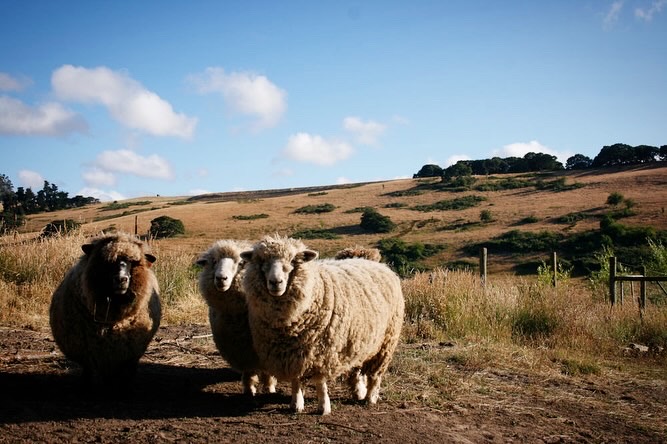
Duckworth Farm is a small, family run farm that grows organic hay and organic blueberries as its main business. They also grow other berries, fruits and vegetables and keep animals for private use. When I arrived, they had just baled their first cut of hay for the season, and there were bales of rough, golden hay in huge piles everywhere on the farm. But the blueberry field was where I spent most of my working hours together with the other wwoofers, the farmer Lorri and her daughters Snazzy and Lauren.
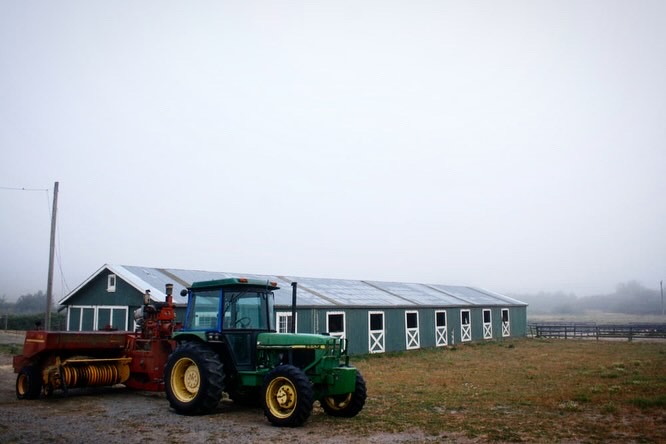
The days started at fifteen minutes to seven, so that we could make it out to the stables in time for the morning stable chores at seven. Almost every morning was misty, cold and raw.
They had a very special microclimate in the small valley where Duckworth Farm was situated. The weather was very much affected by the Pacific and the exchange of air between land and ocean. In the mornings, the mist covered everything like a thick blanket. At around ten-thirty, the sun had made the mist disappear, and we got a couple of hours of heat. Then, at about two or three, the wind started blowing, first just like a slight breeze, then more fiercely, until around seven, when the wind had made it cold again and you really needed something with long sleeves when going outside. And this happened almost every day. Sometimes, the sun was shining in the morning, and other days the wind didn’t become that bad in the evening – but most of the time, it was the exact same cycle, over and over. And all this due to the differences in heat capacity between soil and rock on the one hand, and water on the other. I find it fascinating.
I made it into a habit to get out a couple of minutes before seven every morning, so that I could walk up to the strawberry patch and have a couple of fresh, morning chilled strawberries before the day started for real. It woke me up and filled me with that sweetness that made my skin tingle, and made me feel like I was ready for the new day, despite the mist and cold.
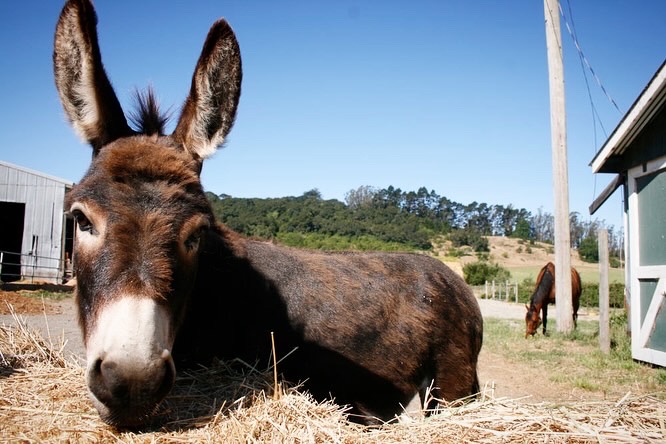
The Duckworths had ten horses and a donkey in their stable, and they all had to be let out into the fields and paddocks in the morning, and then we had to clean the stables and fill up the waters and give them new hay. This usually took about an hour, and us being so many (three to four wwoofers and one of the Duckworth girls) it didn’t really feel like that hard work.
So, at around eight, we all walked up to the main house. I slept in a cozy room in one of the barns together with another wwoofer, but we had all our meals up in the main house with Lorri. Sometimes she made blueberry pancakes for us, and sometimes American biscuits or blueberry pie – but mostly we ate oatmeal porridge or cereals or scrambled eggs. Then, at nine, we picked up our hats and scarves and sunglasses and water bottles, put on thick layers of sunscreen on our noses and our arms, and walked up to the blueberry field.
Some days we picked berries, others we weeded. By noon, Lorri usually called it a day and we were free to do whatever we wanted.
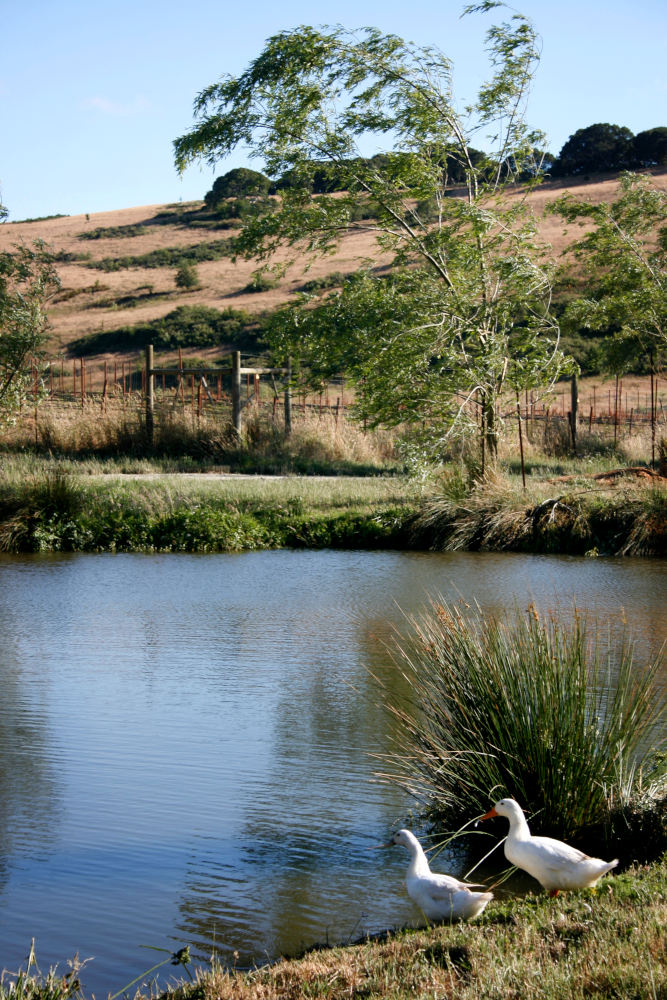
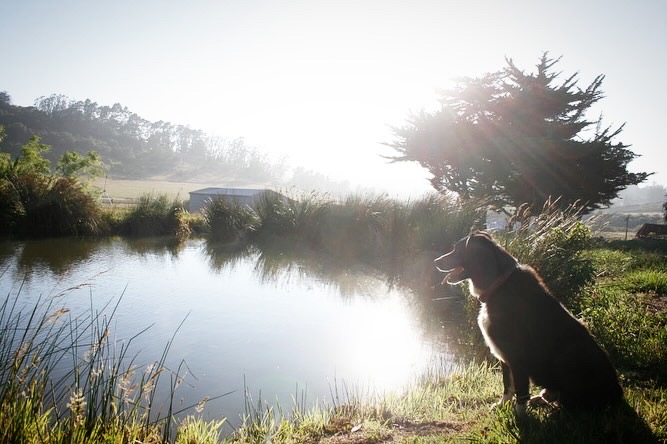
Almost every day, that meant going down to the big pond to swim, play catch with the dogs and read. The water was refreshingly cold. I could’ve spent all of my days by that water, reading and swimming, but by three-ish the wind had usually become too strong and chilly for it to be really comfortable to stay. So, we returned to our rooms and read some more, or took a nap. Some days Lorri taught us how to bake and cook different things in her beautiful kitchen. Other days we took the bicycles and biked for thirty minutes into Sebastopol, where it always, without fail, was at least five degrees warmer than at the farm. Sebastopol was in another valley, not at all as affected by the ocean air.
Sometime between seven and nine, depending on when Lorri’s husband Oscar came back from work, we had dinner. Lorri liked cooking and she did it well, so despite my huge appetite I never had to go hungry at the farm.
Then, at last, at ten thirty I crashed into bed and slept like a log, every single night of my stay at Duckworth Farm. It was a great place, and I had a great time. Northern California is one of those wonderful places on earth, there’s just no point denying it.

I’m sitting on my robust, country house bed in the room that I share with Sandra from Spain. Listening to Sandra sing out of tune with her iPhone, in Spanish, while she’s dancing so that the concrete under her feet echoes outside the window. I can still feel the taste of blueberries in my mouth. When I’m done with this, I might go outside in the sun, pick a few strawberries on the way to the pond, where I’ll take a swim and then lie in the sun and read the last, momentous part of “Anna Karenina” (no, I haven’t finished it yet. It’s embarrassing, I know).
Tonight, Lorri, the farmer, has promised to teach me how to make American chocolate pudding from scratch. (Isn’t it funny, that Lori of Whiskey Creek Farm and Lorri of Duckworth Farm have almost the same name? There must be something special with those Lor(r)ies.)
When I’m writing this, I’ve been traveling for 117 days. I have 29 days left. Part of me doesn’t feel ready to go home quite yet, while another part can’t wait to get back and start studying again. I’ve learned so much. I feel like someone else. It’ll be interesting to see how long that lasts.

My main task as a wwoofer at Duckworth Farm was working in the blueberry field. When I told people back home about this, they got a little confused. Is it really possible to grow blueberries? Don’t they just grow in the wild? Well, these weren’t our small, wild Scandinavian blueberries. These were the big American ones, that are whiteish inside and pop when you eat them. And if you compare, I would say that one wild blueberry and one American blueberry holds about as much flavor, but the second is at least three times as big as the first. Still, I learned to really like them. They were amazing, Lorri’s blueberries.
The blueberries were a new thing on the farm. The small bushes, planted in long, drip irrigated rows in the big blueberry field, were only three years old and won’t be fully mature for at least another five years. By then, though, they will be so big that Lorri will have to prune them so that she won’t have to pick blueberries on ladders. Wouldn’t that be a sight, picking blueberries on ladders?
Being me, I of course asked a lot of questions, and Lorri was happy to answer. She had worked hard to find the perfect crop for her farm. She had acid soil, and thanks to a very shallow artesian aquifer, she had a lot of water. But the acidity made cultivating things tricky, and so did the cold, misty microclimate in the valley. Finally, she found the blueberries. You see, blueberries like when it’s cold. Normally, they don’t like it as far south as California, but thanks to the very special climate conditions right here, combined with the acidic soil, the blueberry bushes were as happy as they could ever be. Because, blueberries are not like most crops. Blueberries want it acidic, and they want it cold and wet. Duckworth Farm was the perfect place for blueberries.
And that’s how it should be done. Instead of adding tons of chemicals and stuff to the soil and on the crops to make them grow, you should choose to grow crops in places where the natural conditions already make it a perfect place. That’s how we create sustainable agriculture. That kind of thinking is what the world so desperately needs. Listening to Lorri talking about soils and cultivars and using nature itself to get rid of pests was so inspiring. I wish the world had more farmers like her.
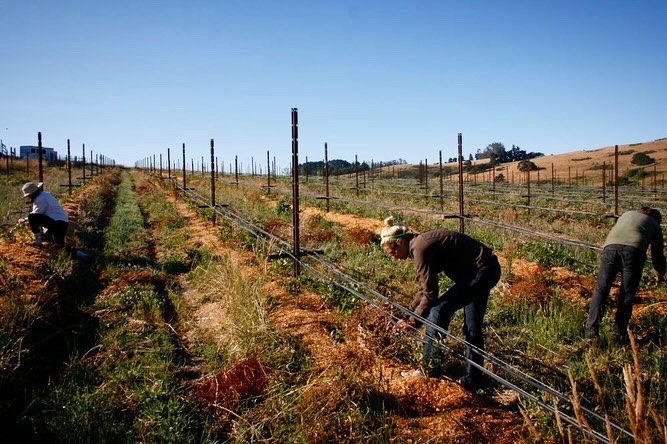
Most days in the field, we weeded. Lorri said that she had been told that she wouldn’t be able to grow organic blueberries for the first five years, because the weeds would kill her. And looking at those thick tufts of grass and thistles, it wasn’t hard to imagine how a less determined farmer than Lorri might yield to the powers of pesticides. But not her. Instead, she invented new ways of weeding. With huge pruning knives, we ruthlessly cut everything down. Cursing the crazy-ass-grass that grew so thick and made us all sticky and itchy. After a row was weeded, someone would take the tractor and cover the soil with wood shavings. In that way, the weed roots in the soil wouldn’t get any sun, and most likely die, or at least not grow as fast as before. A good solution for the organic blueberry farmer.
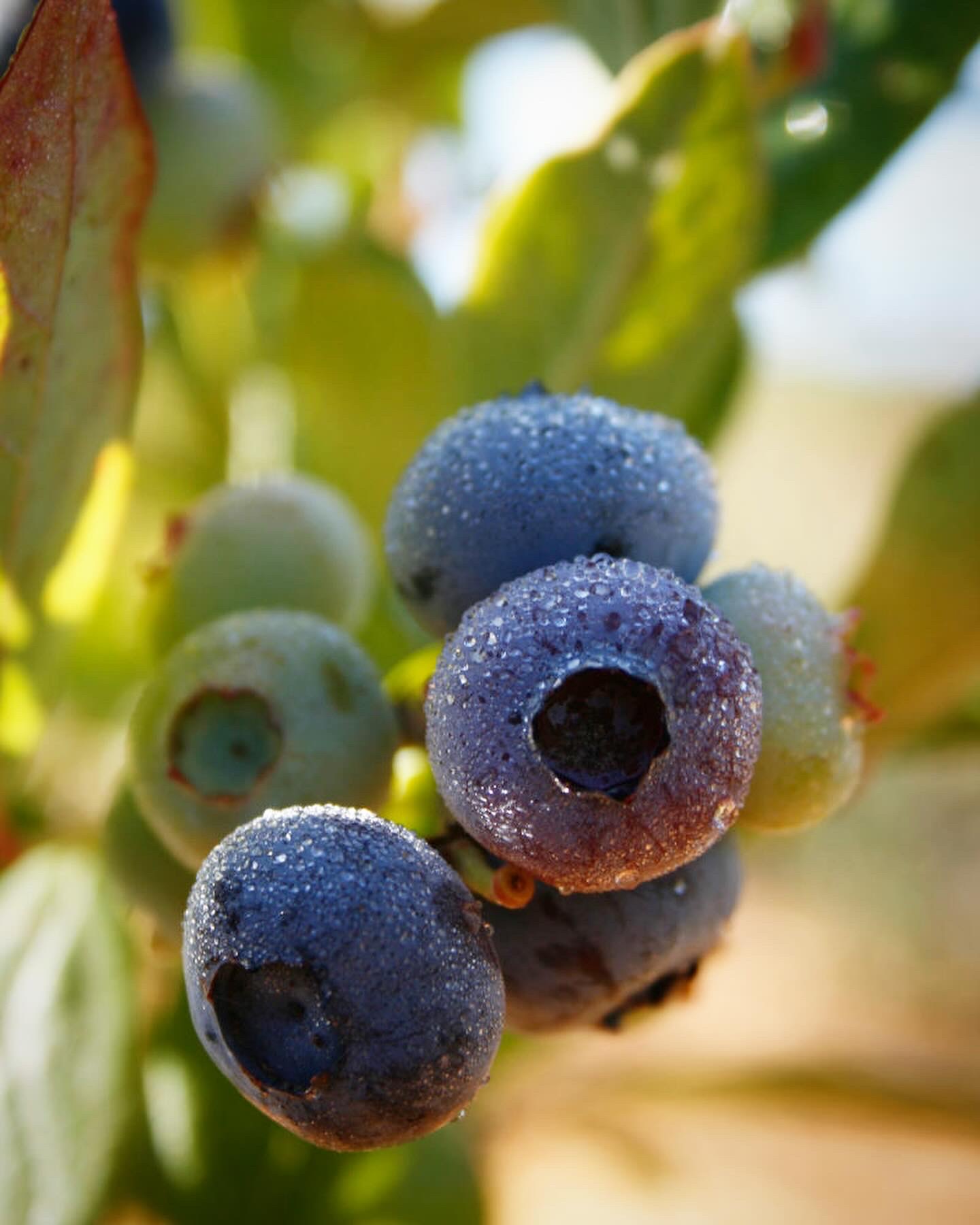
Every third day was picking day. The bushes were still pretty small, but that didn’t prevent them from bearing huge amounts of berries. And they sure were beautiful, the blueberries, in the morning dew.
When the entire field was picked, we returned with our overfull baskets up to the house and it was time to start sorting. A mountain of blueberries, covering the entire kitchen table. We picked out the not really ripe berries, the tart ones that we later would use in pies and biscuits, and the really big and beautiful ones that Lorri would put on top of the baskets of berries that she later would deliver to the culinary school and different bakeries. Because, being a successful farmer is not only about growing a high quality crop, it’s also about knowing how to present and sell.
Oh, I’ve learned so much about blueberries. I wish I had a piece of land back home, where I could put this new knowledge to good use. Well, that’ll have to wait a while. I have at least two university degrees to earn first.

Today, Wednesday the eleventh of July 2012, I finally finished “Anna Karenina” by Leo Tolstoy. It’s been a long journey, both physically, mentally and timewise. I started reading it one morning in Frida’s dorm room in Edmonton, Alberta, Canada in the beginning of March. Now I’m in Sebastopol, Sonoma County, California and it’s July. Four months. That might be the longest time it has taken me to finish a book. And certainly, the longest distance traveled on land with one. I have no idea about the kilometers, but for all of you who know Köppen, I’ve traveled all the way from a cold temperate climate zone to a hot and dry Mediterranean climate zone with Anna and Vronsky and Levin and Kitty in my mind.
It really is a good book. A great book. Tolstoy has such extraordinary finesse and precision in his writing, that you feel like you know the characters already after the first introductory sentence. And the way he makes you feel for them, even though you might not like them. The couple of chapters that describe the birth of a firstborn child from the father’s perspective might be the best piece of prose I have ever read. He is a master, and the novel is a masterpiece. There’s just nothing else to say about it.
But lying there in the dry grass by the pond, after my post-weeding swim, with the afternoon breeze starting to build up in the wild plum trees on the hill, I felt such relief. Reading the last sentence and putting the book down, it felt like I could suddenly breathe freely again. It had been Such a Long Book.
Later, after lunch, when I was preparing to go back down to the pond and realized that I now, for the first time in four months, got to do one of the most exciting things I know, namely, start reading a new book, the feeling of relief was enriched by a bubbly happiness and anticipation. I felt like I had the entire world at my fingertips. It was one of those rare moments of pure happiness.
Of course, I couldn’t control myself. I ended up taking two books with me to the pond: the Neil Gaiman short story collection that I got from Natalia, and the little book about Buddhist meditation that I got from aunt Kaarina just before leaving Stockholm. They started beautifully, both of them. I feel like a completely different person.
 Katja Malmborg