


• In the Mercantour National Park core area •


Life, with the mountains
Location: Alpes-de-Haute-Provence, France • • • Visit: September 2017
Before, journeying:
Getting up when the mist still lingers over the Zürich lake, catching the train. A heaviness in my head, hoping it’s just tiredness – sensing it’s probably not.
Later, rushing down through deep valleys at the French border, listening to Rilo Kiley and thinking about Bolivia. I listened almost only to Rilo Kiley when traveling up and down the Andean slopes eight years ago. Funny how traveling makes connections like this, with memories and places. Like it’s a state of being, partly disconnected from everyday life, whatever is considered baseline.
Further south in France, agricultural fields and thinking: Does this make me better – or am I just fooling myself? Traveling by train. The environmental aspect – how so many environmental researchers fly all over the world for conferences and fieldwork and the cognitive dissonance in that and it’s hard. Staying in touch with oneself. On some level, these three days of traveling by train has made me feel it’s going to be easier to meet my own eyes in the mirror, but on another level: Is it that simple? I don’t know.
Arriving at the azure coast, the train running right next to sun-drenched beaches lined with palm trees. Enormous luxury yachts in the bright blue water. Split worlds. Temporary stop: Nice.

My reason for traveling for three days to reach southern France was to attend the ALTER-Net Summer School in the beautiful village of Peyresq.
As a PhD student, I’m not only supposed to do research and write scientific papers, I am also expected to advance my academic skills in a more general sense by presenting at conferences, participating in reading groups, teaching. And taking PhD courses. Since the number of PhD students with a certain interest at a specific university tends to be low, it is common that PhD courses are done as summer schools where PhD students from all over gather and spend a week or two (or longer) together learning about a topic. In this case, ecosystem services and the science-policy interface.
We were 35 students, mainly from different parts of Europe, but also from Argentina, Brazil, Ethiopia and India. As part of the first days, we presented posters about our work, and the topics of people’s PhD projects were diverse: from hands down, old school entomological studies of counting pollinators in different types of production landscapes to ethnographic studies of locals’ relationship to their urban wetland in metropolitan Accra. Many things fit under the umbrella of ecosystem services research, which was made clear by the wide spread of disciplinary backgrounds in the room.
The same goes for the lecturers. Almost every day for the ten days of the summer school, we had three lectures with three different researchers, many of whom were big names in their respective fields. But they had also been invited to lecture at the summer school because of their engaging, funny or provocative lecturing styles (or their kick-ass skills at giving song-lectures on the ukulele!) – and there was always time for discussions during or in the end of the lectures.
Some of the topics were quite familiar to me, like map-making etiquette and research through participatory workshops, while others were new, like how law has implications for conservation and how research about tree genetics makes (or doesn’t make) it into policy. Others were just thought-provoking and inspiring, like talks about science in a post-truth world or how nitrogen really is the main ingredient in the Philosopher’s stone. Maybe what I enjoyed the most were the talks that brought in my closeted love for philosophy, like different perspectives on how to value ecosystems and for whom – but also what the role of the researcher should be in this whole jumble of things.
You get the picture. So many people, so many topics, such an insanely beautiful, interesting and inspiring environment to be in – which made it completely overwhelming and a constant balancing act between excitement and complete over-exposure. In my case, probably made even more so due to me popping French cold medication like there was no tomorrow. Potentially it made me drowsy, and therefore slightly more relaxed – but still, the exhaustion. I was completely drained by the end of the summer school, maxed-out on social capital and with intellectual food for thought to digest for months to come.
I don’t know if I’ll ever be able to pick up on everything this summer school gave me a glimpse of – but I guess that’s not necessary either. Sometimes, it’s just good to know what’s out there. I have started to build my mental universe of the ecosystem services field. It is not likely to stop growing anytime soon.

When overwhelmed with big ideas and new people, it can be nice to cling to the small things. Like a coincidence: At the summer school, I met a German PhD student who is studying different ways in which the concept ‘multifunctional landscapes’ has been studied. In addition to her research topic being relevant for me, I recognized her vaguely. There was also something about her surname. It took me a couple of days to put my finger on how, but suddenly the pieces fell into place. I asked her if she had a sister who was a teacher? Yes. Who had spent time in Canada? Yes. Wwoofing at a horse ranch outside of Vancouver? Yes. With a woman who filled her house with cats and dogs and wwoofers? Yes.
As it turns out, I wwoofed together with her older sister for a month in 2012 outside of Vancouver. She, the PhD student, even came to visit her sister there and I remember spending a morning talking about horsemanship with her while cleaning the stables. And now we were here, in a tiny village in the southern French Alps, participating in the same PhD course. We live in such a small world!
That afternoon, while standing outside the lecture hall gazing at the magnificence of the valley, I thought about other connections. Like, I was drinking linden blossom tea for the first time in my life, and eating a cupcake not entirely unlike a Madeleine. In France. Like Proust’s main character Swann in “In Search of Lost Time” – the flavors that open him up to his childhood and youth in the blink of an eye. That segment of text, as an example of how to use the sense of taste and smell to open a story, so often used in the creative writing workshops that I participated in as a teenager. Standing here, drinking linden blossom tea and Madeleine-like cupcakes, thinking about my teenage years of writing prose.
Again. Funny, how being in a strange place seems to connect me to my past.

We also did two excursions as part of the summer school – a must, I would say, considering where we were. The mountains and valleys just would not be ignored.
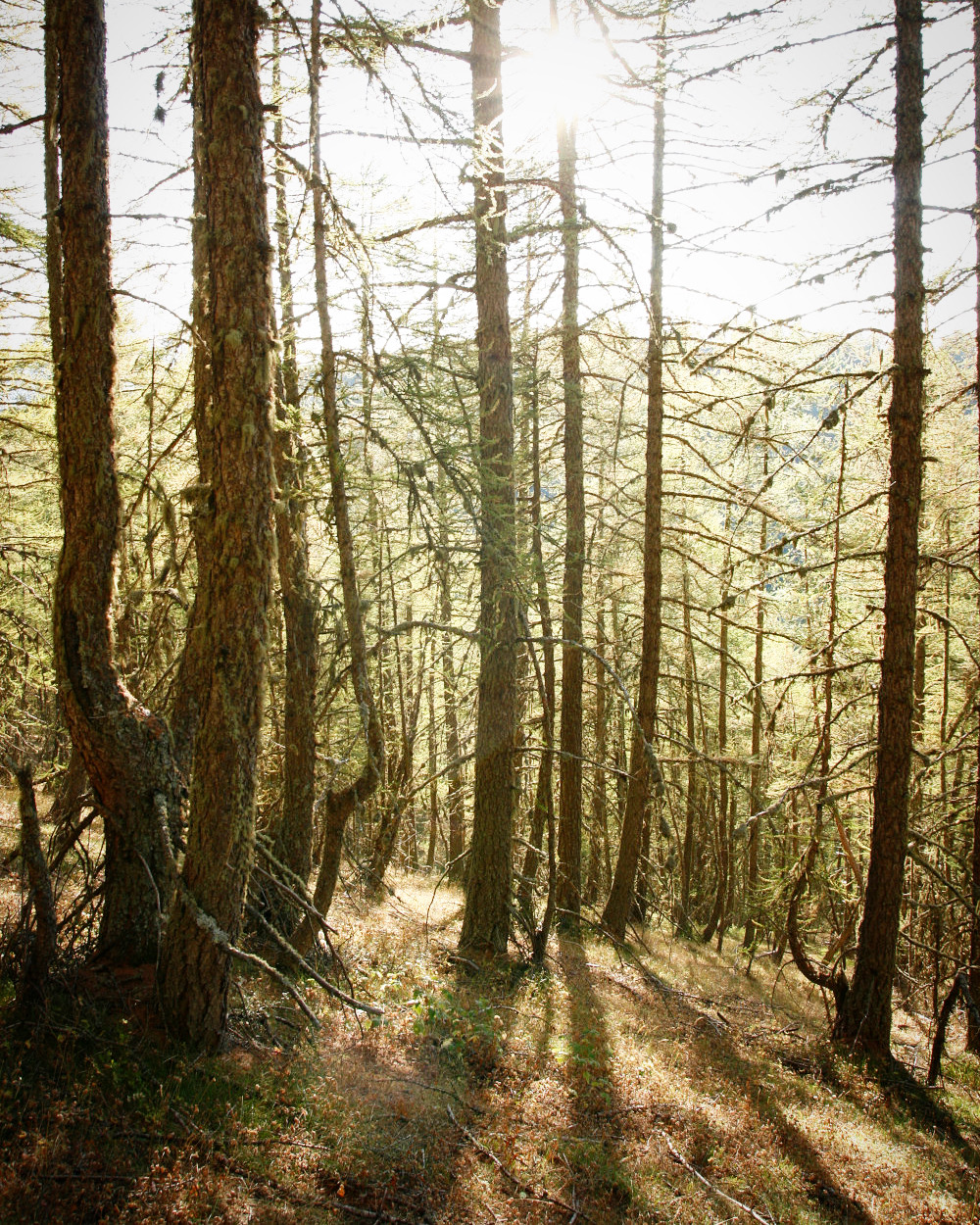
The first excursion was a hike up to a shepherd on the mountain. In the beginning, it was hot, sunny, bright, and we walked up the slope through groves of pine and larch. The breaks were stunning, with nothing between us and the faraway mountain tops turning blue in the afternoon mist.
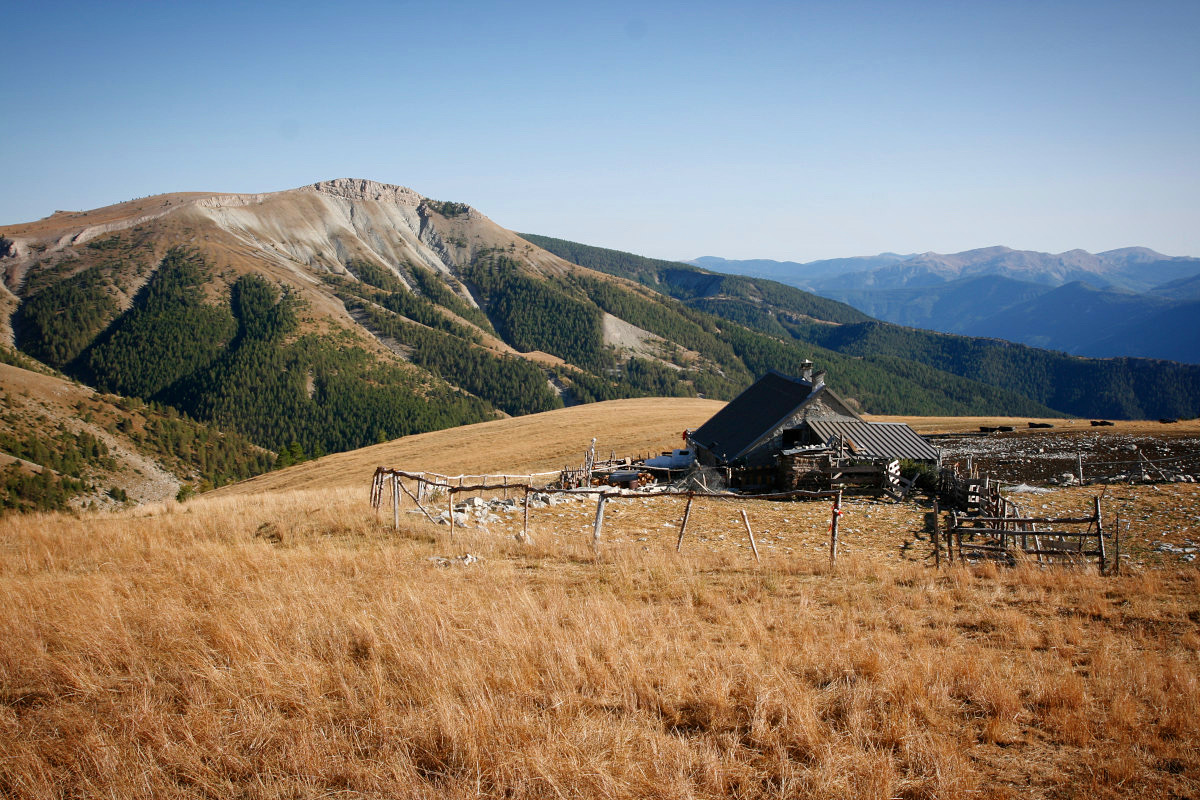
Once we reached the top of the mountain, above the tree line, the wind took hold of our clothes, and it suddenly got quite chilly. There, in the slump between two peaks, stood the shepherd’s cottage, low in the golden grass. Crouching, as if the wind otherwise would sweep it off the mountain.
And we met one of the shepherds. He lives up on the mountain in the summers, herding his 1700 head of sheep from mountain top to mountain top. The sheep are herded by four dogs that always stay with them, even when the shepherd isn’t there, but still the wolves kill sheep. It is a contested issue here, the wolf. There weren’t any for a long time, but over the last decades, they have returned over the mountains from Italy. This year has also been uncommonly dry, so there is not much for the sheep to eat. The life of a shepherd is not easy.
Walking down through the lichen-covered pine trees, I felt an urge to sing. There is something about landscapes that bring that out in me – the sea, forests, plains, mountains. This time I couldn’t, though. My cold had finally subsided, but in its wake, I had lost my voice. It is painful, not being able to sing to the mountain.

The cold left me, but took my voice as it went. In a place full of new people, a summer school built on discussions and a prime opportunity to build a network of like-minded young scholars in the ecosystem services field, being voiceless is not ideal. I felt dull and plain, and like I wouldn’t be making a mark on anyone there.
Part of the summer school was built around a group project. We were all divided into smaller groups according to ecosystem service categories and in the end, we were to present a synthesized ecosystem services assessment of the upper Verdon valley, where Peyresq is situated, and policy recommendations for how to make sure the villages in the valley will continue to flourish. In my voiceless state, it became an exercise in how to not have opinions about everything. Not an easy task for me. In the beginning, the discussions in the cultural ecosystem services group were many. But I’m happy with what we accomplished in the end – and we had a lot of fun getting there.
In the evenings, after the three course dinners, we socialized in the common room, played board games or danced in the makeshift bar. A couple of nights, some of the guys started playing a guitar and it developed into a (semi-drunk) communal singing session. It was painful, not being able to take part in the singing.
But, outside: The moon over the valley giving the hillsides a blue touch of fairy-tale. And in the elder tree, the house mice were munching away at the deep purple berries, jumping from branch to branch.

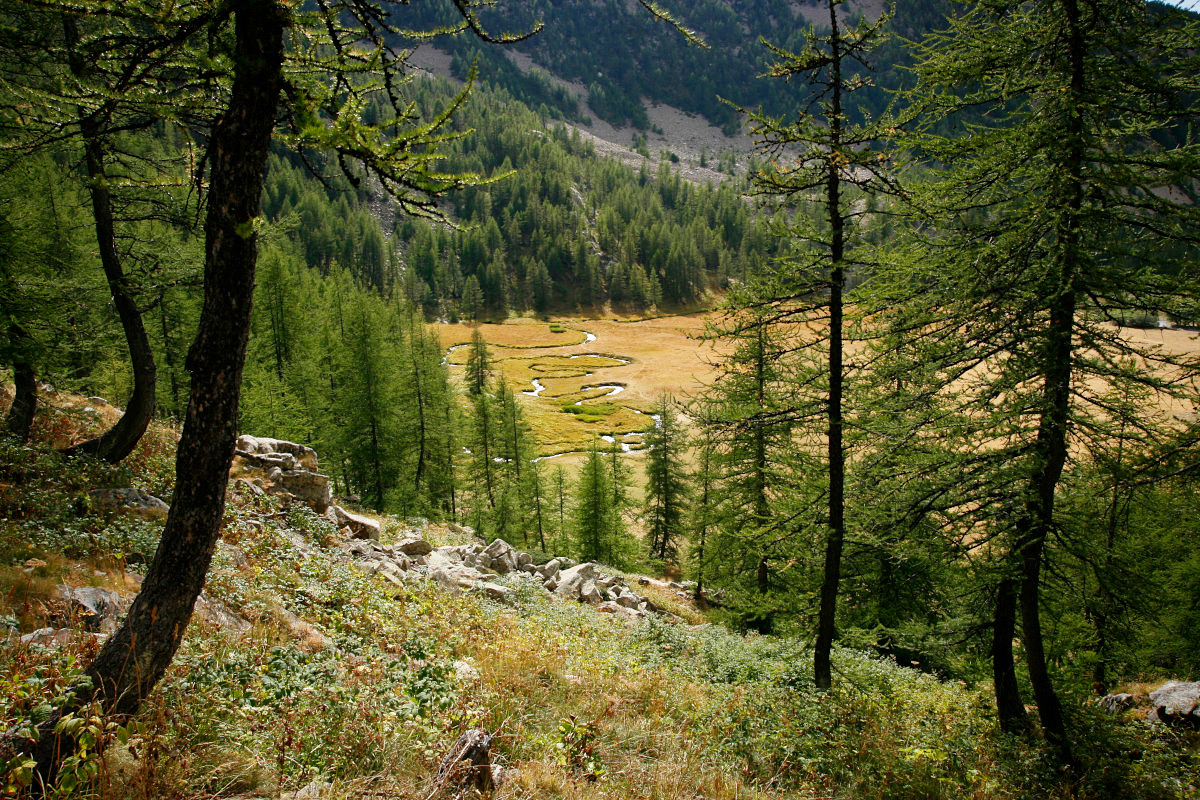
Our second excursion took us to the Mercantour National Park. Or, strictly speaking, we had been in the park our whole time in Peyresq. Mercantour is structured around an inner, fully protected core, and then a periphery where individual communes can choose to be part of the park. The periphery areas, which Peyresq was part of, agree to a certain extent of protection, limiting certain activities in the landscape. In exchange, they get to be part of the park, which attracts visitors and other opportunities for the locals. Our excursion took us to the park’s core area.
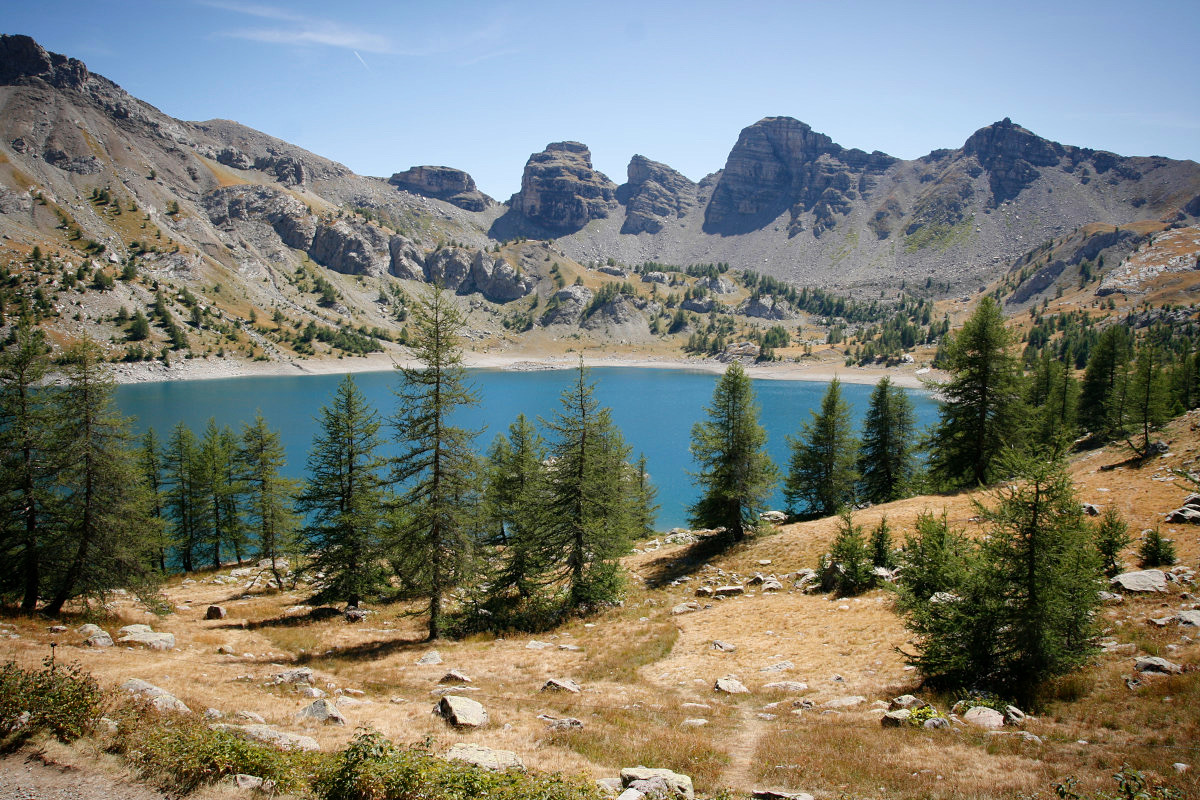
We had lunch next to a meandering stream. We hiked up to a lake, such a deep shade of turquoise, it almost hurt the eyes. We spoke to a paleoecologist about the evolution of the landscape, plants and animals in the park, and the park manager about the current state of the park, its mission and collaboration with the surrounding communities.
A recurring topic were the grazing sheep. Even here, in the core area, the shepherds were allowed to bring their sheep for grazing. Shepherding is a historical practice in this area and considered an important part of the cultural heritage and landscape. Grazing keeps the mountaintops open, which has an aesthetic value, and promotes some species that are important for biodiversity. But there is a fine balance. Overgrazing is also an issue, and an increased input of nutrients from the sheep’s urine and feces affects both species composition and water quality. The sheep also affect other species negatively, making their impact on biodiversity not completely clear. The sheep have been around for a long time, though, and if anything, there has been a decrease of them over the last century. This is at least suggested from the recent increase in tree cover on the mountain slopes.
All in all, though, the park seemed to be doing fine. Previously threatened species had started to return, like the ibex, and the collaboration with the surrounding communities seemed to be going smoothly.
Down by the lake, butterflies were fluttering between thistles and sun-warmed rocks. It was a beautiful day in a beautiful park.

Almost two weeks in Peyresq, and still I never got used to the view. The valley changed faces depending on time of day, weather. The color of the light. I had to stop and marvel, every time. Breathe it in.
I think a place like this inspires open minds, big thoughts. They have chosen location well for the ALTER-Net Summer School.

Towards the end of the summer school, my voice gradually returned. I received some bad news about a friend back home, but being so far away, there wasn’t anything I could do and I felt helpless – and also, weird, from being in such a social situation but not really having anybody there to talk to about my jumble of feelings. Everyone a friendly stranger. But the mountains were comforting and with my voice back, I could sing again – and I realized how much I had missed it. Being able to feel the vibrations of something behind the lungs in a forte. How important that is for me as release.
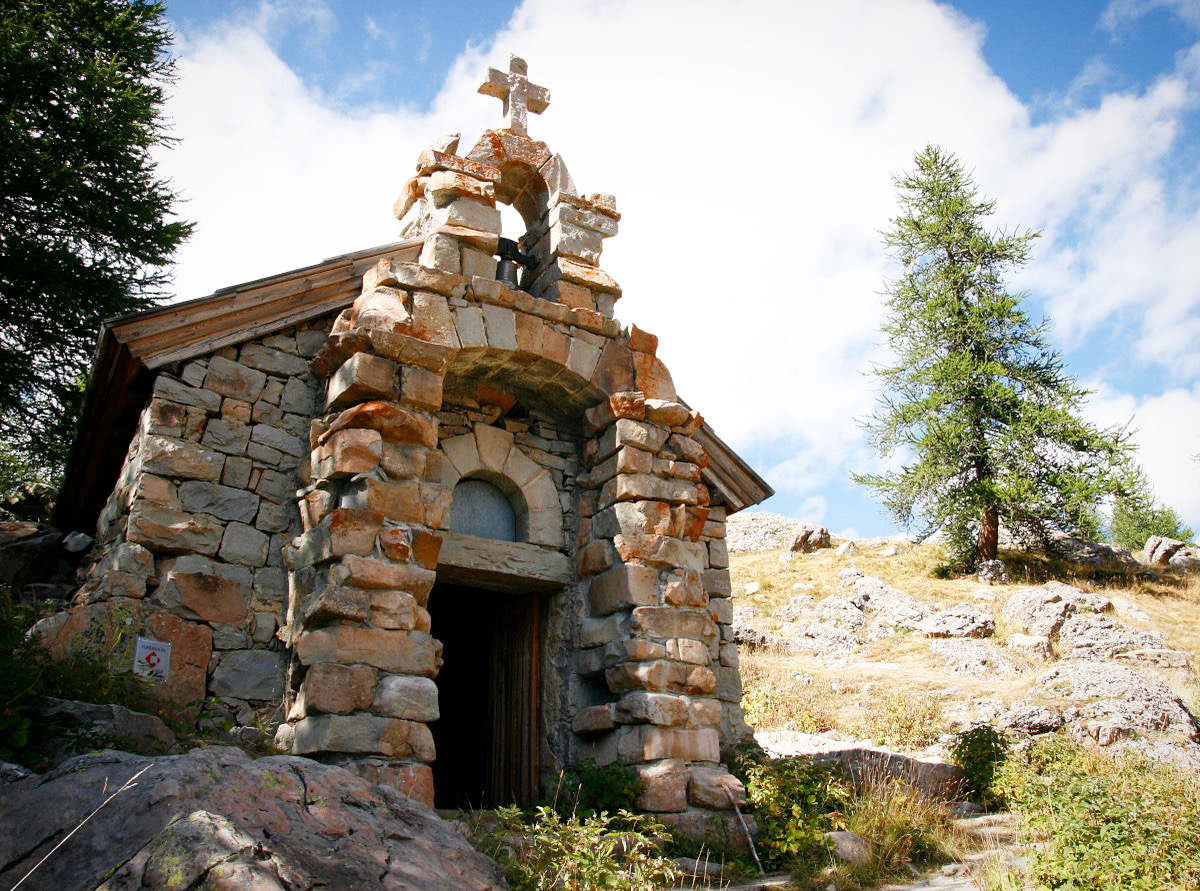
In the tiny village square, next to two linden trees, stood the tiny village church. A modest stone structure, part of it built already in the thirteenth century, it does not look like much to the world. But appearances deceive. On the second to last night, we were allowed to borrow the church key and after dinner, a couple of us preformed some songs, with our voices and two guitars. The acoustics were incredible. The stones had been placed perfectly to make the sound grow and linger in the dark.
The next night, the last one in Peyresq, Miguel and I went to the church ourselves. Miguel, a Portuguese PhD student, also had a past as a choir singer and we could not let the opportunity pass. We needed to try our songs against the acoustics of the old stones. With people dropping in, it ended up being an impromptu acapella concert of traditional Portuguese and Swedish songs.
And just like the sound under the arched ceiling of the church, so did we linger there in the dark. It was like a space out of time, the sound of the old stones so clear and fragile. I could have stayed there all night, listening and singing, filled with wonder. Something let loose in me from the vibrations. And maybe the others felt it too – something other than the academic, rational. An opening to another part of being. But of course, we had to stop eventually. There was a goodbye party to go to. It felt strange, stepping out from that fragile darkness and then going to a dance party, the base heavy and higher in volume than the speakers could really handle. I had to do the dancing in short intervals, with breaks outside to speak quietly or to silently look at the stars.
 Katja Malmborg