Painted on the wall at the EMEC office:
The problems of the world cannot possibly be solved by sceptics or cynics whose horizons are limited by the obvious realities. We need people who can dream of things that never were.
– John F. Kennedy
Painted on the wall at the EMEC office:
The problems of the world cannot possibly be solved by sceptics or cynics whose horizons are limited by the obvious realities. We need people who can dream of things that never were.
– John F. Kennedy
I’m sitting on the train between Petersborough and Cambridge. The day started pretty nicely in Orkney, with some sun and a little bit of breeze, but now the damp air is thick and grey outside the windows, barely revealing the incredibly flat and green landscape of East Anglia.
My mood can’t be bulged, though. It’s my first day of the real Europe trip that I’m embarking on. Orkney with dad was just a little introduction, traveling by car, eating at nice restaurants and sleeping in comfy hotel beds. Now I’m off for the real thing. Trains, couches in stranger’s homes, language barriers and new experiences. Pushing my own boundaries!
First stop: Cambridge. Abbie, whom I met while wwoofing in California, is going to meet me at the train station. So, even now I’m starting it kind of gently, staying with a friend, visiting a small city. Which is good, I think. There’s no sense in doing everything, all at once.
On the train from Edinburgh to Petersborough, I managed to go through all the photos I’ve taken so far, get rid of the bad ones, pick out the really good ones and then edit them so that they can be uploaded to the blog. I’ve also managed to find seats on both trains, and not have any trouble with my ticket. My plan is working out, so far!
Also, I’ve had one text message from Elin and one from Hanna, asking how I’m doing. Even though I have no wish to head back home yet, it still feels nice to know that there are people back there thinking of me.
It is a beautiful place, Orkney. Despite the rain – or rather, because of it.

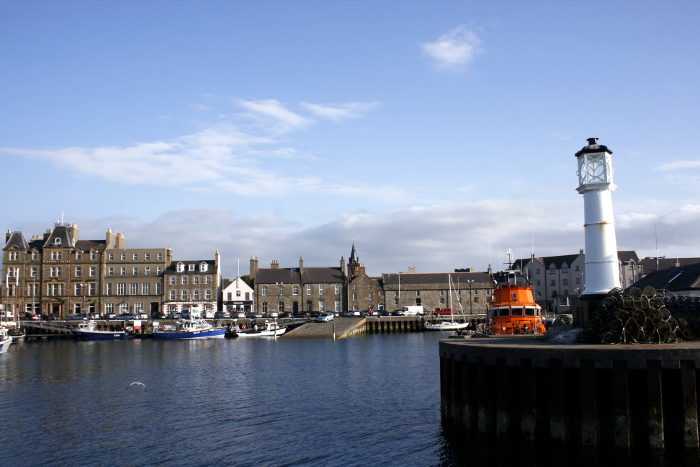
Kirkwall, the capital of Orkney, was an odd place. We lived there, in a hotel with wonderful rooms and the most amazing breakfast, but with a facade and a floorplan that didn’t all feel like a hotel’s. And that was kind of the feeling I got of Kirkwall as well. All the grey houses and the wind made it feel bare and abandoned – but once you looked into places, like the café where we had cream tea, most things were just wonderful. It was as if the extreme weather meant that people saved their coziness and friendliness for inside, while the outside was kept grey and bare – because the island weather would only peel it off anyway.
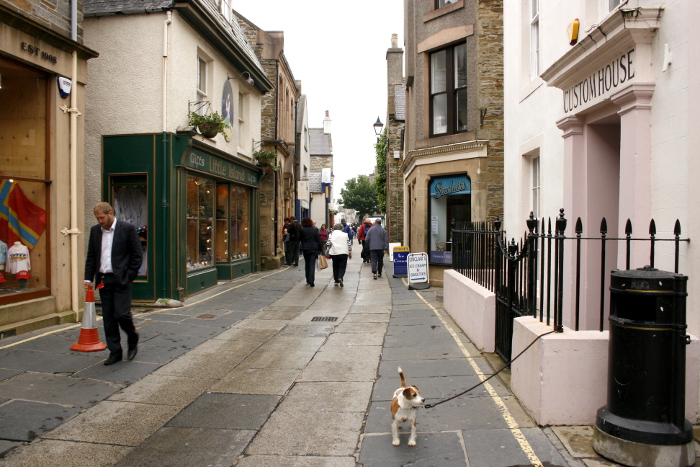
The main shopping street in Kirkwall. Narrow, but still occationally frequented by cars, and bordered by cute little shops.
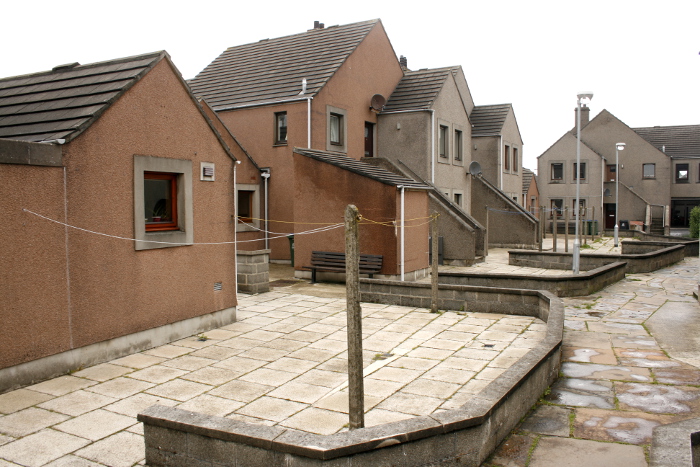
On the street parallell to the main street. Grey.
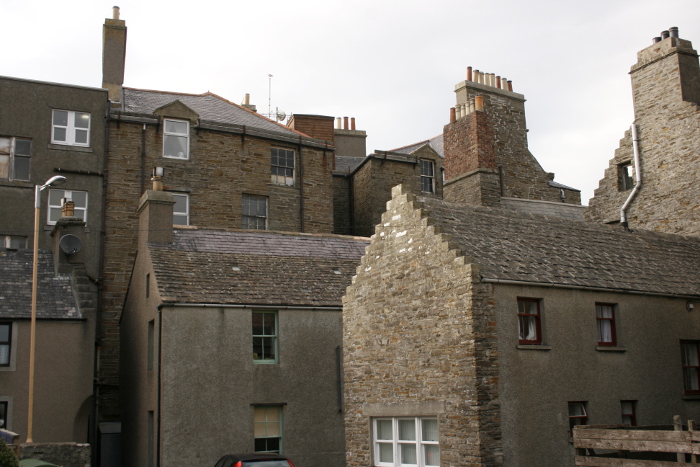
The houses behind the Kirkwall Hotel. Also grey.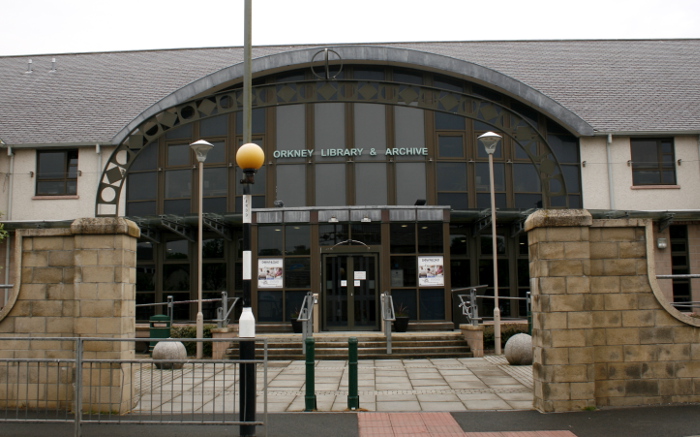
Kirkwall did have a cute little library though, with a good collection of Swedish and Finnish children’s books (Astrid Lindgren and Tove Jansson) and Swedish crime novels of doubtful quality (Camilla Läckberg and Stieg Larsson).
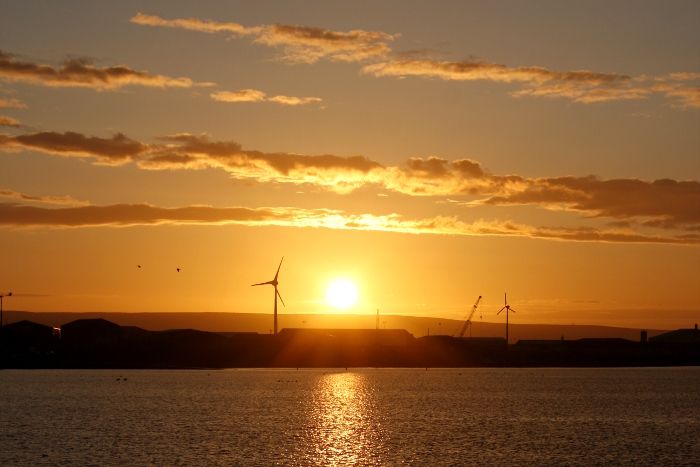
The sun going down, seen from the Kirkwall harbour. The wind turbines creating a hopeful skyline – at least for me.
Great Britain had a big navy base at the Orkney islands during the second world war. At one point, this base got seriously attacked by the Germans, leading to the loss of a big war ship and hundreds of men. After that, Churchill wanted to make sure that the Germans wouldn’t be able to get in without being noticed again. Therefore, under the pretext of creating a greater accessibility to the southern Orkney islands, Churchill constructed huge barriers, cutting off the access between the calm water between the islands and the open Atlantic ocean on the other side. Since then, they’ve been called Churchill’s Barriers, and today the main road from north to south runs on these huge slabs of rocks and concrete.

The waters around these barriers are still full of the wrecks of German ships that met their end here during the end of the war. Some are off limits, but some are apparently popular for scubadiving. If you’re into that kind of thing.
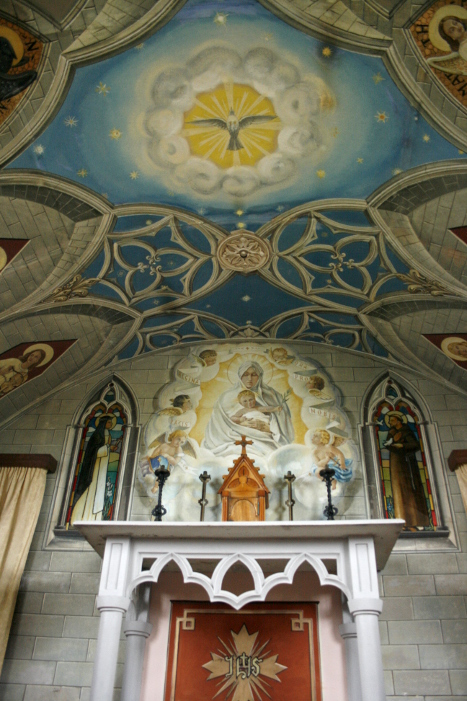
The barriers were built by Italian war prisoners that had been detained in several different camps on the Orkney islands. One of the things they left behind, except the barriers of course, was this tiny little Italian chapel with the pretty wall painting. It was small, and desolate, and kind of strange, but I liked the flying dove.

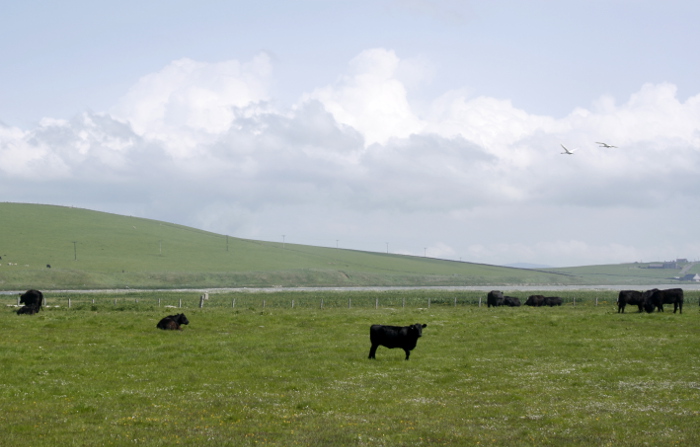
South Ronaldsay is the big, southernmost island of the Orkneys. It mainly consists of even more grass, sheep and cows. And this lonely telephone booth.
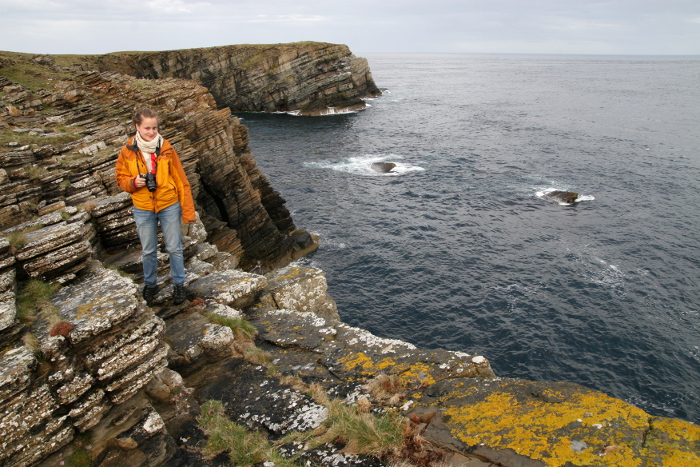
On the southern tip of South Ronaldsay, we could finally glimpse the sun through the heavy clouds. Which made all the difference: For the last time on this trip, we got to experience the extreme contrasts in these islands. The softly undulating hills, green and inhabited by sheep and cows, together with the dramatic cliffs, the raving sea and the never completely cloudfree sky. It really is one of those places.
(Picture, obviously, taken by dad.)
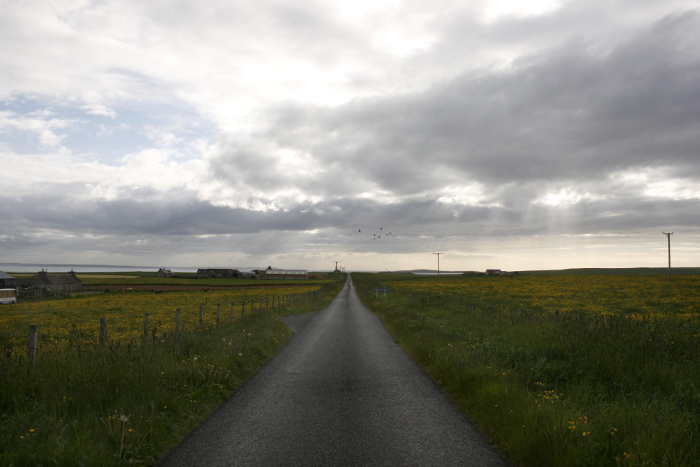
The road leading back to Kirkwall.
When I was little, I used to travel with my dad a lot. He was the editor of the travel pages in a big newspaper, and took me with him on his trips now and again. I’ve been all over, helping him find a good story: sailing past white coral beaches on Zanzibar, crawling through wartime tunnels in Vietnam, riding roller costers in Disneyland in Paris and standing in a never-ending line to get up into the Empire State Building in New York. However, sice the London trip that in the end never turned into anything due to the terrorist attacks in the underground just a couple of weeks before the piece was to be published, I’ve not been anywhere with dad. He quit the travel pages, and later even quit the newspaper, and now he freelances, writing stories about renewable energy mostly.
So that might explain why this trip to Scotland felt both familiar and quite strange. I’m older now, and have traveled a great deal by myself, which means that my dad isn’t the all-knowing travel editor anymore. I’ve got my own set of experiences that make me into a competent traveler. And, most importantly in this case, I have a driver’s license. My dad does not. So obviously, that was the main argument for why I should tag along on this trip. I was the driver. But these things combined also made it so plain for me that I’m an adult now. There are things that I know and can do, that my dad can’t. It felt kind of nice.
I’ve also never seen my dad doing interviews. One rearely does proper interviews when researching for a travel piece. And I don’t really know how interviews are supposed to be made, but seeing my dad with his piles of research, preparing questions, knowing all these technical engineering terms (generally, my dad is very much not a science person – he is rather a humanities kind of guy), it made me realize how competent he is. Not that I didn’t know that before, I just hadn’t seen it in action.
It’s kind of the same experience as the one I had in April, traveling around Liberia with mom. Seeing the way she could talk with anybody, asking them just the right questions to make them relax, even though she was this white stranger arriving in a huge embassy car.
Both my parents are very much what they do, and these last couple of months I’ve seen them in action, doing their thing. They’re not just my mom and dad, they’re professionals too. And I must say that it’s impressive.
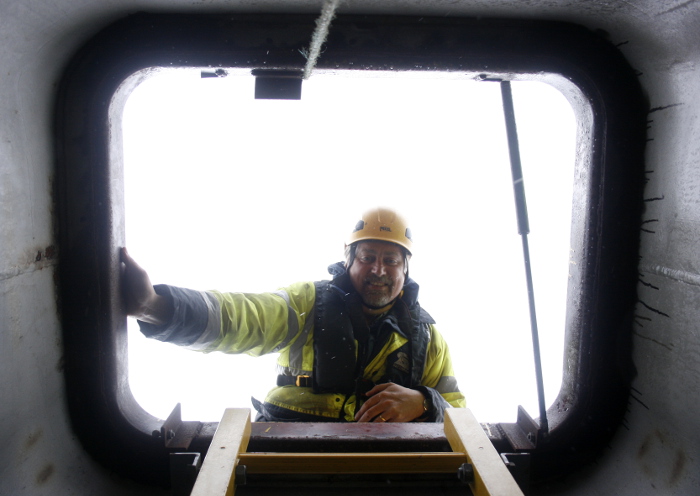
Dad on the job, on his way down into the submarine-like Scotrenewable’s machine.
The real reason for our Scotland trip was that dad was going to do research for an article on wave and tidal energy. On Orkney, the European Marine Energy Centre has been established, and they’ve opened wave and tidal energy parks where different companies can test their technologies. This fall, the first Swedish wave power plant will be opened on the west coast, which means that interest in Sweden for wave and tidal energy solutions elsewhere has grown.
So dad had scheduled meetings with about half of the companies that were trying out their technologies on Orkney. He had an idea that I should take the photos for the article, but in the end I think the pictures he took turned out much better than mine. I’m not used to this kind of reportage photography, and finding interesting angles to these huge machines is really hard! Oh, well, at least I was the driver too. Dad doesn’t know how to drive. I do. So I still had a function on the trip.
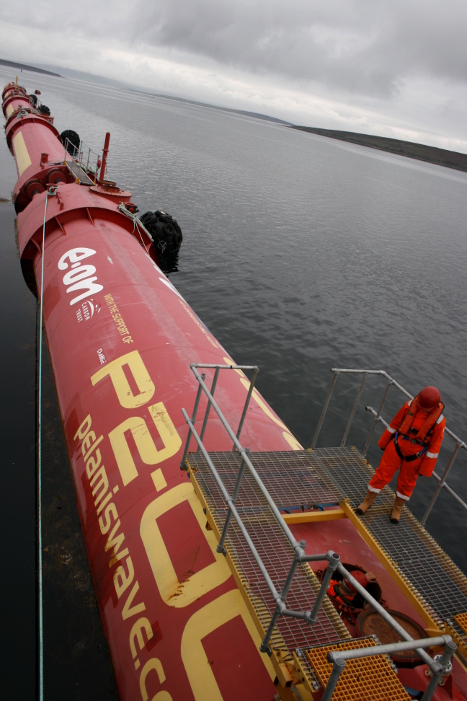
Pelamis’ wave energy sausage.
This business is still so young and the technologies that are being experimented with are very different. It is fascinating, how the engineers have managed to find so many different solutions for essentially the same problems: how to harness the energy in the waves and the tide, where to put the generators (in the machine or on land, connected to the machine through pipes and cables on the ocean floor), how to make sure the machines don’t get damaged during storms. As of now, there doesn’t seem to be a winner, and in the end sever of the techniques might turn out to be successful.
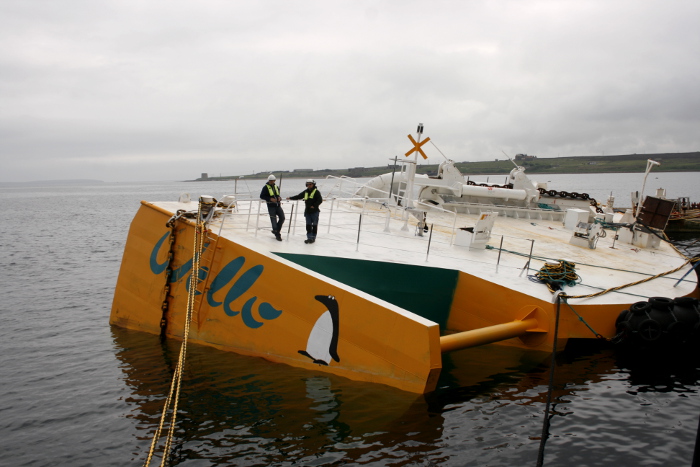
The Finnish wave energy hulk, nicknamed the Penguin.
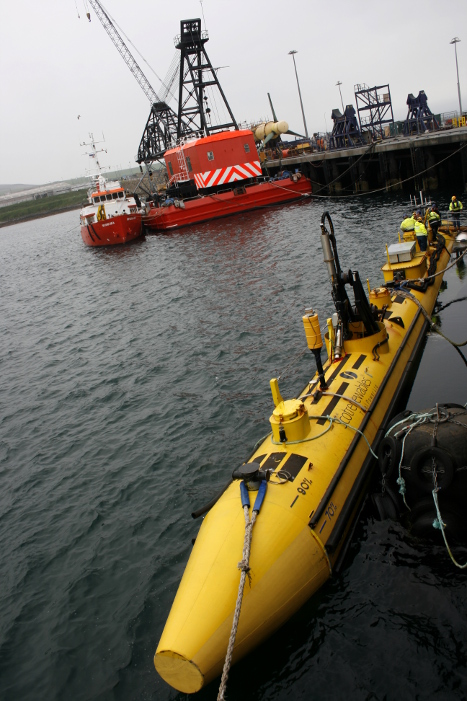
Scotrenewables tidal energy machine.
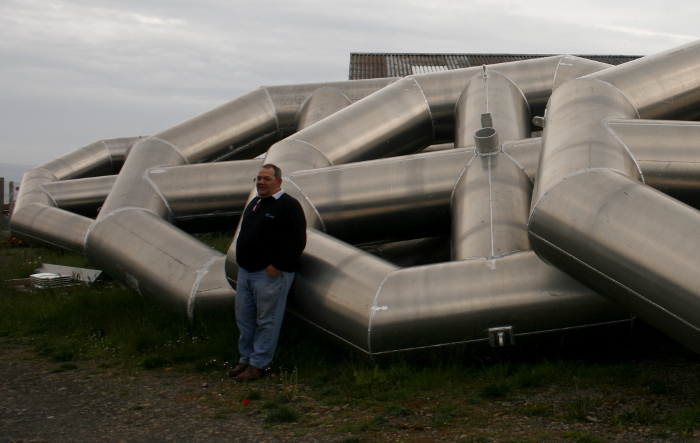
Seatricity’s wave energy buoys.
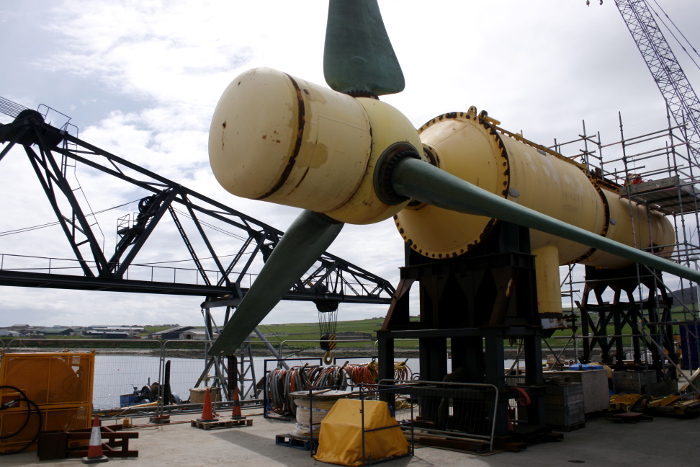
An old machine, the small baby sister of one of the machines that are out in the water. It’s huge, despite it just being a small-scale prototype.
It’s a growing and fascinating business, wave and tidal power, and I almost wish I had studied to become a mechanical engineer. One could say that they are creating a better future for us all. And what am I doing? Just stating all the things that are wrong with the world. Geography can be so depressing sometimes.
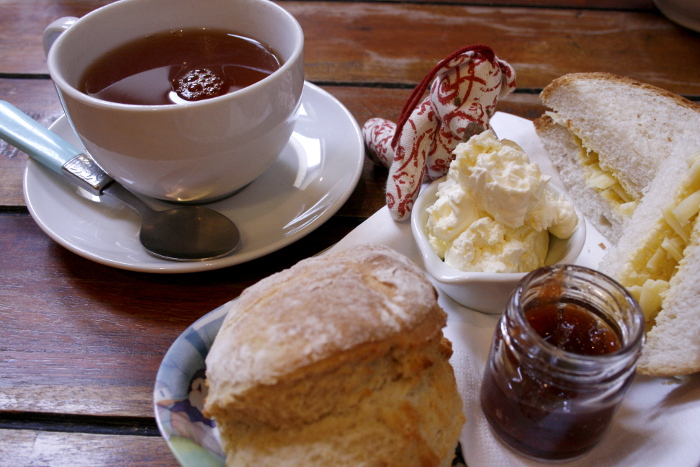 A Peedie Orkney Cream Tea. Not really like a proper high tea, but still. Mr. P approves.
The one tourist attraction that Kirkwall has, is the old Norse cathedral. Its construction was begun in 1137 by the Norse settlers on Orkney, but it took about three hundred years to finish. It’s an impressive sight, though, completely dominating central Kirkwall.
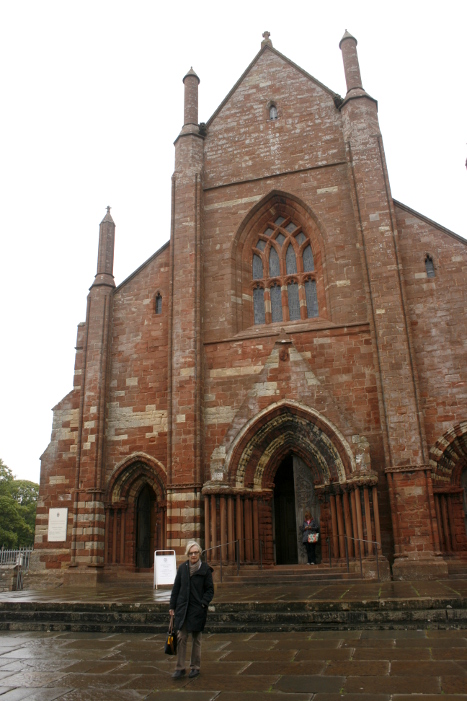

Everything being red, I don’t know, it created a feeling of warmth. I’ve been inside many cathedrals in my life, but this was special. Almost soulful, despite it being so big and bare.
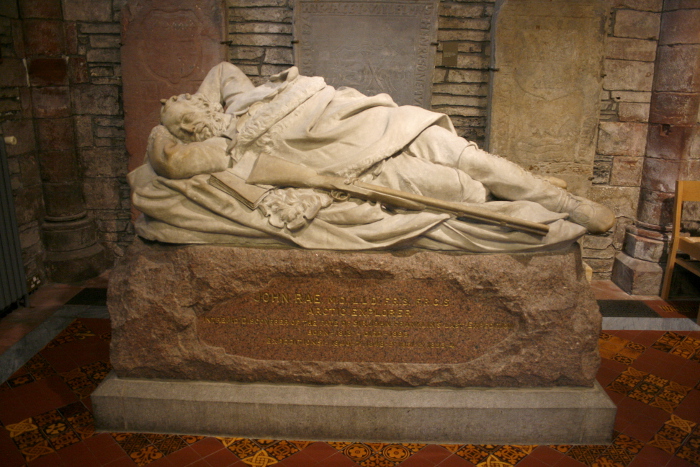
In the cathedral, there are several memorials. Among them, this caught my eye. It’s of the Arctic explorer John Rae. He was born on Orkney in 1813. Isn’t it a remarkable memorial monument? He looks so peaceful, in his explorer’s gear. Like he died in his sleep in a tent in northern Canada, and his body turned into stone in the icy wilderness.
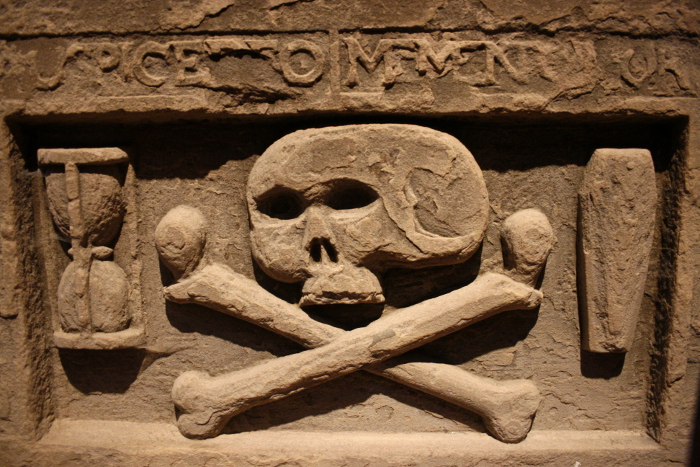
The walls of the cathedral was full of these skulls and bones, combined with the hourglass and something kind of reminicent of a coffin. Above, something unintelligble is written in latin, and then MEMENTO MORI. Remember that you will die. Isn’t that a wonderfully morbid thing to cover the walls of a church with?

The cathedral is built of red sandstone. This particular type of sandstone is probably rich in calcium carbonate, because it’s weathering like there’s no tomorrow. It creates some really cool patterns in the stone, but is sad on the cathedral. It will probably not last for as long as Skara Brae or the Ring of Brodgar, not with the amount of carbon dioxide that we’re releasing into the atmosphere. (Geochemistry, folks. Suffice to say that high levels of carbon dioxide creates more acidic rain, which leads to weathering of calcium carbonate rich stone. Everything is connected!)
Today, while driving up and down the green hills of Orkney, I asked dad to put on some music. He scrolled through the music library in my phone, and asked why I only had one song on it from Mumford & Sons’ latest album. I had no idea, and he put on something else.
But later, when I wasn’t driving anymore, I felt I needed to check what had happened to the Mumford & Sons album. Well, what I found was much more serious than just a couple of missing folk rock songs. When scrolling through the artists, I realised that I’m missing half of my music!
Before leaving home, I did this elaborate iTunes list with all the music that I’d want to listen to during my trip, and since I couldn’t find a way to see how many GB this music would require on my phone, I thought I’d just start uploading them and then the phone would tell me when it was full. Well, it never did and I didn’t think about checking what had actually gotten on there before I unplugged it and left for the airport.
So now, I’m here, far away from home and my music-filled computer, with no music starting N and onwards, in alphabetical order. Will I manage? Probably. The music I especially acquired for this trip, Joshua Radin, Ingrid Michaelson and Frank Turner, are all there. But still. What am I to do without Regina Spektor, Rilo Kiley, The Tallest Man On Earth and the new album from Villagers that I haven’t even listened once to yet? A frustrating realisation indeed.
And mostly, I’m annoyed with my phone. Why didn’t it tell me it couldn’t fit all the music in the playlist? I feel that we’re having a crisis of communication. I don’t know if we’ll ever get past this.

 Katja Malmborg