our limited worlds

I just finished “An Elegy for Easterly” by Petina Gappah. It’s a collection of short stories about life in Zimbabwe. It is a nice collection, depressing, sure, but a good read. Zimbabwe is doing catastrophically, but life goes on and people have their failed marriages or shattered dreams or finally have their greatest wish come true in the unlikeliest of ways.

But it makes me wonder. According to the author bio, Gappah is a lawyer with degrees from Cambridge, Graz University and University of Zimbabwe. She lives in Geneva. Still, she writes about people who live in the shanty towns outside Harare, people who can barely get enough food for their children. I’m not questioning her, I believe it when she writes her stories, but I just wonder: how does she do it? How does she know?

I’m securely middle-class. Both my parents have university degrees. I grew up with divorced parents, moving back and forth every other week, and they both lived in apartments in the suburbs. Skarpnäck and Bagarmossen, the suburbs where I grew up, are both quite average as far as Stockholm suburbs go, slightly lower yearly salary than the municipal average, the unemployment a bit higher and 41,3 percent of the population are immigrants, compared to the 33,5 percent average in Stockholm. They are both suburbs, but not at all with the same segregation issues as in some of the areas north of the city. My family isn’t rich, but I know that in a crisis, I can always turn to them and they will be able to help me, both economically and otherwise. My mom is an immigrant, but physically you wouldn’t be able to tell, not even in my name. My parents chose good schools for me. I’ve traveled. I go to university. Most of my friends go to university too.

I have very little knowledge about what life outside this safe middle-class bubble is like. I am certain that my experience of Sweden is way friendlier than that of many other people – people that I wouldn’t even know how to meet. Often, when discussions about the ‘real’ Sweden start, I don’t know what to do with myself. I don’t know what life is like for an immigrant, for an unemployed youth, someone living in the segregated suburbs or small towns, someone in need of social welfare, someone who is struggling to make ends meet. I don’t feel I have the right to an opinion – barely even to speak for the middle-class experience. Because I don’t really fit in there either.

I feel odd everywhere (and now I don’t mean in the oh-I-am-so-unique kind of way, but rather that I don’t feel I can speak for anyone but myself), and my lack of experience makes me doubt my opinions all the time. As a teenager, my biggest dream was to become an author, but now I don’t know anymore. What would I have to tell that would be relevant for anyone but myself?

And that makes me wonder. How does she know, Gappah? How will I ever be able to tell a story that isn’t only mine?
my summer holiday

I’m spiraling. I’ve started watching Gilmore Girls. Again. It is comfort food for the eyes and I’m in a waking coma. It is not only exhaustion. I’m going through something, I’m just not completely sure what. All my explanations feel too banal.

But maybe I am. Banal. Whoever said that when I plunge into a crisis, it will be for profound reasons? I’m not special. I bleed, just like the rest of them. Sometimes things are exactly what they seem. That can be hard enough to deal with already.

Well. I cooked dinner for my cousins and their children today. Two two-year-olds. Nothing can pull you back to the present moment like children yelling for your attention.

And then I went for an evening swim. The lake was still, the sun was going down and the smell of the water calming. Cleansing. Biking home barefoot. Summer evenings. Everyone deserves a break occasionally, even when while going through stuff.

the religiously anti-religious

The other day, I found myself in a heated discussion about religion with someone who thought religion was the worst invention ever to come out of the human race. More or less. And I found myself defending religion, a position that is kind of weird for me, being an agnostic and not particularly knowledgeable about any of the world religions. However, it wasn’t the first time, either.

I do not believe in a god. I often wish I could. Don’t get me wrong, at 15 I was just as hardcore an atheist as the next average Swedish teenager. But since then, I’ve met people. And I’ve read books. I’ve traveled, and I’ve experienced crises, both my own, in the family, and seen it in strangers.

Some of the most intelligent, truly good people I’ve met in my life have been religious. And in them, religion has not led to a narrow-mindedness. Rather, they have also been enlightened, curious about the world, honest. They have been people who have really thought things through. People who have had hard, life-altering experiences. And somewhere there, either before, during or after, they have found faith. As an anchor and a sail.

I lost my fear of death while reading the Bible to my Finnish grandmother on her deathbed. Cancer was eating up her lungs and there was no rest from the pain for her, but as soon as I picked up her Bible and slowly started reciting parts of the New Testament for her, a sort of bliss came over her face. She knew that she soon would meet Jesus Christ.

And life is hard, on all levels, both existentially in the way that we get here in Sweden, but even more so in many of the places where I’ve traveled, Bolivia, Liberia, Namibia, where the issue about identity is more or less completely overshadowed by the very pressing difficulty of surviving through the day. Having faith there is how many people survive, and I resent anyone who claims that this is mere stupidity.

Of course there are many awful things being carried out in the name of different religions. I’m not denying that. But I think blaming religion for the awful, narrow-minded things that some people do is just lazy and ignorant. There is something so militant about some anti-religious people that I find just as scary as the blind faith in some religious people.

I picked up a book the other day from the library. It’s called “Religion for Atheists” and it’s written by Alain de Botton. They only had it translated into Swedish at the library, so this will have to be my translation of something that has already been translated once, a English-Swedish-English excerpt if you will, from the first chapter of the book:

God may be dead, but the burning questions that drove us to invent him in the first place still haunt us, and demand answers that won’t loose their validity once we’ve been made to see the flawed scientific precision in the metaphor about the fish and the seven loafs of bread.

If there is anything that studying science has taught me, it is that we can’t be sure of anything. I believe in being humble, and open to other people’s worlds. And I believe that science isn’t the only source of reality that is available to us. I think existence is more than what we can weigh or measure. (I just can’t believe in a bearded man sitting on a cloud.)

I am really looking forward to reading this book.

first day of summer (in a sense)

First day of my summer holiday. I went into town and bought yarn for 300 kronor. Then Natalia and I went to do aerobics at Skarpnäck’s sports field. Jumping around to Destiny’s Child in the July evening sunshine is damn close to perfection.

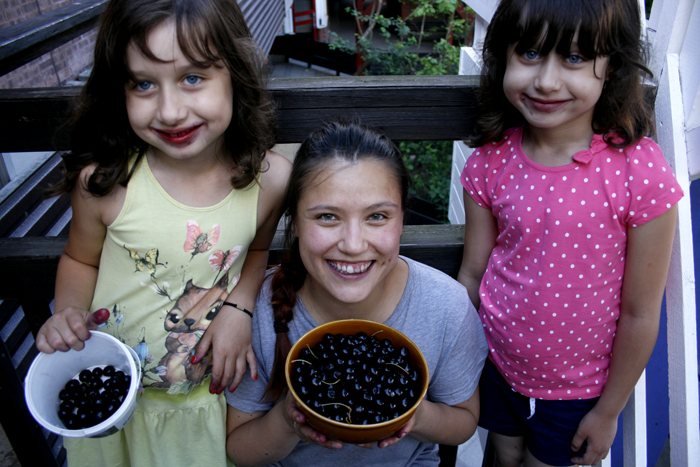
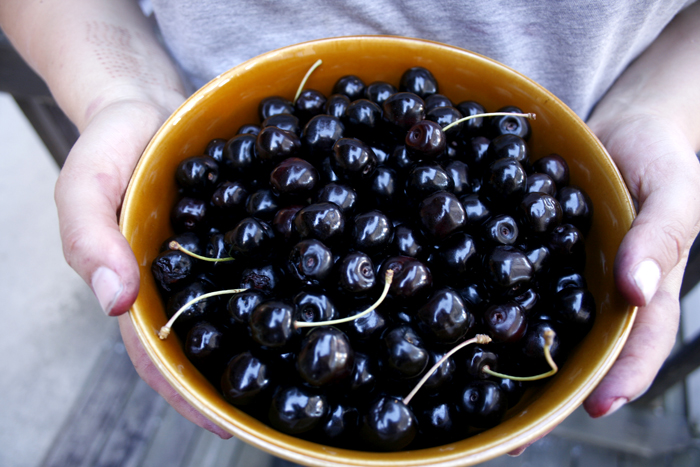
On the way home, I started telling Natalia about the cherries that are going to waste by my house, and one thing lead to another and suddenly we were both standing on the roof of a bicycle shed, picking big, black cherries into old yogurt buckets. The six-year-old twins that live in my building helped us by running around on the ground, yelling instructions to us about where the biggest cherries were.  Deep purple cherry juice all over their faces.

_MG_9834 _MG_9842

Then we made lentil soup, watched an episode of Twin peaks and ate cherries for dessert. Nice start of the holiday.

I have new yarn now. New knitting or crocheting projects make me so excited (and now I don’t mean in the way that made Natalia laugh when I told her, me having some weird yarn fetish – even though that would be really funny). It’s just something that I really enjoy doing. Like, I-can’t-stop-even-though-it’s-after-midnight-excited. And right now, I think I prefer crocheting before spending time with people. Not Natalia, obviously, or Ashley or Kirke or those really special ones – but people in general. Those outside the closest circle.

I’m not always like this. Generally I like socializing. In moderate doses. I think it’s just exhaustion, overload. I need to reboot. I’ll finish up the pillow case, knit a hat to Elin’s baby and maybe another pillow case – and then I’ll be ready for the world again.

would you come if I called

I move slowly tonight. Watching the skin on my hand wrinkle when I move my fingers. The feel of having joints.

It is a warm night outside, I took a walk and the air against my bare legs was gentle and sweet. There are so many layers of me here, in Skarpnäck. These red brick buildings and trees. The traffic lights at the three-way junction ticking out of sync, telling me not to cross. The street completely empty, as it is most of the time. The smell of the white roses. The cherries are black and ripe now, but no one picks them. I should buy a ladder. Or make friends with someone really tall.

I’m almost done with the crocheted pillowcase now. But I’m running out of yarn. I think I’ll go into town tomorrow to buy some more.

another of those Sundays

I honestly don’t remember if I had any plans for today. Either way, I haven’t done anything. Or, at least not anything of value.

I have a vague memory of waking up, thinking I should go lock the door, and running into Kate, one of the couchsurfers, in the kitchen. Still half-asleep as I was, I just waved at her and turned back into my room again. I must have seemed so strange. They were leaving, you see, Kate and Fran from London, on an early train and we had already said goodbye yesterday evening and, well, now Kate got an extra wave. That’s nice, I guess. They were really nice, so I don’t think she minded. They left a little thankyou letter on the kitchen table for me when I woke up the second time, way later. Always nice, the appreciation that you get from couchsurfers.

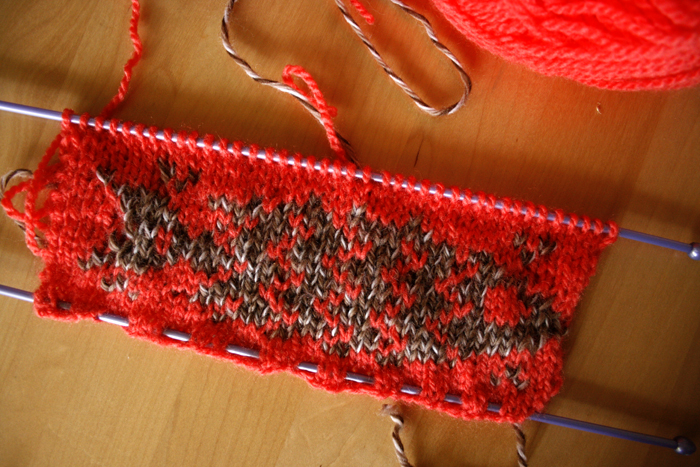
I did knit a fish today, though. To try and see if a design I did at a lecture earlier this spring would look nice.

_MG_9831

Looks like a fish, doesn’t it (even though the color combination is unfortunate, I know)? Now I can knit fish mittens to all marine resilience people, so that they won’t freeze their precious little fingers off this coming winter (which has to be long and cold, now that the last one turned out to be so crappy). I’ll take orders. First come first served and all that.

Not a completely wasted day. Eating strawberries and whipped cream is also a nice thing. For a Sunday like this.

* * *

It just hit me. I also spent two hours or so this morning reading scientific articles on the Arctic. Coastlines are eroding away in Alaska, from melting permafrost and decreasing sea ice. Heavy stuff. Not a wasted day at all.

the rescue mission

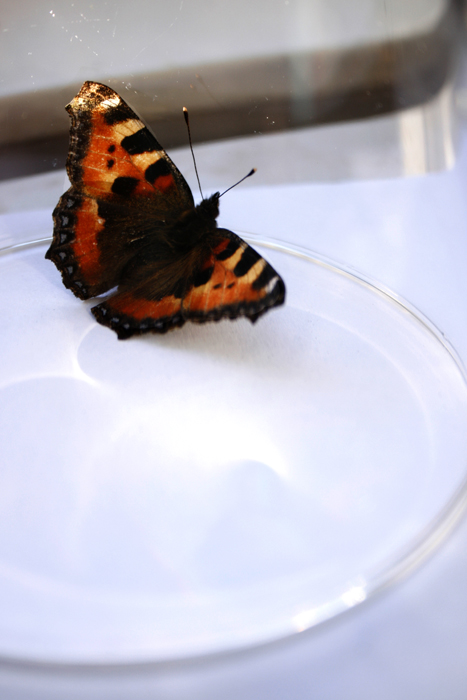
When I woke up this morning, the butterfly was still there, sitting on the ceiling.

But when I came home, after work, it wasn’t. It had moved to the wall next to a window. Perfect place to catch it from.

It fluttered in the glass, probably tired and exhausted little thing, but I managed to get a picture before I released it into the warm, sunny July evening. A small tortoiseshell butterfly, it was. It flew, high up above the buildings, toward the milky blue summer sky.

Or, better yet, a well-tended, lush villa garden in Enskede.

_MG_9821

when you think in maps

Another book that I read about a month ago is “Maphead” by Ken Jennings. Oh, it was an amazing book, really, funny and informative and endearing. All about maps and other geography related stuff that, you know, melts me like butter in the sun.

I don’t remember when I’ve last started crying as many times when reading a book – but in this case, not because it was sad, but because of how touched I felt from recognizing myself in all the nerdy geography buffs and mapheads Jennings described.

This just proves it. I AM a geographer. It wasn’t just coincidence that I started studying it back in 2009. I think spatially, in systems, I am visual in my way of understanding the world. And places matter. Jennings describes the concept of topophilia, which is from the Greek for “love of place”, and describes the strong sense of place that some people have, an intense connection to landscape. Jennings continues:

Young topophiles are most deeply shaped by the environments where they first became aware they had an environment: they imprint, like barnyard fowl. Baby ducks will follow the first moving object they see in the first few hours after they hatch. If it’s their mother, great; if it’s not, they become the ducklings you see following pigs or tractors around the farm on hilarious Sunday-morning news pieces. /…/ Falling in love with places is just like falling in love with people: it can happen more than once, but never quite like your first time.

For me, those places are widely spread, a legacy left in me from my vagabond parents. It’s Skarpnäck, obviously, and Södermalm, which are the two neighborhoods in Stockholm where I spent most of my time before the age of seven. The Stockholm archipelago, where my family rented a small cottage on a tiny island without electricity and running water. The southern Finnish rural landscape, with small fields, lakes, forest patches and tiny villages – the sun going down behind the spruce forest beyond the wheat field that lay at the foot of the hill of my grandmother’s house. The red earth and hot, dry smells of southeastern Africa, Zimbabwe, South Africa, Botswana, Tanzania. The turquoise waters of Greek islands.

I’ve seen many other places after that, landscapes that are more beautiful, dramatic, fascinating. And I wouldn’t be able to say which ones I like the most. I just like landscapes. But with Stockholm, Uusimaa in Finland, Tanzania, Greece, it is different. Those are places that I feel a bond to, in a way that goes beyond liking.

Jennings ends one of the book’s chapters with a quote by Simone Weil. It says:

To be rooted is perhaps the most important and the least recognized need of the human soul.

I couldn’t agree more.