walking to the shepherd: the first excursion

We also did two excursions as part of the summer school – a must, I would say, considering where we were. The mountains and valleys just would not be ignored.

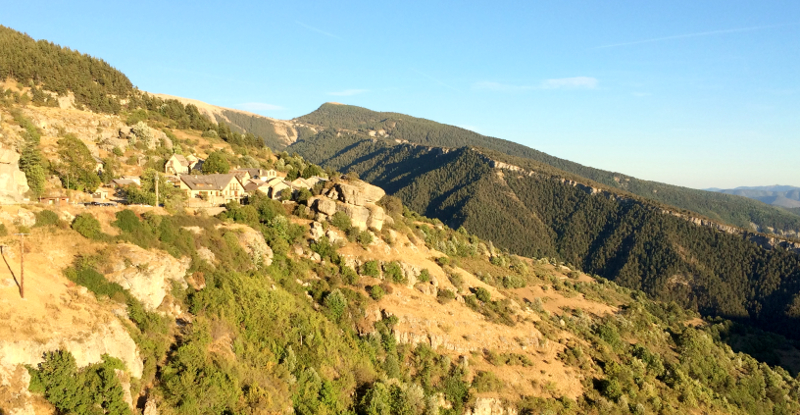
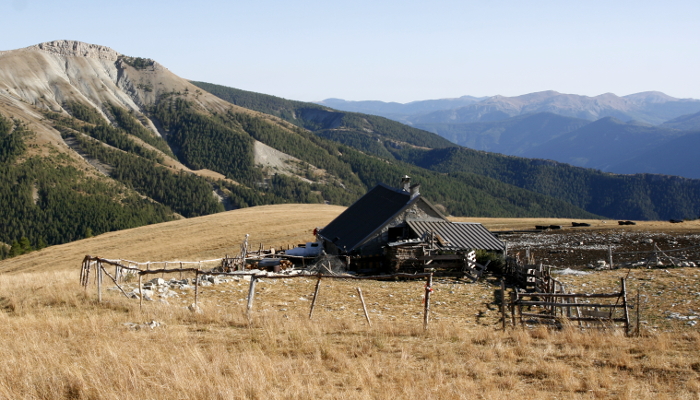
The first excursion was a hike up to a shepherd on the mountain. In the beginning, it was hot, sunny, bright, and we walked up the slope through groves of pine and larch. The breaks were stunning, with nothing between us and the faraway mountain tops turning blue in the afternoon mist.

_MG_3206

Once we reached the top of the mountain, above the treeline, the wind took hold of our clothes and it suddenly got quite chilly. There, in the slump between two peaks, stood the shepherd’s cottage, low in the golden grass. Crouching, as if the wind otherwise would sweep it off the mountain.

And we met one of the shepherds. He lives up on the mountain in the summers, herding his 1700 head of sheep from mountain top to mountain top. The sheep are herded by four dogs that always stay with them, even when the shepherd isn’t there, but still the wolves kill a lot of the sheep. It is a contested issue here, the wolf. There weren’t any for a long time, but over the last decades, they have returned over the mountains from Italy. This year has also been uncommonly dry, so there is not much for the sheep to eat. Life of a shepherd is not easy.

Walking down through the lichen-covered pine trees, I felt an urge to sing. There is something about landscapes that bring that out in me – the sea, forests, plains, mountains. This time I couldn’t, though. My cold had finally subsided, but in its wake, I had lost my voice. It is painful, not being able to sing to the mountain.

small coincidences in life

When overwhelmed with big ideas and new people, it can be nice to cling to the small things. Like a coincidence: At the summer school, I met a German PhD student who is studying different ways in which the concept ‘multifunctional landscapes’ has been studied. Already that is interesting to a certain degree, since the paper I wrote based on my master’s project together with my supervisors, which is still in review by the way (!!), claims to show that the landscape in northern Burkina Faso is multifunctional. But. That is not the point here. This PhD student and I turned out to have a stronger, but much more surprising connection.

See, I recognized her vaguely. And there was also something about her surname. It took me a couple of days to put my finger on how, but suddenly the pieces fell into place. I asked her if she had a sister who was a teacher? Yes. Who had spent time in Canada? Yes. Wwoofing at a horse ranch outside of Vancouver? Yes. With a woman who filled her house with cats and dogs and wwoofers? Yes.

As it turns out, I wwoofed together with her older sister for a month in 2012 outside of Vancouver. She, the PhD student, even came to visit her sister there and I remember spending a morning talking about horsemanship with her while cleaning the stables. And now we were here, in a tiny village in the southern French Alps, participating in the same PhD course. We live in such a small world! She only seemed mildly amused by the coincidence, but me it kept going for the rest of that day.

IMG_0622

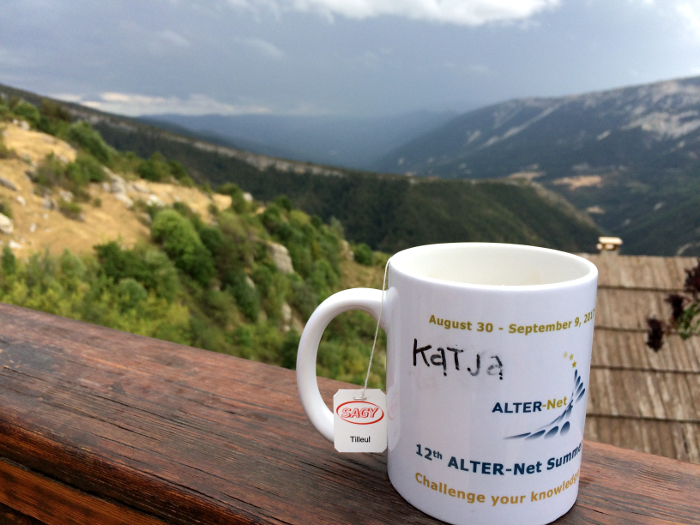
That afternoon, while standing outside the lecture hall gazing at the magnificence of the valley, I thought about other connections. Like, I was drinking lime blossom tea for the first time in my life, and eating a cupcake not entirely unlike a Madeleine. In France. Like Proust’s main character – the flavors that open him up to his childhood and youth in the blink of an eye. That segment of text, as an example of how to use the sense of taste and smell to open up a story, so often used in the creative writing workshops that I participated in as a teenager. Standing here, drinking lime blossom tea and Madeleine-like cupcakes thinking about my teenage years of writing prose.

Again. Funny, how being in a strange place seems to connect me to my past.

The ALTER-Net Summer School

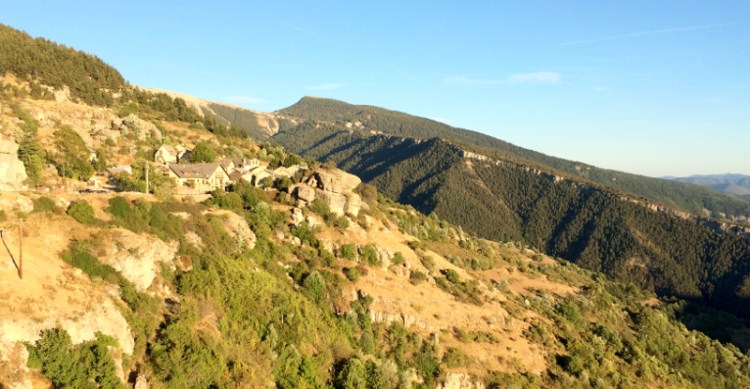
My reason for traveling for three days to reach southern France was to attend the ALTER-Net Summer School in the beautiful village of Peyresq.
IMG_0645

As a PhD student, I’m not only supposed to do research and write scientific papers, I am also expected to advance my academic skills in a more general sense by presenting at conferences, participating in reading groups, teaching. And taking PhD courses. Since the number of PhD students with a certain interest at a specific university tends to be low, it is common that PhD courses are done as summer schools where PhD students from all over gather and spend a week or two (or longer) together learning about a topic. In this case, ecosystem services and the science-policy interface.
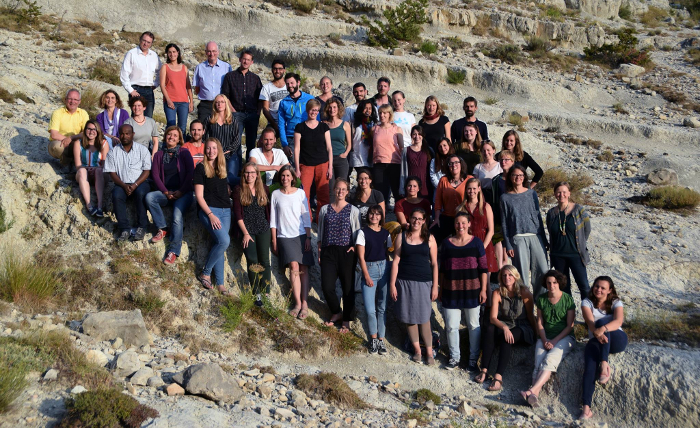
21741077_10210112357981108_7905788812257793829_o

We were 35 students, mainly from different parts of Europe, but also from Argentina, Brazil, Ethiopia and India. As part of the first days, we presented posters about our work, and the topics of people’s PhD projects were really diverse: from hands down, old school entomological studies of counting pollinators in different types of production landscapes to ethnographic studies of locals’ relationship to their urban wetland in metropolitan Accra. Many things fit under the umbrella of ecosystem services research, which was made clear by the wide spread of disciplinary backgrounds in the room.

The same goes for the lecturers. Almost every day for the ten days of the summer school, we had three lectures with three different researchers, many of whom were really big names in their respective fields. But not only that, they had also been invited to lecture at the summer school because of their engaging, funny or provocative lecturing styles (or their kick-ass skills at giving song-lectures on the ukulele!) – and there was always time for discussions during or in the end of the lectures.

Some of the topics were quite familiar to me, like map-making etiquette and research through participatory workshops, while others were new, like how law has implications for conservation and how research about tree genetics makes (or doesn’t make) it into policy. Others were just thought-provoking and inspiring, like talks about science in a post-truth world or how nitrogen really is the main ingredient in the Philosopher’s stone. Maybe what I enjoyed the most were the talks that brought in my closeted love for philosophy-leaning endeavors, like different ways of valuing ecosystems and for whom – but also what the role of the researcher should be in this whole jumble of things.
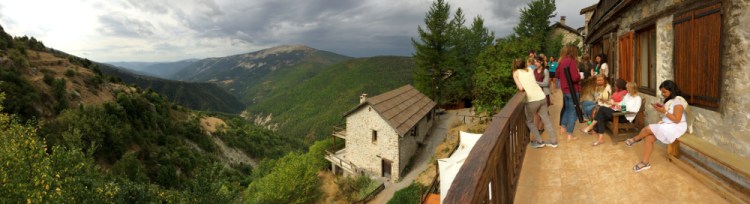
 IMG_0605

Yeah, you get the picture. So many people, so many topics, such an insanely beautiful, interesting and inspiring environment to be in – which made it completely overwhelming and a constant balancing act between excitement and complete over-exposure. In my case, probably made even more so since I was popping French cold medication like there was no tomorrow. Potentially it made me drowsy, and therefore slightly more relaxed – but still, the exhaustion. I was completely drained by the end of the summer school, maxed-out on social capital and with intellectual food for thought to digest for months to come.

I don’t know if I’ll ever be able to pick up on everything this summer school gave me a glimpse of – but I guess that’s not necessary either. Sometimes, it’s just good to know what’s out there. I have started to build my mental universe of the ecosystem services field. It is not likely to stop growing anytime soon.
unfair impressions of Nice

[Written on August 29th]

I only have one thing to say about Nice:

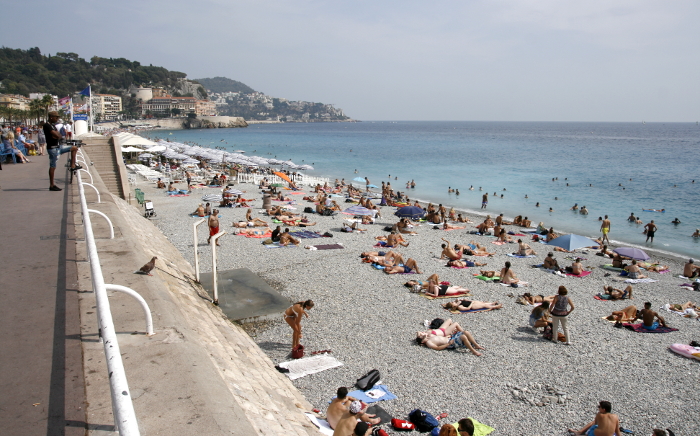
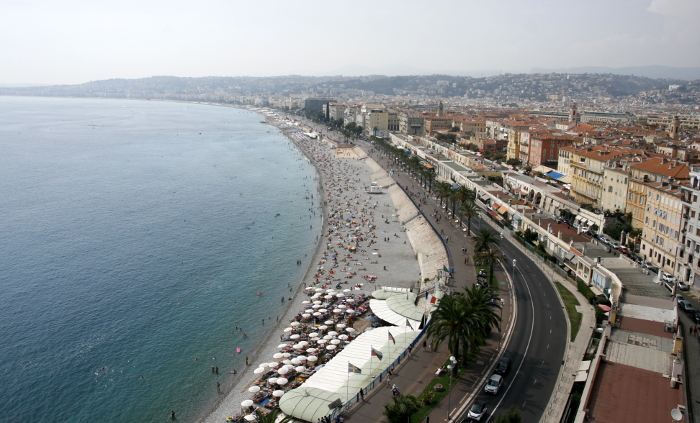
I arrived in a heat-wave, carrying a budding cold, and everything about the city felt a little over-done, stuffy, deprived of oxygen.

I am aware, though, that in my state of sore throat and running nose, I am not a fair judge of anything, and therefore I’ll end with this:

_MG_3092

The shade of blue of the ocean is amazing, the narrow streets of the old town really cute and the fountain by Place Masséna, where laughing children played, delightful. I had crêpes at a cozy little crêperie that brought me back to the crêperie off the main square in Montpellier – they even had the same mugs and jugs for cider!

So, yes. That was Nice.

an alpine train ride

[Written on August 28th]

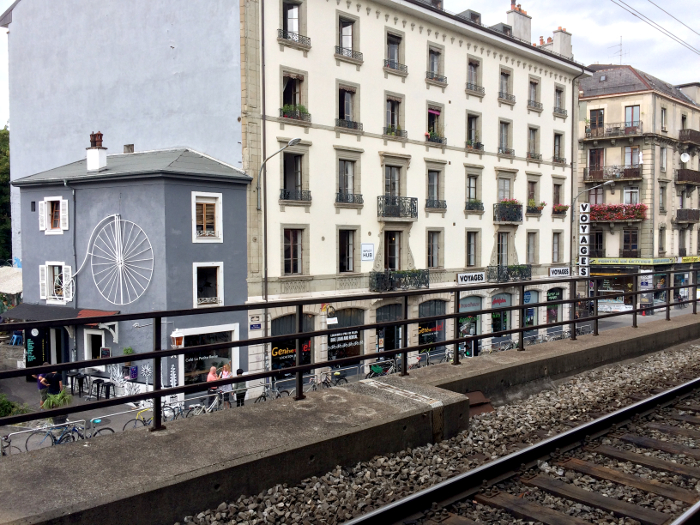
Getting up when the mist still lingers over the Zürich lake, saying goodbye to Maija and taking the tram to the train station. A heaviness in my head, hoping it’s just tiredness – sensing it’s probably not. Changing trains in Geneva, the only things I see of it are some artsy cafes on the other side of the train tracks – but I like it. Maybe next time, I’ll stay here for a night or two.

IMG_0582

Later, rushing down through deep valleys at the French border, listening to Rilo Kiley and thinking about Bolivia. I listened almost only to Rilo Kiley when traveling up and down the Andean slopes eight years ago. Funny how traveling makes connections like this, with memories and places. Like it’s a state of being, partly disconnected from everyday life, whatever is considered baseline.

Further south in France, agricultural fields and thinking: Does this make me better – or am I just fooling myself? Traveling by train. The environmental aspect – how so many environmental researchers fly all over the world for conferences and fieldwork and the cognitive dissonance in that and it’s hard. Staying in touch with oneself. On some level, these three days of traveling by train has made me feel it’s going to be easier to meet my own eyes in the mirror, but on another level: Is it that simple? I don’t know.

Arriving at the azure coast, the train running right next to sun-drenched beaches lined with palm trees. Enormous luxury yachts  in the bright blue water. Split worlds.

the green domes of Zürich & words of care

Of course I visited the botanic garden in Zürich too. I’ve been trying to figure it out. Where this interest comes from. My obsession with botanic gardens. I’d like to say there’s something profound about it – but maybe it’s just a type of collection. I come from a family of collectors, list-makers and chroniclers. I tick gardens off my list and I write about them. That simple satisfaction.

But I’m not sure. Maybe there’s something more. Like this thing about naming. I’ve read a couple of articles lately about how people are losing their literacy of nature. Words to name species and landscape features are disappearing from dictionaries and people’s vocabularies. Robert Macfarlane, the author, has written books about these words and then written articles about these books and they are on the top of my very long list of books to read. And then George Monbiot, another author, wrote about the significance of words – that we construct our world with language and that how and what we choose to name limits what we care and can take action for.

I believe in the magic of words. I believe that most people care deeply – but that care mainly arises for things we know and have experienced. A nameless tree in the Amazon rain forest or an anonymous succulent in the Atacama desert might be too abstract a concept for many people to take action for. And this is where the botanic gardens can come in. A place to learn the names of exotic and strange species, be seduced by their colors and sense their scents in the air. Experiences that can inspire a little bit more care for faraway ecosystems in people who otherwise would feel them to be too abstract and unknown. Maybe.

_MG_3017

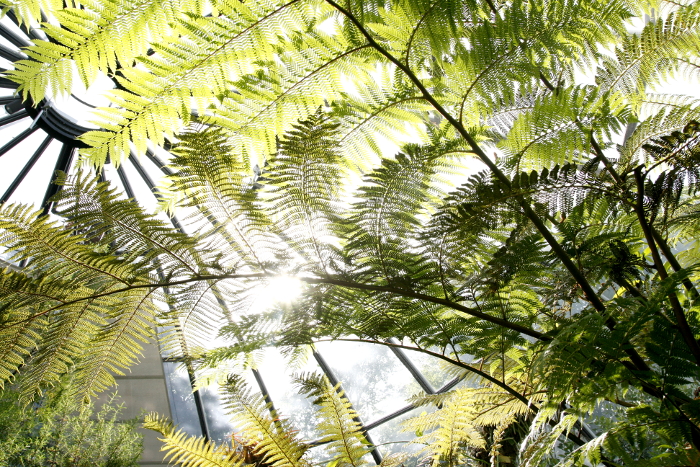
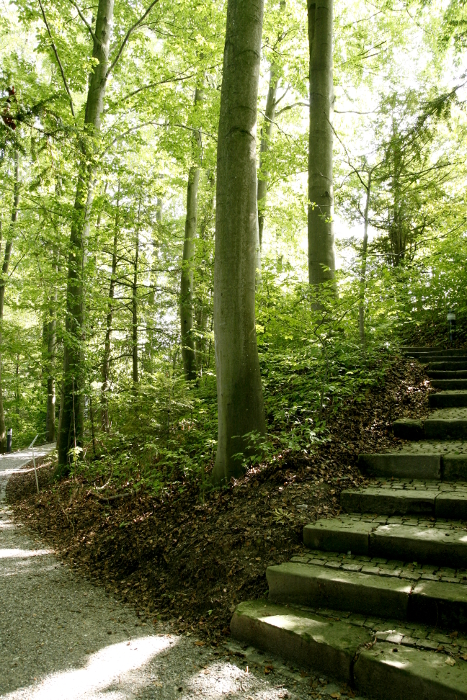
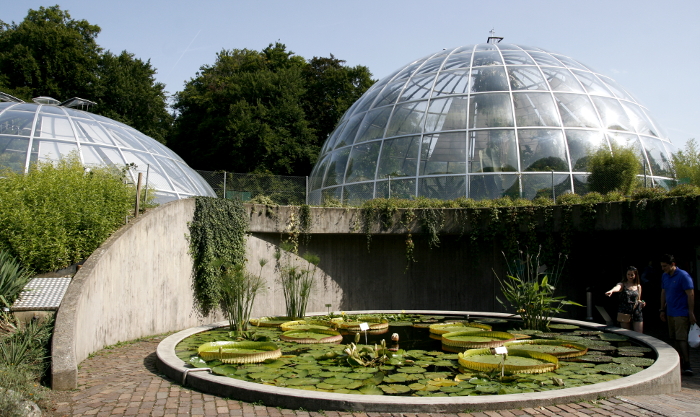
I think the botanic garden in Zürich is a good place to learn care. It is small, but well kept, with winding trails across the hills and through the groves of beeches and lime-trees. The dome-shaped greenhouses were both architecturally interesting and intensely lush on the inside.

_MG_3021

And on the grass next to the pond, they had made a neat little arrangement with chili fruits. I had no idea they came in so many different shapes and colors. Beautiful – but dangerous!

A really nice hidden corner of Zürich. Yet another commendable botanic garden to expand the parts of the world I care about.

Zürich, in between the mountains

[Written on August 28th]

Not that two days in Zürich makes me knowledgeable in any way – but Switzerland sure feels like a surprisingly coherent mixture of being in the center of Europe, and being other, apart. In Zürich, where German is spoken, I’m not surprised to recognize so much from southern Germany and Austria – but also, not. Maybe it’s mainly not being part of the European union that makes it feel a bit stubborn, unbending, proud. Highly international, but without going bland.

There is no point in me going into the politics, because I simply don’t know enough to judge. But my spontaneous feeling about Zürich as a city is: LOVELY. I arrived in the end of a long warm summer, and the streets were full of happy, sunburned, good-looking people enjoying the picturesque alleys in the old town or the turquoise waters of the lake and river. With the mountains giving everything a feeling of being contained, protected, in our own little world of beauty. I can really see how my old friend Maija has fallen in love with the place.

IMG_0564

And that’s really the best way to sight-see in a city: In the company of someone who really loves the place. I think she infected me with her new-love-butterflies. That, and all the cheese we ate (the Swiss really love melted cheese!), and Maija’s love-bomb dog-teddy bear Pomeranian Nala.

IMG_3083

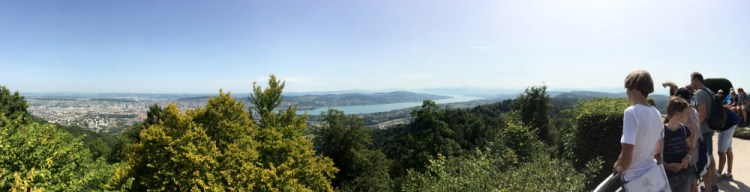
A visit to the mountains, the weekend energy injection I so craved!

on a winding rail from Stockholm to Zürich

[Written on August 25th]

The conference ended and I barely slept before I got on a train the next morning, over-packed and feeling almost like one of those eggs that kids make at Easter, emptied, fragile.

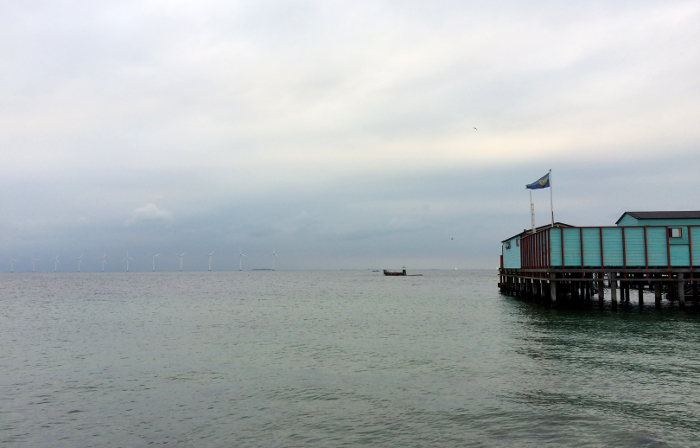
But afternoon in Copenhagen was beautiful. I was staying with an old classmate from before the turn of the millennium, but since he had to work, I wandered around on my own in his neighborhood. Enjoying the feeling of flexing my sense of direction. I stayed with him for two days four years ago, the last breath of my big pre-master’s Eurotrip, and I could still find my way. Dinner at a hip burger place, the red brick buildings (I’m biased, I grew up in Skarpnäck, the red brick fortress of suburban Stockholm). Experimental Danish architecture (so much more alluring than anything that gets built in Stockholm now), lush gardens around romantic turn-of-the-century villas. A maze of streets, so easy to get lost in the love of arched window frames and doorways – but I made it. The sea. I was born with a sense of direction that doesn’t put my geography degree to shame, and the sea lifts the pressure from my chest like few other things can.

The sky blended into the water and people were out sailing, kayaking, skinny dipping. I sang. I like Copenhagen.

IMG_0542

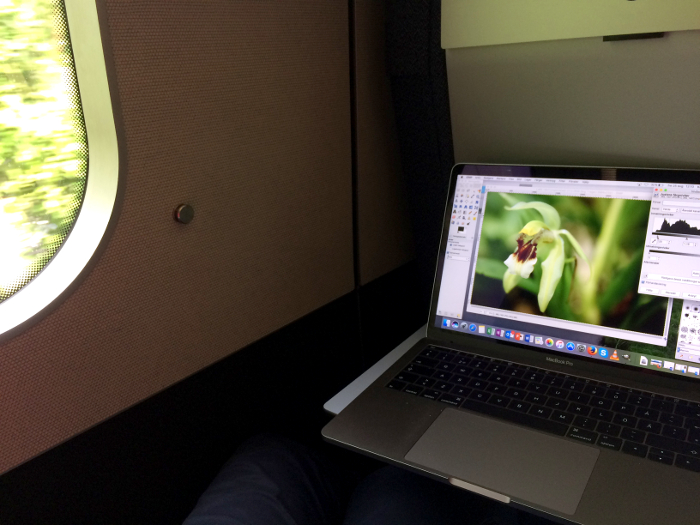
The day that took me from Denmark to Switzerland was long, delayed by a landslide and I barely made it to Zürich by the end of it. Part of the day I spent editing photos of orchids from the botanic garden in Glasgow, and I remembered another German train ride, another set of flower photographs: Traveling from Münich to Vienna, editing photos from Kew (London), and sitting next to a friendly South Korean man who marveled at my photos, and at my bravery of being a twenty-something girl crossing Europe by train on my own. He said he couldn’t imagine his teenage daughters, a couple of seats over in the train, ever having that kind of independence. Maybe it’s a culture thing, or maybe the way I was raised – but I never thought there was anywhere where I couldn’t go by myself that would be safe in a group. At least not in Europe. And of course it’s nice to travel with company, but there is a special feeling of freedom when you’re on your own. Like you can handle anything. I don’t know, it makes me feel good about myself, like an assurance that I will survive. After the overwhelming spring and summer that I’ve had – the last three years really, I think I needed this feeling of being in charge of my own situation. Sitting on the train from Hamburg, watching the rolling crop-covered hills gradually increase in size outside my window, I felt even more pressures lifting.

IMG_0557

Until we reached a small town just before Baden Baden. Apparently, there had been a landslide and now this train couldn’t go all the way to Zürich and it got chaotic, people shouting information in German and a bus that took us to another train station, lots of running, two train changes, just making it, and finally: sitting on the train from Basel, assured I will be in Zürich before midnight, Maija informed and me with my man-sized backpack eating Finnish chocolate to make my heart-rate slow down. In those moments it would have been nice to have someone to be confused with. But, then again, I made it. So, it’s all good.

IMG_0563

once upon a time at a conference

A month and a half ago, there was a conference. Big, located in the fanciest, most central conference center in Stockholm. A thousand participants from all over the world. All about the frontiers of resilience research. Organized by Stockholm Resilience Centre.

The planning had gone on for years. I jumped in about a year ago, just like most other people working at the center, everyone had to pitch in where they could. I coordinated couchsurfing for PhD students, a small handicraft station at the conference center, was part of the planning committee for one of the evening parties and for the PhD and early career researcher side event, curated some photo exhibitions. Small and insignificant things, but by the time the conference arrived, I felt like I had already used up all my conference energy on the preparations.

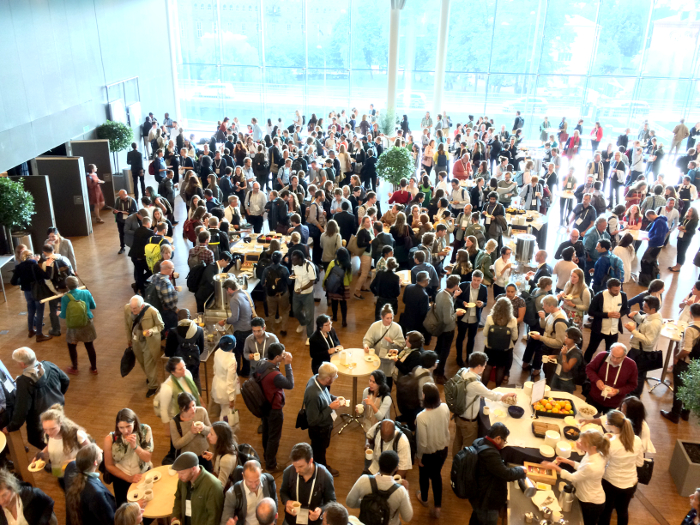
The actual conference is a little bit of a blur. The welcome reception in the Stockholm City Hall was nice, mainly because the City Hall is beautiful. I presented a speedtalk at a session about mapping ecosystem services. I think it went well. I chaired a poster session. That was just chaotic. I sang at a jam session and a cappella during a break. Have no recollections of that (but I was captured by a conference photographer [above] singing a Finnish tango accompanied by some SRC colleagues at the jam session, so it must have happened). Went to a bunch of talks. Don’t remember much about them. Crocheted at the craft station. I guess I should have mingled, networked, made valuable contacts for my future in academia, but my brain felt like such a jumble of odd puzzle pieces. I could not put them together to form coherent thoughts.

I guess conferencing is something one has to learn. Especially at a conference as big as Resilience 2017. Or at least I hope so. Otherwise I’m screwed.

art in the forest

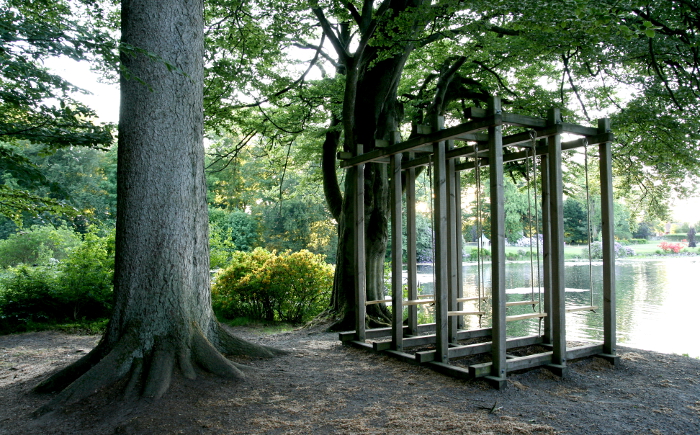
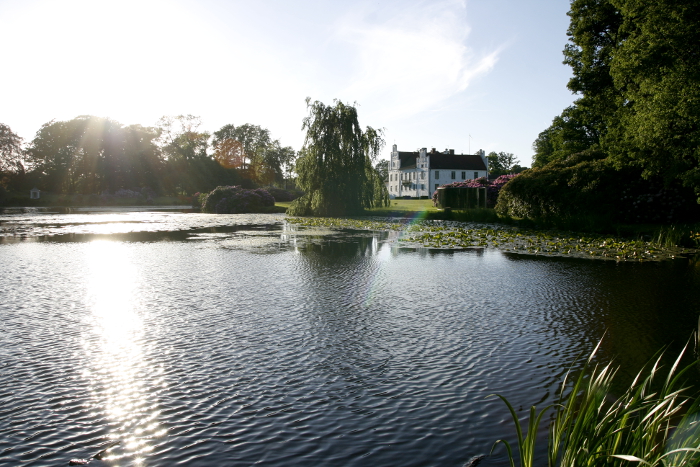
Strictly speaking not a botanic garden, but I can be generous in my definitions. Smack in the middle of my study area, in the municipality of Östra Göinge, lies the castle Wanås. It has a history stretching back into the 15th century and the castle played an important role in the wars between Sweden and Denmark during the 16th and 17th centuries. The current castle, which was built in the early 18th century, is still a private home, but the groves of oak and beech that cover the old castle grounds have been turned into an outdoor art exhibition. A place where nature, history and art meet, as they’ve phrased it on their website.

_MG_2207

I really like the way they’ve done it. How the curators and artists really have taken advantage of and respected this old, historical place, with the massive trees, and managed to keep the integrity of the old groves while at the same time challenging our ideas of what a forest is and what art is by making the sculptures and installations blend into the landscape. It is surprising, and really exciting to explore. Normally, I’m not a big fan of modern art, but here, as an aesthetically challenging walk in the woods, I really enjoyed it.

_MG_2231

_MG_2223

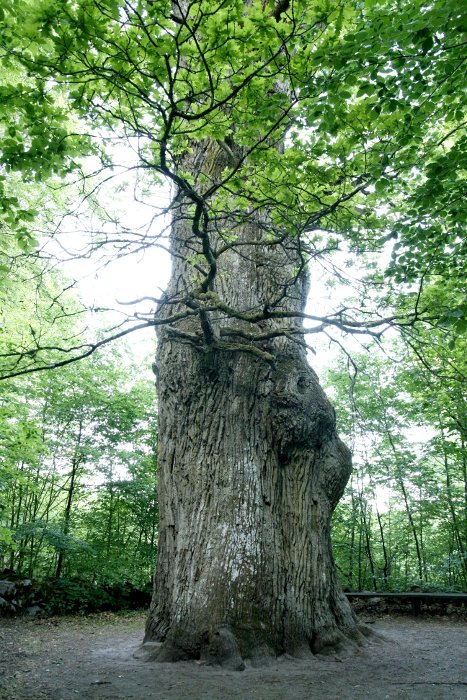
But what left the deepest impression on me was still the tree. The Snapphane oak. It was already standing there when the first castle was being built in the end of the 15th century. It is said that several of the Snapphane soldiers, Scanians who fought on the Danish side against the Swedish crown in the 17th century, were hanged from its branches. It has seen so much life.

I stood for a long time with my palms against its rough bark. I felt like it was breathing. But that was probably just me.