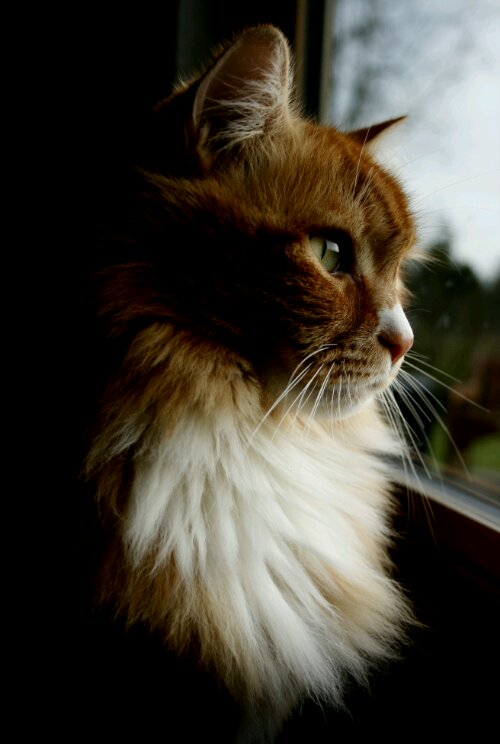
Harley
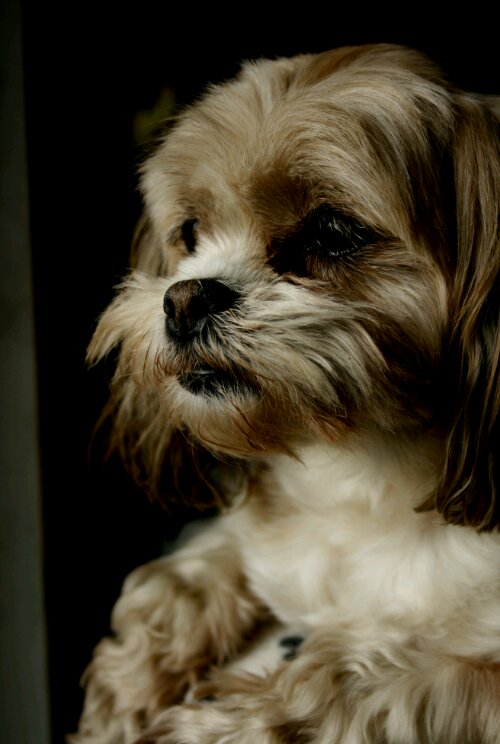
Maggie
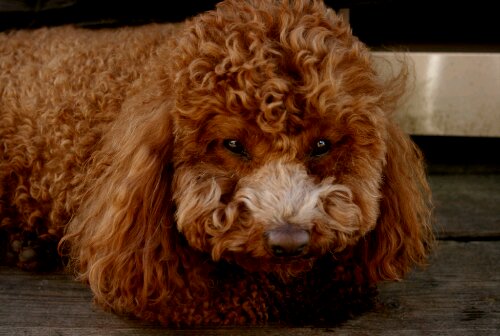
Remi the teddy bear
Harley
Maggie
Remi the teddy bear
The other morning, the pen that I had left lying on my diary next to my bed was gone. It was one of my favourite pens, one that I had ‘accidentally’ forgotten in my pocket on my last day at a receptionist job I had a couple of summers ago. It was a really nice pen. Blue, soft, steady flow of ink. The one I always used for writing in my diary. But now it is gone.
I’m pretty sure Leo took it. The night before, I saw him eyeing it greedily, but I never thought a cat would want to steal a pen. Apparently, I was mistaken. Leo the thief. Yet another thing that Leo the cat and Baby the monkey have in common.
I do realise that some of the things that I write might seem offensive. I generalize alot and write about ‘Canadians’ or ‘Swedes’, as if they were all the same. I am well aware that in a more serious context, this wouldn’t be appropriate. But as this is a blog about my travels in Canada (and later on the US too), my narrative is centered on my impressions and experiences. And I’m nothing more than a human, with faults and shortcomings, and we tend to be fast to judge, prejudiced and a little suspicious of things that are new to us.
But I always try to be open-minded and ready to change my opinions if someone or something that I meet contradicts my prejudices. I enjoy being challanged, and I hope I manage to convey this in my writings too.
So, please, tell me if I’m being stupid, and, most importantly, why – and I promise that I will listen.
Generally, my days look like this: I wake up between seven thirty and nine, depending on cat activities, the weather (there are no curtains in the wwoofer room) and if someone of my room mates happen to be on horse feeding duty. Then, I usually stay in bed for a while, reading a couple of chapters in “Anna Karenina” (the chapters in it are so wonderfully short) and maybe cuddling with a cat. If I have horse feeding duty, that is to be started at eight.
Breakfast.
At ten, the stable work begins: we let the horses out into their paddocks, clean the stalls and change the water, clean the paddocks and sweep the concrete walkway in front of the stalls. All of this while the radio channel Sonic plays its extremely un-imaginative music. That is usually done by twelve. Then we give the horses their lunch hay and so our stable chores are done.
After that we eat lunch, mostly prepared by ourselves – which means sandwiches or leftovers from the day before.
Sometimes we have afternoon chores, like doing something in the garden or helping with the renovations that Diane has going half speed in the house. But mostly we’re free to do whatever we want. And, you know me, I always have things to do: writing, reading, photographing, knitting, baking. Peter started a 1000 piece puzzle, and when he left a few days ago, I took over the responsibility to finish it. I have groomed a few of the horses, almost choking on all the hair that starts flying from their shedding winter coats.
Sometimes Jay, the horse trainer, comes by to have a lesson or train the horses. Then I stand leaning on the roundpen fence, trying to catch his every word. He’s got such amazing contact with the horses, he makes everything seem so simple, and I will write a lot more about how he works, but not now. It requires its own chapter – if not five or fifteen.
Since Tuesday, I’m also allowed to ride Zena, the horse that Jay has his lessons on, on the day that he doesn’t have any lessons. He started using her only this week and before that she hadn’t been ridden for a while, so she’s fat and totally out of shape. She needs exercise, so on the days that Jay isn’t here, I take her out into the roundpen for some lounge lining and riding. She’s such a cute horse, small and round and quite untrained.
At six, the horses get their evening meal, so if I’m on food duty, that’s what I’m doing. But otherwise, we hang around the kitchen, assisting, waiting for dinner to be served, which usually is at about seven. Diane loves to cook, so when she’s here, she’s in charge. When she and Willie are not here, we take turns cooking. We’ve had some amazing German and Spanish dinners.
After dinner, we wwoofers usually remove ourselves to the wwoofer room, play a game of poker or watch a movie, and then we go to bed. The guys here become sleepy so early, so I tend to stay up in bed for a while before putting out the light, reading a little, writing in my diary, listening to some Swedish podcasts.
At about eleven, eleven thirty, I crawl into my sleeping bag, turn off the light and fall asleep quite immediately.
So. That’s how most of my days look. Not especially busy, not tiring, in fact, quite relaxing. One day a week, I get off, but excepting the morning stable cleaning chores, the free days tend to look quite the same as all the others. And this far, I have really enjoyed myself.
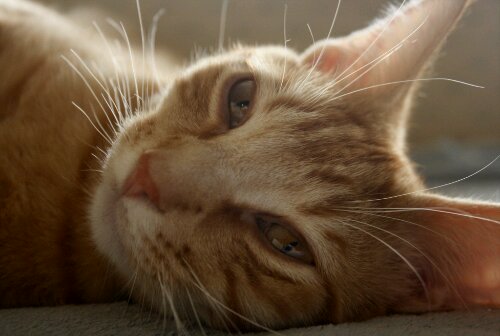
One of all the cats in Dianes house is a young, redish nine-month-old called Leo. He is really wild and playful and likes to scratch things. I find him completely charming, but then I’ve always had a weak spot for the unruly ones.
He likes to jump on my bed, which is a thick and wide matress on the floor in the wwoofer room. The other night, he sat completely still next to me, looking intently at my hands while I was flossing my teeth. I could see in his eyes that he wanted to jump, to catch the floss in my hand and that he didn’t care for a second what consequenses his sharp claws might have on my face.
That made me think of another rascal I knew once, one that also showed a particular interest in human dentistry. His name was Baby and he was a capuchin monkey. This was when I was working at the animal rescue / nature reserve in Villa Tunari, Bolivia. Baby had once been living in the quarantine, which was where I was working, but he was too smart for that, he always managed to escape from his cage and finally the vets at the park gave up. They let him out into the actual park, but he wouldn’t stay there either. He always kept returning to the main building, the clinic and the quarantine to do mischief and create chaos.
He stole my copy of “Open Veins of Latin America” by Eduardo Galeano from a cupboard, but didn’t find it interesting enough so he left it on the beam right below the ceiling in the quarantine kitchen. He helped the other quarantine monkeys to escape, and then sat on the roof watching us trying to catch the fugitives. And once, I’m pretty sure I saw him sitting with a knife, trying to cut a carrot into smaller, more easily eatable pieces.
And on my last day at the park, I was standing outside brushing my teeth when Baby came by, watched me for a while and then, as if wanting to take part in the action, climed up on my shoulder and grabbed my toothbrush. (And, you now, capuchin monkeys have sharp teeth and extremely strong jaws, so if one of them is sitting by your artery and wants something, you give it to him.) At first, he just put the brush in his own mouth and tasted the tooth paste. But when nothing exciting happened, he turned his attention to my mouth.
And that’s when he showed his acute ability of perception. With the determination of a pro, he tried to get the tooth brush back into my mouth, to help me brush my teeth. I really didn’t know if I should laugh or panic. As mostly when I’m in a stressed situation, I did the former, but with my lips tightly pressed shut. Luckily, one of my fellow volunteers walked by just then and managed to get hold of my camera – so I even have this Baby incident documented on photo.
Finally, when I wouldn’t let him become my new dentist, Baby lost interest and jumped off my shoulder and run off to the jungle with my green tooth brush as his new toy.
And Leo, with his intense yellowish eyes watching me flossing with extreme attention, doesn’t seem at all that different from the thieving, practical joking, aspiring dentist apprentice monkey that I once knew.
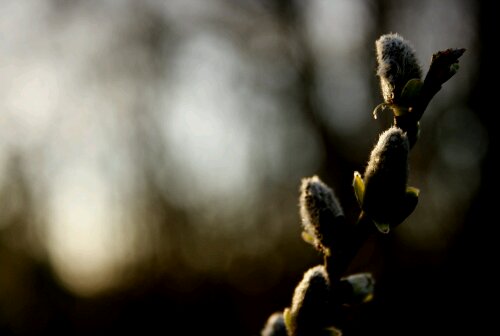
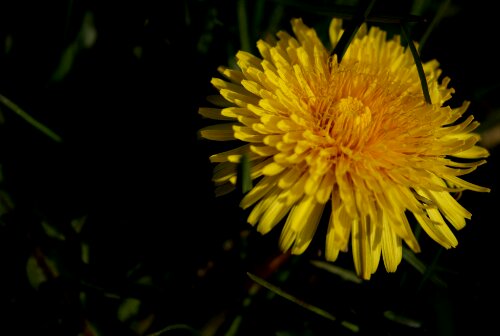
I just want to warn you all that there is a considerable risk that quite a few of the upcoming texts I write here on the blog will be horse related. Since I work at a horse farm at the present, this old favourite subject of mine is quite unavoidable. I apologize for this and promise that I will try to make the horse stuff as understandable and interesting as possible even for those of you who haven’t really gotten aquainted with these magnificent, beautiful creatures. If I will succeed with this endeavour, on the other hand, is a totally different matter.
In the mornings, when you go out to feed the horses their morning meal, the birds are having a concert in the trees that border Time Out Farms. In the evenings, they give an encore. It’s a wild kind of song, with hundreds of birds trying to outsing each other.
A couple of hundred meters from the house, the rails carrying the freight trains with goods into the Rocky Mounrains run. At night, you sometimes hear the freight trains’ signal, a slightly melancholic sound that for some reason makes me think of the sea and lonely, windswept islets.
And after a rainy day, when the fog has covered everything into a mystical forgetfulness, hundreds of frogs quackle in the swampy meadows.
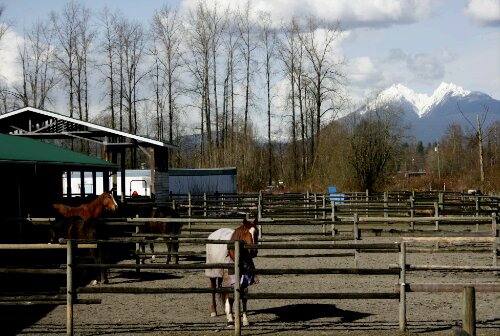
The area around Time Out Farms is quite flat, with wet fields and clumps of trees on small hills. But as a way to give the lowlands around Vancouver some perspective, the northern horizon is blocked by majestic mountains. And I can’t think of a better time to arrive here: The spring is knocking on the door, the buds on the trees are about to burst into green fireworks, but the mountain tops are still covered in snow.
I can’t seem to get enough of them. It’s a kind of dramatic beauty that we rarely get in Scandinavia. The pointy peaks of young mountains.
The first farm that I’m staying at is in the Fraser valley, close to Fort Langley, which is about an hour from Vancouver. It is called Time Out Farms, and it’s inhabitants are Diane and Willie, the hosts, four dogs, four cats, twelve horses, three ponies and an everchanging number of wwoofers.
When I arrived, there were four Germans here, but already the next day, an additional Spanish couple arrived. That means that there are a lot of people and a lot of animals around, always someone ready for a chat or a cuddle or an intense game of chase the toy mouse.
The main house is a one storey building with a large wooden deck on the back facing the horse paddocks and sunset. Diane has a large, newly renovated kitchen that I would just love to sink my teeth into – but as Diane really loves cooking, I haven’t had the opportunity yet.
I sleep on a queen size mattress on the floor of the wwoofer room – a kind of activity room with a large flat screen tv, a piano and a lot of cozy furniture where we wwoofers usually spend a couple of hours after dinner. For the first four days of my stay here I slept in the wwoofer room together with Peter (one of the German guys), the Spanish couple, the old majestic dog Sally and three of the cats, but now that Diane and Willie have left for a one week stay at their lake cabin and the Spanish couple and Sally have moved into the master bedroom, it’s only me, Peter and the crazy cats.
But really, it doesn’t feel crowded. It’s a huge room, and I have a chest of drawers (only half filled with ALL of my stuff) with a banana plant in a huge pot on top as a kind of semi-wall between my bed and the rest of the room. It’s only when the nine months old crazy cat Leo comes and jumps on my feet or the split-peronality cat Alex comes and just lies down on my chest that I feel a little claustrophobic. But it’s cozy, too, with the purring and the softness. I like cats.
Eleven of the horses live in a row of outdoor boxes with doors that open to paddocks in the back and the remaining four in larger paddocks with sheds for shelter from the rain. Because rain they do get alot here. Due to the circulation in the northern Pacific, even the winters are mild here – but as a trade-off, the ocean currents make it rain almost every day.
There are big meadows where the horses go in the summer, a lot of cars and tractors and sheds for Willies business and three trailers, two of which are occupied. The first impression might be that Time Out Farms isn’t a very big place, but once you start looking around, there are a lot of things to discover.
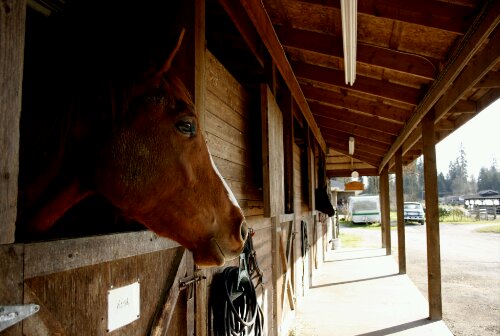
Victor the rascal watching over the farm

 Katja Malmborg