Chapter 99: My blankies

I have a bright blue sleeping bag and dark blue silk traveling sheets. The traveling sheets I got from my aunt Eva, who is now living in South Africa, just before I left for South America in 2009, and the sleeping bag I borrowed from my dad once and never ‘remembered’ to give back.

I slept in them in Potosi and Uyuni, where the nights were amazingly cold, considerng the dry Andean heat in the daytime. I didn’t need the sleeping bag, only the traveling sheets, during the warm, humid nights in the Amazon, but halfway through my monkey park stay the rains came and made the nights surprisingly chilly. Then I was happy to crawl into my sleeping bag again. On the bus from La Paz to Lima, the sleeping bag became my little cocoon and made it possible for me to sleep, even though the bus was crowded and uncomfortable and the journey very very long. And I was never cold in the sleeping bag and traveling sheets in the tent on top of the jeep in Namibia in 2010, even tough the desert nights are freezing.

Now, I sleep in my bright blue sleeping bag and my dark blue silk traveling sheets. Even though Diane has provided me with ordinary sheets for my kingsized bed. I find them cozy, my traveling set. The sheets and the sleeping bag have become my traveling home, a tiny space of familiarity where I can relax and feel comfortable whereever I am in the world.

Diane calls the set my blankie. As in the blanket some small kids carry around and need in order to fall asleep. And I guess she is right in a way, even though it makes me feel kind of stupid. I’m twenty-four and have been traveling around the world since I was three months old. I should be able to sleep without my set of blankets and sleeping bag. But I don’t know. I like them. I feel comfortable in them. And considering I sometimes even have trouble falling asleep at home, anything that makes it easier for me to fall asleep is good, right?

I love my blankies.

Chapter 98: The weed is greener in Canada

Honestly, I’m a bit surprised. I’m sorry if this is something that it isn’t really appropriate to write about and if it might disturb some people, but my gosh, Canadians smoke weed like I don’t know what. And atleast among students in Alberta and people in general here in British Columbia, it seems quite accepted.

I don’t mind. I don’t smoke myself, but if others choose to do it, it doesn’t bother me. I find weed to be a relatively harmless drug, and as long as people use it responsibly, I guess it’s their own business. Especially if it’s bought from the person who has been growing it. What bothers me is when people buying drugs support the maffia and other illegal activites and in a way are the cause of a lot of suffering of innocent people in the earlier stages of the drug production chain. Think all the people being killed and disappearing in Colombia and Mexico due to the cocaine trade. Not thinking about where a product comes from when buying it is the worst kind of arrogance and egoism and one of the biggest problems that globalization has caused.

But the weed people smoke here seems to be grown in somebody’s friend’s friend’s backyard and a guy that was here wwoofing before me was even leaving to go working at a medicinal marijuana farm later in the spring. I feel I can’t really condemn it. I just feel surprised at how common it is.

Chapter 97: A weekend in April

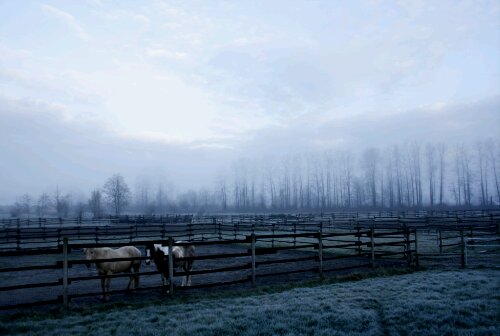
This morning when I went out to feed the horses, the mist was just dissolving, leaving the grass with silver edges. The rising sun was making the snow covered peaks of the mountains shine and the horses were neighing their good morning welcome (feed us now please!). And diving from the roof, the swallows were singing.

The trees have started getting leaves now, tiny bright green things. Yesterday, the sun was shining and it was so warm, I was sitting on the patio reading “Anna Karenina” and managed to burn myself on the chest and left shoulder. Maybe not what first comes to mind in a temperate rain forest region, but I’m managing to get myself a tan.

But it has rained a lot this last week too, so much that the roundpen and the arena have been full of puddles and the sand too wet for the horses to have any good footing. So I haven’t been able to ride. Instead, I’ve returned to Anna, Count Vronsky, Kitty and Levin. Honestly, it just keeps on going. It’s like several books put together into one. I love it.

Chapter 96: Jay’s three principles

So, following Jay’s training programme, the first thing you have to do, is to establish yourself as a strong leader. To accomplish that, Jay has a number of exercises that you do from the ground, in a roundpen (a circular riding paddock with a high fence around, maybe fifteen meters in diameter). Doing these exercises and later on when you start riding, you should strive for Jay’s three basic principles: cause movement, yield to pressure and follow a feel.

The cause movement part is easy to understand, because that is what you see in the paddocks all day, horses chasing each other around, biting and kicking. What they are doing is pushing each others boundaries, trying to see who will fold first. The strong horse that can cause another horse to move, has the higher status. Eventually, no biting or kicking will be necessary, the low-status horse will move out of the way as soon as the high-status horse approaches, if the approach is made in a ‘move out of my way’ kind of way.

That is what a person working with horses should also try to accomplish. The horse should not be able to get you to move by taking a step closer to you – instead, the horse should move out of your way. If the horse comes into your space uninvited, he has to be sent away, for example with the end of a rope swung in a way that resembles the end of a swinging horse tail. In the roundpen, you practice this by getting the horse to run around you, and in a saddle the whole point is to get the horse moving. It is horse logic. Horses are all movement, and to the horse, the individual that can make it move has the power.

To get the horse to yield to pressure becomes necessary when you want to start riding. That is what riders do, putting pressure on the sides of the horse to get it to move foreward, putting pressure in the mouth to get it to stop or turn. What Jay wants is for the horse to listen to a pressure that is as light as possible. This you also start practicing from the ground in the roundpen, getting the horse to move around you in a small circle with you in the middle holding the halter rope, getting it to turn and change directions by only lifting your hand. And the trick is not to start using force. We don’t want to punish the horse if it doesn’t understand. Instead, we use the same amount of light pressure, but persistently, until the horse yields. Some horses are stubborn. What the horse trainer needs to be is even more stubborn.

The same principle applies when we ride. The rider should ask persistently, and be consistent and forgiving, not forceful and punishing. Eventually, most horses will cooperate. I’ve seen Jay do it, several times.

And all this seems easy, right, quite logical once you get into that way of thinking. The difficult thing is the last principle, follow a feel, that should actually be present from the very start. Because all of the exercises and all the work you do with horses has to be on the horses terms. You have to be able to read the horse and know when to be hard on it, when to just wait for it a little bit longer and when to be forgiving. Horses are instantaneous and you don’t get any second chances. So, you have to develop this feel, practice your timing to perfection. And that, my friends, requires more than a lifetime.

It’s hard work, this training programme of Jay’s. It requires much more from the trainer than from the horse. I will probably never have the time and opportunity to learn it properly. But watching Jay do it is amazing.

Chapter 95: … and then we have Jay

But Jay doesn’t really do western nor English. He looks like a proper cowboy, with the hat and the boots with long spurs and the sunburned face, but what he trains and teaches isn’t what any ordinary cowboy would teach.

Jay says that cowboys know animals, but don’t really care about riding well, and they can be really rough on their horses while riding. Other western riders are generally much lighter on their horses, but still have the same lack of theoretical knowledge as the cowboys. The English, on the other hand, can be really good riders and know everything about technique and movement, but they don’t know shit about how horses think. What Jay does is that he combines the two schools and also adds alot of his own knowledge and experience from a lifetime of working with horses.

What he teaches might seem simple at first. The main idea is to work on the horses terms, to cooperate instead of using force. It’s about being light and to train in a way so that you never have to be rough. And this is all possible, because horses are sensitive creatures and extremely aware of everything that happens around them. They notice everything, and if you train the horse to react to a word or a light touch in a specific way, they’ll eventually learn it as long as you’re consistent. The practice of pulling the reins hard and squeezing the sides of the horse very tightly with your legs that is common in English, but also to a degree in western riding, is desensiticing and sometimes even harmful, but most of all unnecessary. The horse can respond almost to a mere thought, if you have the ability to train it right.

The training of any horse should be based on two evolutionary facts: that horses are flock animals, and that horses are pray animals, while humans are predators. As flock animals, they respond to leaders. In the wild that would be a combinatin of a strong stallion and a dominant mare. In captivity, with people, the leadership issue tends to be much more confusing and sometimes even lead to dangerous conflicts. Any person working with horses should establish herself as the leader of the flock, but that is not just getting the horse to do the things you wish by force. The true leader has the respect of the horse and has been able to prove that it is strong and brave and trustworthy.

Being prey animals means that horses are very perceptive and aware of everything around them. Humans on the other hand are predators, which has given us an amazing capability to focus on one thing. While horses always are ready to flee, humans are always ready to attack. So, the training of any horse should be aimed at teaching the horse to focus, while the trainer or rider has to teach itself to be more perceptive and aware. And most importantly, not working with one thing for too long. Jay calls it thinking with horse logic, not people logic.

This is what Jay teaches, how to become the leader of your horse and how to think with horse logic. And once you are the leader and have the respect of your horse, training it to respond to lightness will be no problem at all, as long as the training is carried out with horse logic. The horse will WANT to do as you ask. That’s how evolution has made them – follow a good and strong leader, or perish. As long as the horse understands what you ask of it, it will do as you wish. It might take some time to get the horse to understand, but patience and calmness is essential to any kind of horse training.

The tricky thing is that the simplicity of the theory becomes quite difficult when put into practice. It’s all about reading the horse, and responding in a way that is both logical for the horse (but not necessarily for humans) AND establishes you as a strong leader. But the signs from the horse are sometimes so small, and the timing is of such essence, that the whole thing eventually feels impossible. It needs practice and practice and a horse that is willing and even then it takes even more time to teach the horse exactly what you want.

But Jay, he has it all in the tips of his fingers. Without seemingly moving at all, or only a step here or there, he can get a horse to run or stop, come to him, walk away from him or follow him. It’s amazing to see. I’ve spent hours just watching the horses melt like butter in his hands.
image

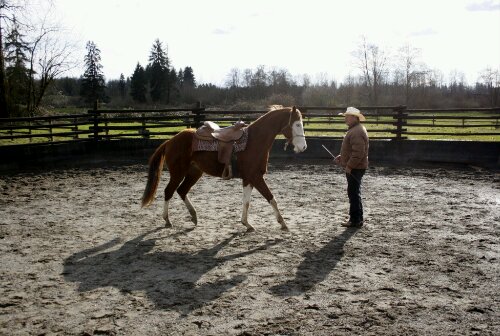
Jay working with Casper in the roundpen.
Chapter 93: The strain of having nine wwoofers

Yesterday, Jaime and Paloma left. I felt sad to see them go, because we had had such a good, relaxed time together. But they were immediately replaced by two Austrian girls and a French girl. A lot of new names to learn and introductions to remember.

The work this morning was total chaos. First, there was a lot of teaching to be done (the German couple from before came back about a week ago, did I tell you that? I can’t remember). So we had one new girl each to show the routines of Time Out Farms. Then a few people came to look at Tully, the pony that I have been helping Jay train, and Diane asked me to ride him a little, just to show the potential buyers. But he just wouldn’t cooperate. There were too many people watching, too much at stake, he just wouldn’t and I felt like the worst horseback rider ever to have stepped into a roundpen. (The woman liked him anyway, though. And who wouldn’t, he’s such a beautiful little thing. I haven’t asked for the details, but I think Tully might get a new home in a couple of months once Jay has had the chance to train him a little bit more.) Well, and in the middle of that, Russ the stallion escaped and created havock, especially among the mares. And then, when Diane finally had him cornered in a meadow, the two mares that escaped before, Tapestry and Tappen, escaped again. Crazy day. Really crazy day.

And I’ve realised here that it’s hard for me with new people. Not as if I didn’t know that before, but it becomes so obvious here. It’s not that I can’t talk, it’s more that it requires such an effort that I become mentally tired and feel kind of confused after a while. And I become this really boring person. Which makes everything even worse. So I took a brake this afternoon, sitting in my room, listening to the heavy rain outside and streaming four episodes of The Good Wife. Atleast I know when I need to press pause.

So, this evening, an additinal three persons arrived, two German girls who have been here before and a frend of theirs. They’re only here for a few days, but still. We’re nine wwoofers. A week ago we were three. I’m overwhelmed.

At dinner, I only said one thing. The German girls were telling a story about a French guy that they met that systematically used a couple of words completely wrong, like, calling dust ‘weird’ (as in “sweep the weird”). My comment was a reference to the Monty Python sketch about the Hungarian phrase book. Not a single person around the table got my reference. And think about it, we were twelve eating dinner. Atleast one more should know their Monty Python. Instead, I just created an akward silence and then the German girls went on with their story.

Ah, what I wouldn’t do for an hour or two with someone with a similar pop cultural reference frame as my own. I’m not picky. Dad or Natalia would do just fine.

Chapter 92: Random photo update

Since I don’t have a computer of my own here, only this tablet of mine, I’m forced to rely on the mercy of others to be able to go through my photos. Yesterday, I borrowed Dianes computer. So, here are a few odd pictures from the last couple of weeks.

image

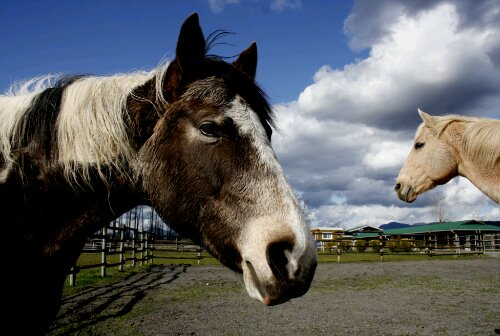
Zena and Millie, enjoying a sunny afternoon.

image

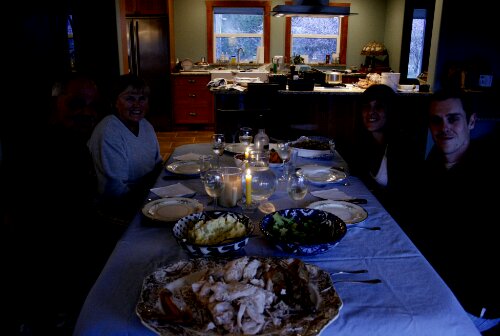
The Easter Sunday turkey dinner with Willy, Diane, Paloma and Jaime.

image

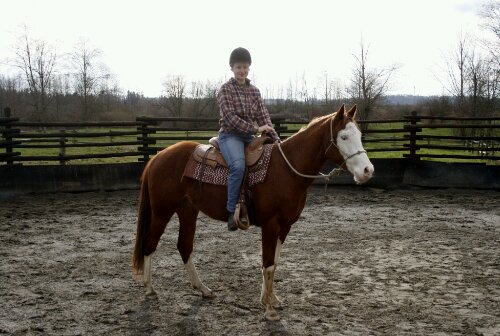
Me, on a real western horse, Jay’s Casper, learning how to ride like a cowboy.

Chapter 91: Some more signs of spring in the Fraser Valley

image

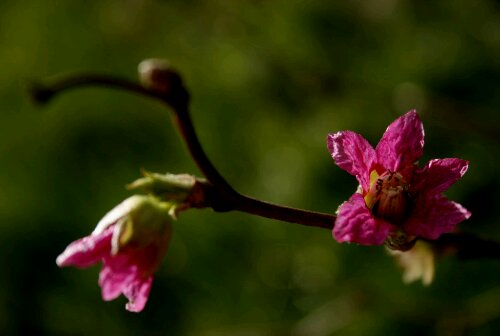
These bushes grow everywhere. Even in the park where we went riding with Jay. Beautiful pink flowers.

image

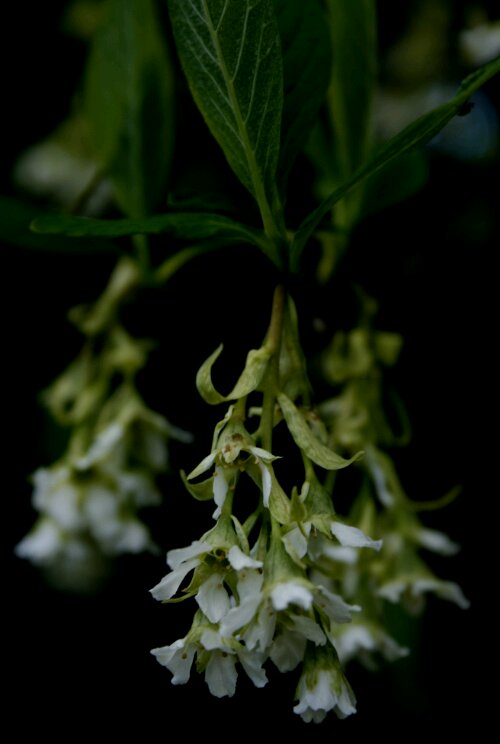
These looks like hägg. They might not be, they didn’t really smell anything at all. But still, pretty flowers.

image

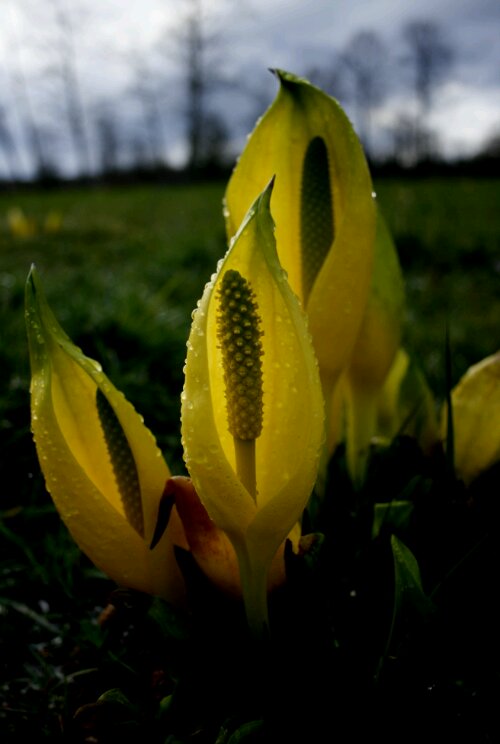
Skunk cabbage. Dianes meadows are full of them. Apparently, they can help horses with breathing problems. An old indigenous trick. I just think they look funny.

image

Dianes garden is full of blossoming cherry trees. It’s beautiful.

Chapter 90: Mr. P has a Monday night burger

image

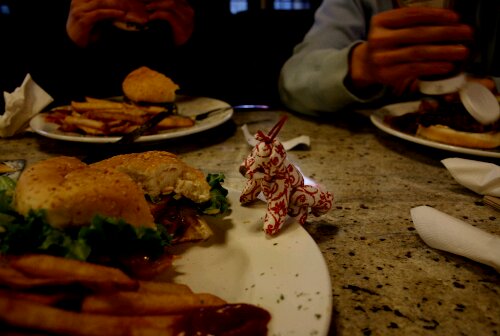
Mr. P having a Monday night burger at the Fort Langley pub with Jaime and Paloma. They are extra cheap on Mondays, like less than half the usual price, and they’re so good. Might even be the best burgers Mr. P has ever had. And he doesn’t usually like burgers. Too messy, have to be eaten with your hands. Nah. But these – mmm.

(And I know, neither Mr. P nor I should eat meat, and at home atleast I am more or less a vegetarian. But these Canadians are crazy about their beef. And since I live in people’s homes, I feel I can’t ask them to cook special dishes just for me. And working like this, I really need the proteine. And, to be honest, I love meat. The only reason why I’m a veggie at home, is because I can’t stand the bad conscience from all the Amazon trees that have had to give up their living space for GMO soya bean plantations, producing food for all the meat animals. And the eutrophication of lakes in Europe. And the emission of greenhouse gases. And water shortages, sinking water table levels, pollutants, over use of antibiotics. But I also have to be practical, and here, I would only be fed with rice and sallad if I didn’t eat the meat too. You can’t ride three horses a day on rice and sallad. So I’m taking a holiday from my conscience. And so is Mr. P.)