the Swedish war history

A couple of weeks ago, I was reading an article about the differences between European and United States’ean foreign policy and view on security. It was very provoking and the author (originating from the US) claimed that the reason why Europe can be so civilized and demilitarized is becaue the US is so militarily strong and can protect Europe if needed. Well, to make a long train of thoughts slightly shorter, I convinced myself that one of the reasons for the difference in view of the military in Europe versus the US is because the continent of Europe has experienced war much more recently than the US. The US has sent soldiers to fight elsewhere, but in Europe there are civilians that have grown up with the constant threat of living in a war zone. There is simply a much more recent memory of war trauma in the general population of Europe than in the US.

There were more arguments to this, but what I really wanted to write about was that I realised that this logic doesn’t hold for Sweden. Sweden was never attacked during WW2. Which led me to thinking about when Sweden last was at war. I’m not really that experienced when it comes to history, but to my best knowledge, the last time a Swedish king sent soldiers to fight for the Swedish cause was when Sweden kind of half heartedly tried to defend Swedish Finland against the Russian tsar. That was 1808-1809, and then Finland became Russian for a hundred years. But even that wasn’t in Sweden. The war was fought on Finnish territory. Not a lot of Swedish civilian war experience there.

Before that, Sweden was down in Denmark and Poland and Estonia and Germany, fighting wars against the other great powers of Europe. But not even that was on current Swedish territory.

It would require going back hundreds and hundreds of years to reach the time when Swedish soil saw war last. So, why has Sweden been pushing its neutral and peaceful stand so forcefully for the last hundred years? My theory of recent war trauma does not hold.

Maybe, just maybe, there’s a chance I’m just not as smart as I think I am. Everything considered, I’m probably not.

security policy in the seven kingdoms of Westeros

This fall, I have been studying the A course of peace and conflict studies at Uppsala University. When I’ve not been busy reading articles about American foreign policy and writing papers about the wars in Darfur, Libya and Syria, I’ve been reading fantasy. And not just any fantasy. George R. R. Martin. His A Song of Ice and Fire series, to be exact. Or, the books that Game of Thrones is based on, for those of you who are more TV show oriented.

The thing is, they kind of clash. Or rather, they have created a surreal bubble around me this fall. A bubble of imagined and theorized war. On the one hand, we have the cold calculations of realist conflict theory and on the other the highly passionate wars of revenge in A Song of Ice and Fire. I’ve spent my evenings sitting curled up on my couch reading, not being able to keep from thinking that the weakening of the Targaryen house led to an imbalance in the system of the kingdoms that make out the realm of Westeros, a condition that first led to the first rebellion and then to the eventual war of the five kings. A pretty good example of the balance of power theory. Or should a theory about hegemony be used instead? And how about the people? Is the reason why the five new kings could gather up their armies and rise against King’s Landing because no real Westerosian identity had been created, that people identified more with their old kingdoms and their lords, like the Starks in the North, the Tullys in the Riverlands and the Greyjoys of the Iron Islands, than with the king far away in King’s Landing. What if – –

You see! This is terrible! This fall has brainwashed me with war and to be honest, I feel sick and tired of it. Because, wouldn’t it be much more fun to muse about what kind of atmospheric system, planet and solar system that can create such distinct, irregular and comparatively short periods of climate change instead. Winters that last fifteen years! Our ice ages last considerably longer than that, and arrive much slower.

Or, even better, just read for the pure enjoyment of the story.

Naah. This fall has been odd. Luckily, Christmas is almost here.

the trials of auto-correct

One thing that actually is good with having a smartphone, is that I can write posts to the blog and upload them wherever I am. I’ve been doing that more and more lately.

The problem is: my phone has a Swedish auto-correct. Which means that, when I write in English, some words get switched because they resemble Swedish words. Birch became bitch, for example. (Not that bitch is a Swedish word in an etymological sense, but it’s been borrowed.)

So, there is a risk that there are some irregularities in the posts that I write on my phone. I’m really anal about spelling, but I just can’t re-read everything all the time. I’ll just have to accept that my writing will contain a slightly higher degree of errors. Probably a good lesson to learn.

I apologize in advance for that.

snowflakes covering my eyes

I’m sitting on my kitchen floor, with a perfect view of the top of the birch tree, the light grey sky and the falling snow. I have an exam in three hours and I really should spend this time doing some last minute studying – but I just can’t concentrate.

Snow has always inspired me to write. I remember sitting in my 9th grade science class writing poems instead of learning about esters and carbon chains. Poems about snow. Or in highschool, when I spent entire phsychology lessons writing snow filled short stories, not caring about the id or Pavlov’s dogs.

Maybe it’s because of the metamorphic power of snow. How you can wake up one morning and the world outside your window is something completely new and different from the world you went to sleep in. How it can turn the very mundane into a fairytale.

That’s what words should do too. Maybe that’s what I’ve been trying to copy.

So that it’s hard to concentrate on American security policy and the broadened security agenda when it’s snowing, that might not be that strange after all.

down by the Fyris river

Biking in snow is not easy. Especially since the rubber in the brakes suddenly has no effect at all. Getting to this morning’s seminar took twice the time it usually does.

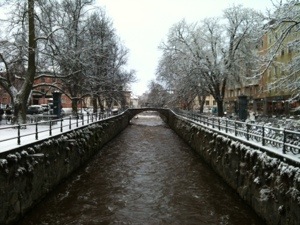
But even though I was in such a hurry when I finally arrived at the department, I couldn’t help pausing for a moment to admire the Fyris river framed by snow covered trees. Uppsala isn’t just beautiful in the fall. It’s beautiful in winter too.

20121129-144858.jpg

running in the snow

It’s snowing today.

I went running in the forest, in the dark, with a classmate of mine. We took it easy, at a light jog, in order to be able to discuss the broadened security agenda. You see, we have an exam on Friday. And my classmate is one of those really sporty types. He has been trying to get a group together, to go running, but today I was the only one to show up. The crazy, half Finnish person. So he suggested that we should do today’s running session at a slow pace so that we would be able to prepare for the exam at the same time. Always efficient, those young ambitious men.

It must have  been the most absurd run I’ve ever been on. Trying to keep up with my classmate while discussing theories about security policy. Having to stop in the middle of a sentence about securitization just to catch my breath. But that’s also a way to do it, I suppose.

To be honest, I think I enjoyed it.

And in the looming darkness, the falling snow was leaving a thin layer of white on top of the blueberry bushes.

future endeavours in an alternate reality

It’s no secret that I watch too many TV shows. Lately, I’ve gotten into a crime/mystery/sci-fi show called Fringe. It’s about an FBI agent, a crazy old scientist and his bad boy son. It’s got similarities with Bones, and you know how I love the (propably very unscientific) science talk. But when Bones is a lot of medicine, forensic anthropology and some geology as well, Fringe is just incredible amounts of theoretical physics and chemistry.

And that has made me realise. Chemistry is just so cool. That’s the magic. Not physics, as I’ve always thought, that’s just calculations and probabilities and things that are impossible to grasp. Chemistry is actual stuff. Things you can touch. Matter, in the way that is actually understandable for humans – but still so complex and just, like, exciting. There are infinite things you can do with chemistry. Now, after Fringe, I actually think that chemistry is the key to understanding the world. Atleast the one within our mental limits.

I kind of wish I could get into chemistry now. Change direction completely and start dressing in lab coats and wearing protective glasses all the time. I think I could’ve become a decent chemist. I think I’ve written it before, or else I’ve just thought it, that I have a certain tendency toward meticulousness that I imagine could become handy in a lab. Previously, I’ve thought about it in terms of the possibility of becoming a quaternary geologist – but I think the same principle could work for more traditional chemistry too.

But it’s too late, I’m afraid. With the weeks I have left of student loans, I would only barely be able to get a Bachellor’s in chemistry, and with a Bachellor’s degree you don’t get to do any of the fun stuff. Not to mention that I would have to spend about a year to study the highschool chemistry and physics that I never took way back when, in order to be accepted to the university program. I feel old already as it is, still studying on the undergraduate level while almost all of my classmates were born during the 90s. No, I’ll just have to stick to the geography that I started with.

But in another, alternate reality, where I chose to major in science instead of social science in highschool, I might have had Eva Allard in chemistry instead of geography (believe it or not, those were the two subjects she was teaching, this lovely monument of a pedagogue that is partly responsible for me ending up at the physical geography department at Stockholm University in the fall of 2009). What an intriguing thought. There is no knowing where I might have ended up.

Meanwhile, in this universe, I’ll have to make due with pseudo-scientific TV shows. Pretty enjoyable, that too.

the illogical Islamophobics

I read on my Facebook news feed, a guy commenting on a group page about forbidding mosques in Sweden to have their call of prayer (the adhan) broadcasted in speakers so that people in the surrounding areas can hear. It’s become kind of a buzz thing, and I now and again see people writing about it on my Facebook news feed. Mostly what they write is pure racism and prejudice. And usually it’s not even about the prayer calls, not really, it’s just used as an excuse to write bad (and false) things about Islam. I understand why someone would want to have a discussion about the prayer calls on the account of them being a kind of public disturbance – but that’s also where the discussion should end. It rarely does, though. It always ends up being about Islam not being part of the Swedish culture, that we shouldn’t let Musilms take over our society and that we shouldn’t encourage those inherently brutal Arabs.

What made me react in this particular guy’s comment was what he wrote about Islam and war. That we shouldn’t allow the prayer calls, because that would be another step in letting Islam spread in our society (as if it was a disease) – and this spread is something we should really be worried about. He wrote that it’s not chance that the wartorn regions in the world are concentrated to Muslim countries and Muslim movements.

And I just couldn’t believe him. This guy, I don’t really know him, he’s a friend of a friend and I only met him a couple of times back in my late teens, but I got the impression that he was a smart and sensible guy, really into music and kind of considerate. I thought that he would be the kind of guy who could check his facts before he went out in the world and started to preach mistrust and arguing for political change. I guess I was mistaken.

But yeah, it’s the war thing. I spend my days reading about war, listening to lectures about war, discussing war. I am on high alert, always scrutinizing peoples statements about war, trying to tell them about the latest in research on the subject if their views lack foundation in fact. So maybe I’m overreacting here. It just annoys me, that people care so little about supporting their beliefs with facts, with science. They just believe, and that becomes their world.

Because, the facts are these: the majority of the worlds armed conflicts are in Africa, even though the mass media in Sweden seems to want us to believe that it’s in the Middle East. A pretty large number of these conflicts are about religion, that is true, and are fought between parties that have different beliefs – but all of them are not Muslims. We have the Christian extremists in Uganda, the Lord’s Resistance Army, and the rebels in South Sudan, who are Christian/animist. To name a couple. So you can’t say its only the Muslims.

What you can say, though, is that what most of the conflicts in Africa, and in most other parts of the world, have in common, is that they persist in countries where the states are extremely weak or corrupt or marginalizing. From my perspective, it seems like it would be easier to blame the politics than the religion. All the lecturers I’ve had this far would probably agree – they always end up blaming it on the politics.

Claming that wars are caused by Islam because some of the world’s conflicts are justified by claiming it’s for Allah, is like saying that because the majority of murders are committed by men, men in general are murderous. As an argument, it just doesn’t hold. Not with the empirics currently at hand. If anything, just look at the bloody, brutal history of Christianity. People always find ways to justify their violence in their pursuit of power, money, or bare survival. Looking at the justifications won’t solve the problem. If anything, blaming the justifications will only make the situation worse.

I should probably communicate this somehow to that Facebook acquaintance of mine. But I fear it’s a battle I’ve already lost. I don’t think I would be able to convince him. Tonight, I feel pretty pessimistic about the world. So instead, I write. To get rid of my frustration.

the dangers of a smartphone

Inheriting an old iPhone from my stepmom has created new habits for me. I check my Facebook account several times a day. I had a period around 2007, when I joined, and until about 2009, when I came home from Bolivia, when I used Facebook kind of regularily. Not much, but I uploaded pictures sometimes and sent messages to friends. After that, though, my Facebook habits have become more and more irregular and the last year, I haven’t been active at all. But, now that I have an iPhone, with internet connection everywhere, it’s just so easy to just pick up the phone and do some Facebooking while waiting for a lecture to start or the pasta to be done cooking. It’s not as if I have started doing more on Facebook, leaving  a trace of myself there. No, I spy on other people. Mainly, read the news feed.

I know that Maija, the Finnish friend I made in Tanzania twelve years ago but haven’t met for atleast six years, lives happily in London. I know that her little brother is studying in London too. I know that Helena, a girl I used to ride with as a teenager, now lives in Miami with her husband and competes in show jumping with her beautiful horse. I know that Sanna and Niklas, old classmates from highschool, are still trying to make it with their rock band. I know that Jessica, another riding buddy, has twins. And that Lottie, a friend of an old highschool friend, just bought an apartment. The list could go on and on and on.

What do I need all this knowledge for? These are all people I lost contact with years ago, that I’ll probably never meet again and whose lives are so completely different from mine. They mean nothing to me anymore. But still I can’t stop. It’s like the tabloid headlines – you just can’t not read them. It is gossip, and I compare with myself, and mostly it just makes me irritated. But I keep on doing it.

I need to learn how to handle a smartphone. Otherwise, it will ruin my life.