It’s been more than half a year, now, but at the hostel in Oaxaca, in the mornings before the adventurous twenty-something backpackers had woken up yet, I read. In the tiny inner courtyard, with the small mossy fountain and potted plants, there were hammocks and the black cats would walk by, stroke their sides against my back, wanting to get scratched for a minute, and then jump up on the not-yet-opened hostel reception counter to watch over the waking guests. It was calm, in the fragile light of the morning sun.


The book I was reading was a history of female mental illness in the early twentieth century. The title of the book was ”Den sårade divan” (“the wounded diva”) and it was written by the Swedish historian Karin Johannisson. It was a fascinating read. The main argument in the book revolves around the narrow and inflexible role of the middle- and upper-class woman in the late nineteenth and early twentieth century. The expectations on her. Beautiful, pleasing young woman, wife, mother, keeper of a household. How this, if a woman could not fit into that form, sometimes took the shape of mental illness. Women being admitted to mental institutions for weak nerves, hysteria, schizophrenia, paranoia. Immoral behaviour.
Particularly with female artists at the time, being admitted was not uncommon. During the Romantic era and afterwards, the artistic genius was celebrated as something higher, nobler. That is, the male artistic genius. The same erratic, eccentric, rule-breaking behaviour in a woman was considered sick, against nature, and had to be cured or locked away. And Johannisson tells this story of repression through the lives of the author Agnes von Krusenstjerna, painter Sigrid Hjertén and poet Nelly Sachs.


I had a brief obsession with Agnes von Krusenstjerna when I was seventeen. I read all the books in her series about the misses von Pahlen, which starts out as a beautifully written, but still quite banal story of a broken-hearted lady in a manor taking in the orphaned daughter of her brother. However, during the course of the seven books, spanning the two first decades of the twentieth century, the story develops into something quite exceptional. The type of liberal and alternative family relations described in the end could be considered controversial even today. So imagine how they were received when the books were published back in the nineteen-thirties. At seventeen, I read them as a feminist manifesto, and loved them.
I read a collection of Nelly Sach’s poems in 2010. She was Jewish and born in Germany in 1891, and managed to flee to Sweden with her mother during the second world war. She was awarded the Nobel prize in literature in 1966, and was accompanied to the award ceremony by her psychiatrist. In my notes from 2010, I wrote: ”the pain [the poems] expressed, that was heavy. [some] I didn’t get at all, but [others] had a sort of abstraction, emotion, I don’t know, appeal that moved me.” So, a mixed bag, I guess.
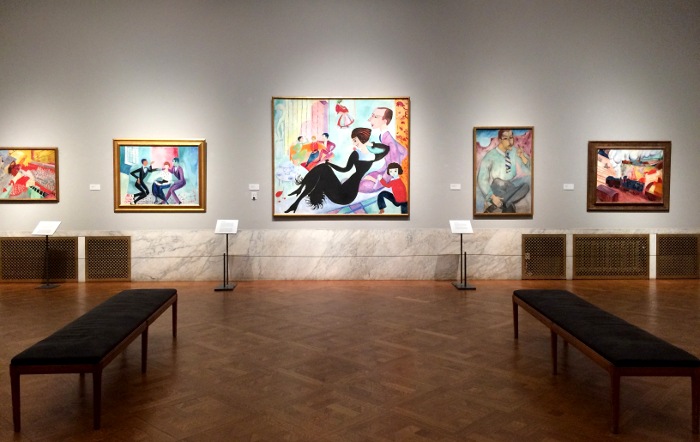
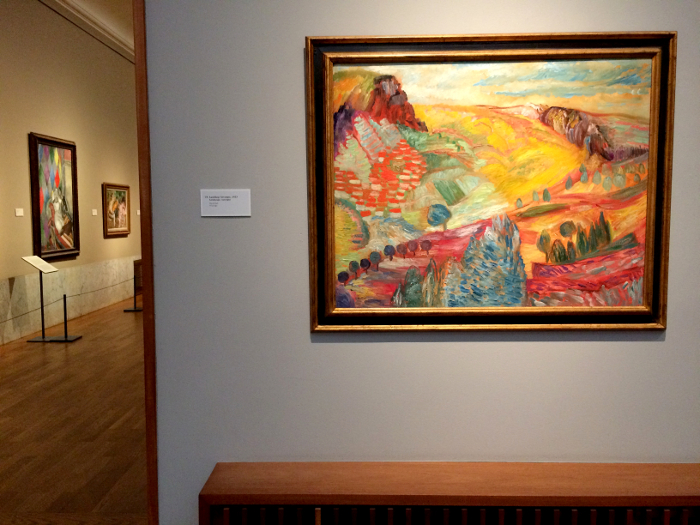
And just the other week, I went to an exhibition at a gallery in Stockholm, showing paintings by Sigrid Hjertén. The colors so vivid, constant, expressing emotions, shapes moving from clarity to abstraction throughout her life, ending up in something almost completely disintegrated before she died of a failed lobotomy. And the heart-breaking isolation – or is it just that I see it, because of what I know about her life?
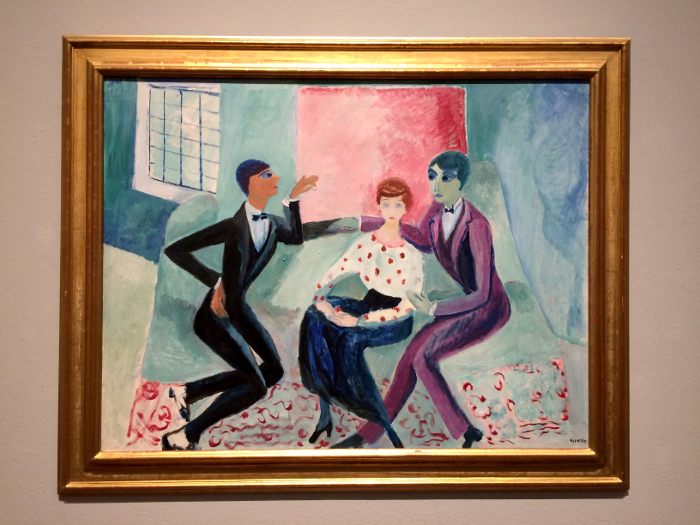
Because what these three women had in common, in addition to being part of the absolute avant-garde of the Swedish art scene of their time, is that they spent considerable amounts of their time in different mental institutions. Voluntarily, or admitted by their families. But what Johannisson argues, by having studied their medical journals, is that they were not only victims of a patriarchal society that considered them improper, misfits. To a certain extent, there is an agency in their illnesses. They are unstable and self-destructive, yes, but also at times very deliberate in their acting out of the disease. At the institutions, they are allowed to behave as eccentrically and erratically as they please – because they are not women, they are crazy. Normal societal expectations do not apply.
In this way, there seems to be a sort of dialogue between the female artist and the societal expectations on the woman. The creative personality of the artist is considered abnormal in a woman, forcing her into psychiatric diagnoses – but in that process, the female artist can use the temporary boundlessness that the diagnosis allows her to act out her creativity. Safe within the uniform of the insane. All three of the chronicled women create some of their most inspiring art either while hospitalized, or during periods between being admitted.
This is not to belittle the very serious issue of mental illness. Johannisson never claims that either of the three artists were actually not struggling. Like many people with creative dispositions, they were probably very sensitive, prone to depression, manic episodes, paranoia. But the fact that they were not allowed to deal with this through creating art as freely as their fellow male artists probably exacerbated their issues. And the varying degrees of freedom from judgement that they felt at the mental institutions must have felt like a relief, mixed up with the anguish and darkness they were already struggling with. Their medical journals suggest that they at times acted out the role of whatever diagnosis had been assigned to them, because it granted them more freedom than being a woman in the world.
That trip to Mexico was tumultuous in many ways. That can be part of the reason why Johannisson’s book made such a strong impression on me. The right book at the right time. Things have changed since the early twentieth century. Women are not admitted to mental institutions for hysteria. In many ways, gender roles have become much more flexible and porous. But in other ways, also not. For both women and men, societal expectations are creating a lot of unease and distress. It still requires courage, confidence and a touch of recklessness to act outside the norm, and people’s reactions to your norm-breaking behaviour still varies depending on who you are.
But reading this book encouraged me. Made me feel like it is okay that people sometimes call me weird and crazy. It became like a protective blanket there in Oaxaca, at the conference full of intelligent, interesting people, the vulnerability I always feel when trying to make a connection. The erratic behaviour of my inspiration. It made me realise I need to forgive myself my unease. And that sometimes, maybe leaning into it instead of hiding it will make me feel more at home in my own body. Make me freer.
I still carry that feeling with me. Like a talisman. And I am going to put up a Hjertén reproduction on my wall. To remind me, for whenever I am feeling lost.
 Katja Malmborg