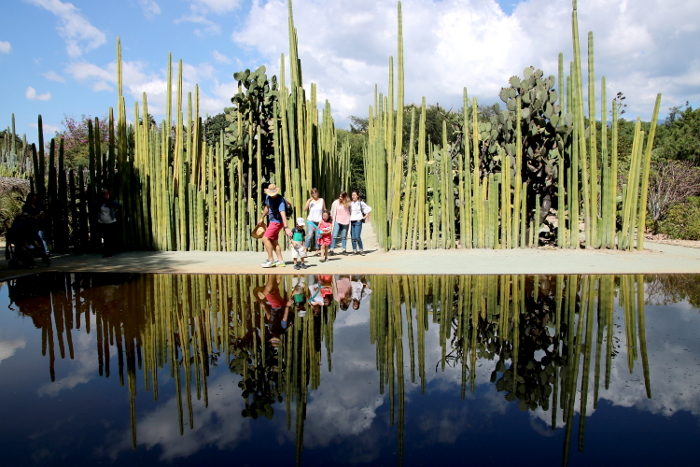
I was so excited about the ethnobotanical garden in Oaxaca. It is one of the top sites in the city and it’s an ETHNObotanic garden. Ethnobotany has become one of my academic side interests ever since my visit to Burkina Faso, so I was seriously pumped about this place. And then I arrived, and realised the only way to visit it is to take a guided tour. In Spanish, because there’s only three English tours a week, and with my conference and fieldtrip schedule, I would not be able to make it to either of those times. No planlessly wandering around, no solitary exploring. Such a disappointment. Well. I went for the Spanish one-hour tour, and by the end of it my disappointment had waned somewhat.

The ethnobotanical garden lies in the former monastery gardens, the beds separated by a grid of narrow gravel paths and surrounded by the high monastery stone walls. It was originally part of the 17th century monastery grounds, and it wasn’t opened as an ethnobotanic garden until 1998. They used to allow visitors to wander around freely in the garden, but had so many plants stolen that they had to restrict the visits to guided tours (or so I understood the guide – my Spanish is far from fluent).


And to be fair, there is definitely a point to having a guide explain things in the garden. There were no signs, but the guide was incredibly knowledgeable and explained all about the wild and the cultivated, the native and the species that were brought here by the Europeans. The state of Oaxaca, according to the guide, is an incredibly biodiverse place and is home to more plant species than grows wild in all of Europe. And the different peoples of Oaxaca have been using the plants for everything from food and medicines to fiber production and dyes for centuries, way before the Spanish arrived with their monks to catalogue it all.


The garden is organized into the different vegetation zones that exist in Oaxaca, from the high-altitude drylands to the lowland lush forests, and it is just as much a place for research as a plant museum. For example, they’ve just finished a climate-controlled greenhouse where plant experiments will be conducted, testing how different species will react to changing climates.


I was most intrigued by the cacti. The life force in these inhospitable plants, and the beauty in the patterns on their skins. It amazes me. This is pure survival. And I must admit, the cacti and pond installation in the end of the tour was really a masterpiece of organic symmetry and reflection.


The garden was small, but dense, and with the guide there was much to learn. It is definitely worth visiting. I would have liked it better, though, if I’d been allowed to wander around on my own after the tour, to marvel at the cacti in a little bit more intimate and slow detail.

 Katja Malmborg