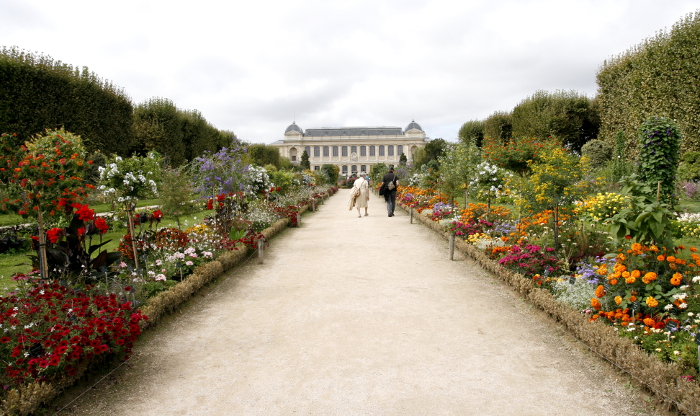
The main plan for my day in Paris was to visit the botanic garden, Jardin des plantes de Paris. It was established in 1635, in France only surpassed in age by the botanic garden in Montpellier (which is a lovely garden, by the way). It also figures in the beautiful but sad novel “All the light we cannot see” by Anthony Doerr. Granted, in the book it is mainly the natural history museum that is described in such a colorful, romantic fashion – but the adjoining botanic garden also gets sprinkles of attention. And it is the main botanic garden in France. Needless to say, my expectations were high.
I think this garden follows the French style, more so than the Montpellier garden does – although, admittedly, I barely know what I’m talking about. What I mean with the French style is pictures I’ve seen from French castle gardens, especially the ones at Versailles. The open spaces, meticulously cut bushes and trees, flowerbeds, geometric patterns created by the paths. More elegant than lush. And flowers, so many flowers, with bees and butterflies in abundance.


The greenhouses were rather small, with the first one containing an impressive jungle – but otherwise, not very systematic or educational. In that sense, more pretty to look at than useful for learning names and expanding horizons.


It was a well-frequented garden, with people taking walks and running along the paths. What it lacked were the snug benches to sit and read in, the nooks and hidden corners that were so easy to find in Montpellier or Glasgow. I was also surprised by the presence of guards (I guess due to the general terror threat in Paris?) and that part of the garden was a zoo just made me outright uncomfortable.


So yes, the botanic garden in Paris is pretty, and meticulously cared for, but it is not the lush oasis in the middle of the city like the gardens in Montpellier, Glasgow or Copenhagen. I prefer the gardens with hidden spaces to disappear in.
 Katja Malmborg