Our second excursion during the summer school first took us to a lavender farm. This is a completely different kind of agricultural endeavour than the shepherding. While the shepherd got a majority of his incomes from European Union support funds, the lavender farmer ran completely on what her crop could give her. Since lavender comes from this part of the world, growing it like this in the mountains requires very little fertilizer or pesticides – and since she uses her own seeds, the lavender bushes are very resilient. That’s what happens when natural seeds are used – the genetic diversity will give the next generation of lavender bushes varying degrees of coping capacities to different stresses and threats. This means that whatever happens, be it drought or rain or a pest, there will most likely always be some bushes that survive. The yields might not be as high as when using store-bought, genetically identical seeds, but this practice is also much less vulnerable to unexpected events. That’s what evolution is all about. Lavender is also a perennial, meaning that once the bush is planted, it will grow for several seasons and the mountain slopes will not be left bare, protecting the soil against erosion.


We did not get to see any lavender fields, but the lavender farmer showed us her refinery and we got to buy her products in the adjoining store. In general, though, she said that she exported her products and that there is very little of a local market. She also had trouble finding farmhands – there simply weren’t enough skilled people around in the nearby villages. Transportation was hard, and many young people chose to move away. She gave us a lot to think about for our group project.
The rest of the excursion, we spent in the Mercantour National Park. Or, strictly speaking, we had been in the park our whole time in Peyresq. Mercantour is structured around an inner, fully protected core, and then a periphery where individual communes can choose to be part of the park. The periphery areas, which Peyresq was part of, agree to a certain extent of protection, limiting certain activities in the landscape. In exchange, they get to be part of the park, which attracts visitors and other opportunities for the locals. Our excursion took us to the park’s core area.


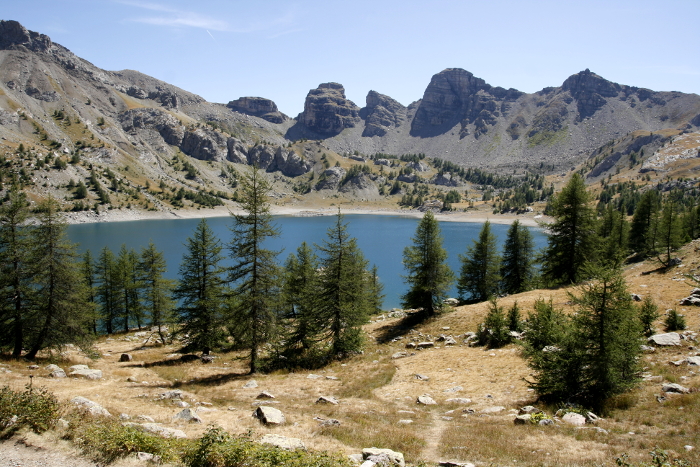
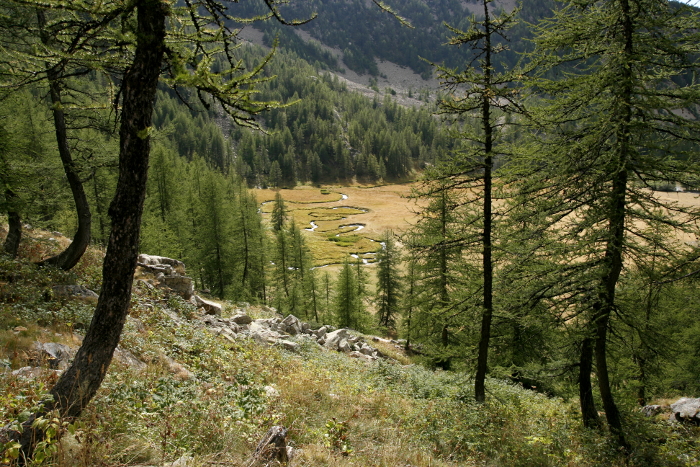
We had lunch next to a meandering stream. We hiked up to a lake, such a deep shade of turquoise, it almost hurt the eyes. We got to speak to a paleoecologist about the evolution of the landscape, plants and animals in the park, and the park manager about the current state of the park, its mission and collaboration with the surrounding communities.


A recurring topic were the grazing sheep. Even here, in the core area, the shepherds were allowed to bring their sheep for grazing. Shepherding is a historical practice in this area and considered an important part of the cultural heritage and landscape. Grazing keeps the mountaintops open, which has an aesthetic value, and promotes some species that are important for biodiversity. But there is a fine balance. Overgrazing is also an issue, and an increased input of nutrients from the sheep’s urine and feces affects both species composition and water quality. The sheep also affect other species negatively, making their impact on biodiversity not completely clear. The sheep have been around for a long time, though, and if anything, there has been a decrease of them over the last century. This is at least suggested from the recent increase in tree cover on the mountain slopes.
All in all, though, the park seemed to be doing fine. Previously threatened species had started to return, like the ibex, and the collaboration with the surrounding communities seemed to be going smoothly.


Down by the lake, butterflies were fluttering between thistles and sun-warmed rocks. It was a beautiful day in a beautiful park.
 Katja Malmborg