Now that I’ve changed projects from studying smallholder farmers in the Volta basin in West Africa to bundles of ecosystem services in the Helge å catchment, my fieldwork has become both less time-consuming and less exotic. It is both nice, and a bit sad. Burkina Faso is an incredible country to get to know – however, I’ve really been enjoying getting to know my own country better too.
I am one of those quite typical Stockholm city kids who has traveled more abroad than in Sweden. My first international trip was to Greece when I was three months old. Until May, I had never been to Malmö, the third largest town in Sweden. Until recently, I had probably seen more parts of Bolivia, the US and Burkina Faso than of Sweden. The last couple of years, though, I’ve made an effort to go places closer to home, visiting friends in different parts of the country. And during three weeks in May and June, I did a proper tour of towns, big and small, all over the south of Sweden. Mainly, to conduct interviews with stakeholders from municipalities, county boards, NGOs and companies, but I did make some time for sightseeing too. Here is a summary of my impressions.
KRISTIANSTAD


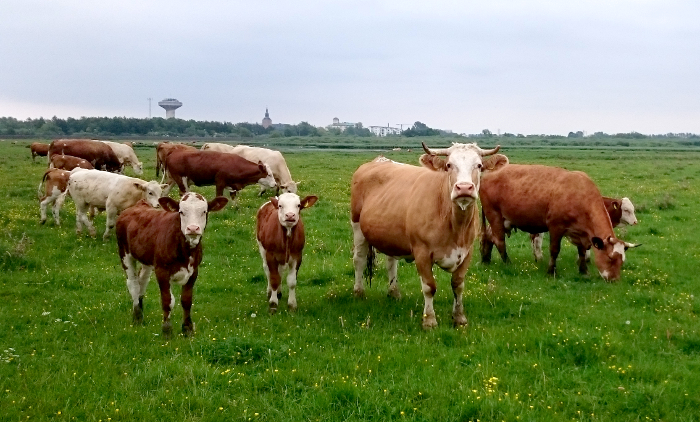
Most of my time was spent in and around Kristianstad. As a town, not particularly exciting – but the UNESCO biosphere reserve Kristianstad Vattenrike! Amazing! Within the resilience literature, the reserve is seriously overrepresented as an example of successful adaptive management, with several of the now senior researchers at Stockholm Resilience Centre having published papers on it. I’ll write more about that at some later time. Now, though, let me just say: I get it. I thoroughly enjoyed the artistically designed nature museum Naturum, standing on poles in the wetland, and the hiking trails. Took a selfie standing over the Helge å river (one could say the central figure of my coming four years). And I love the cows.
ÅHUS


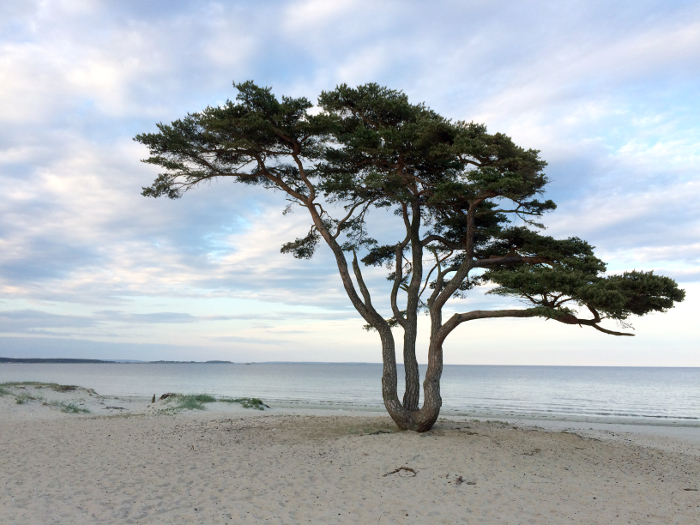
Downstream, where the Helge å meets the Hanö bay, lies Åhus. A cute little town, with a history spanning almost a thousand years. Beautiful, with the forests, eel fishing huts and sand in the Äspet nature reserve, the cobbled streets, and the willfully growing pine trees by the beach. This is also part of the Kristianstad Vattenrike. AND, this is where Absolut Vodka is distilled.
ÄLMHULT


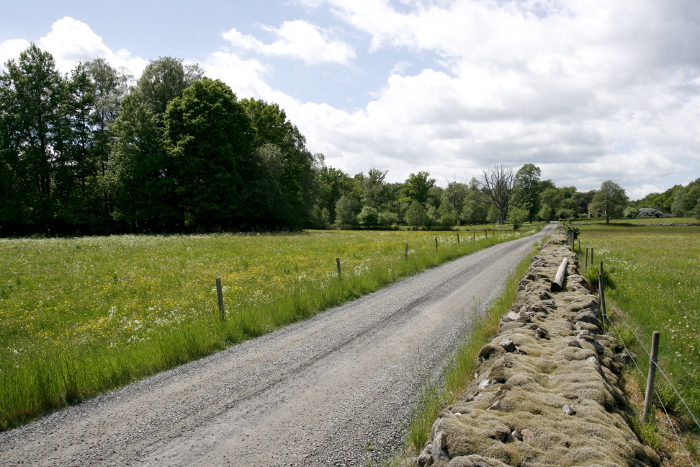
Upstream in the catchment lies Älmhult, deep in the Småland forests. I spent half a day there, conducting interviews at the municipality office – but I did also take some time to visit Älmhults claim to fame: IKEA. This is where the Swedish furniture giant got started. Here, Mr. P is posing in front of the first ever IKEA store, today a museum. Otherwise, Älmhult is small, and I didn’t have to drive far to find this idyllic rural landscape close to the farm Råshult, where Carl Linnaeus, the 18th century botanist, was born.
MALMÖ
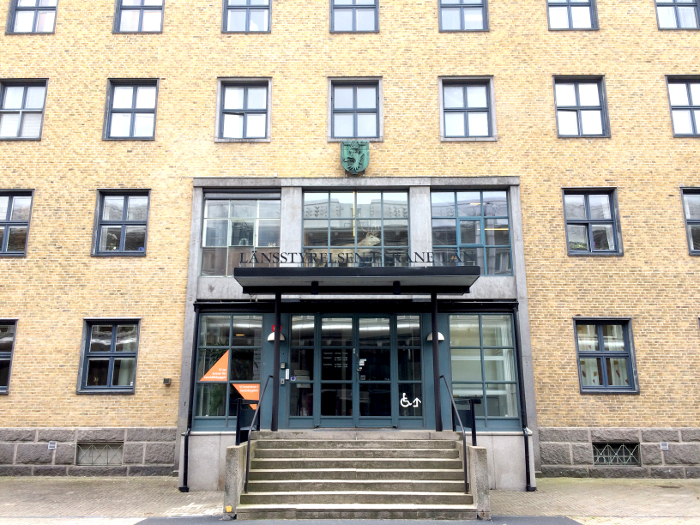
I ended up not seeing much of Malmö, which is a real shame. It’s not within the Helge å catchment, but I went there to conduct two interviews at the county board offices. With the busy schedule I had, I wasn’t able to stick around after. It was a pretty building, though. (And I’ll definitely make sure to have more time to explore the city next time I go.)
LUND


My main draw to Lund, the old university town of southern Sweden, was the botanic garden (which I’ll write about in a separate post – obviously), but I really liked what little I saw of the old town center too. Cute 18th and 19th century buildings and a huge cathedral. And right next to the train station, there’s an ICA named Malmborgs. A really good grocery store too, with a lot of organic and local produce. I just had to buy one of their Fairtrade canvas bags – it has my name on it, after all!
KARLSKRONA


Karlskrona, which lies completely outside of my study area but where I had an interview, is an old military town. Thanks to the largely intact 19th century military housing neighborhood and other well-preserved parts of the old city center, it has been assigned a UNESCO World Heritage Site. My great grandfather was stationed there during the Second World War and my grandmother spent a considerable part of her childhood there. It was really pretty, with beautiful buildings, both old and new. I can see how she, growing up in that environment, became so interested in architecture.


VÄXJÖ


Lastly, I did a brief visit to Växjö, just north of the Helge å catchment. It was pouring down the whole time I spent there, so I didn’t end up doing any extensive exploring – but from the little I saw, it felt like an ordinary mid-sized Swedish town, with an old city center, a main street, a large church and a body of water close by. I particularly liked the playground next to the church – everything had a botany theme! Beautiful, pastel colored! Probably to honor Carl Linnaeus, who did not grow up in Växjö – but close enough.
 Katja Malmborg