In mid-August, I was invited to talk about my research at the yearly Burkina Faso day at Öland’s college. The day was organized by the local UN association and the Sweden-Burkina Faso friendship association, and consisted of a series of presentations about Burkina Faso by different professionals: a social anthropology professor who studies local democracy reform, a doctor who has built a hospital, a law student who wrote her thesis on female genital mutilation from a human rights perspective, a documentary maker who was filming a movie about young female mechanics in Ouagadougou, a representative from the Burkinabe consulate in Copenhagen, and me.
It was strange, trying to put together a presentation for an audience I didn’t know anything about. I expected many of them to have a connection to Burkina Faso, meaning that they would probably know a lot about the country already. On the other hand, the sustainability science proficiency would probably be limited, meaning that the particulars of my research and the concepts I’ve used would be more or less new to them. This meant that the expected profile of this audience was the complete opposite of the one I’ve been used to present in front of for the last couple of years: highly educated environmental scientists with (often) limited knowledge of my specific case study area.
I really didn’t know how to approach this new challenge. On the one hand, I wanted to make the talk interesting and not have too much of that scientific mumbo jumbo. But I also didn’t want to oversimplify things and seem like I thought that the audience was stupid. There’s a fine balance between the two. I was working up some serious nerves.
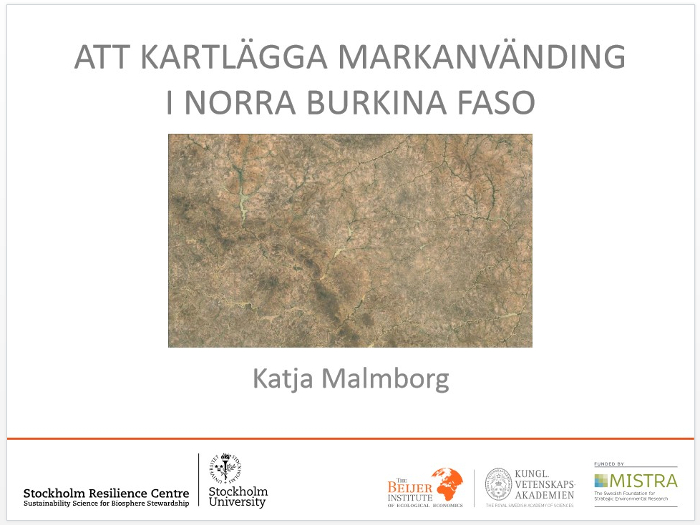
In the end, I chose to tell the story about the multifunctional landscape. How small-scale farmers in northern Burkina Faso actively manage their village landscapes to integrate several different uses in both fields and shrublands, forest patches and depressions. That focus isn’t only on maximizing the production of cultivated crops, but also on harvesting wild plants for food, medicine and spiritual uses, and managing vegetation so that there is enough of both fodder, fire wood and building material, while still protecting the sacred groves where ancestors reside. Many photographs, but very little about methodology and nothing about remote sensing or ecosystem services theory. I did include some maps, but mostly just to show what my actual research results looks like, I didn’t get into detail about what they actually meant. And all in Swedish! A lot harder than one might think.
I don’t know how well I did, in the end. I tend to forget presentations the moment they’re over. Nervousness playing games with my mind, I guess. Several people approached me afterwards, though, and told me that my talk had been interesting, so probably I didn’t embarrass myself. But I’ll really do have to practice all steps of popular science public speaking for the future, if I want my research to reach further than being stuck in rarely quoted scientific papers.
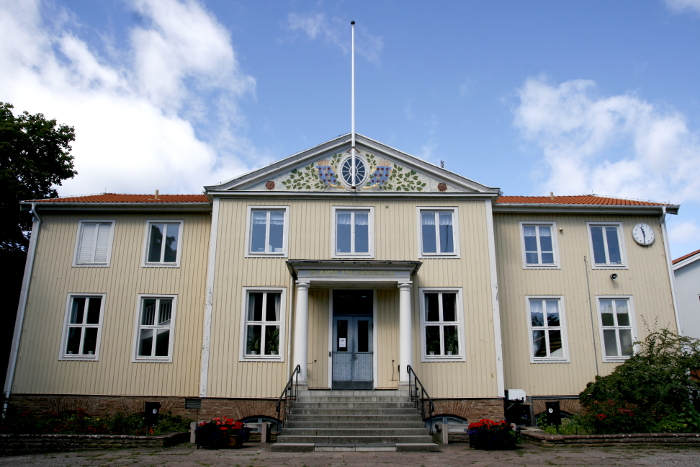
Öland’s collage (Ölands Folkhögskola)
 Katja Malmborg