The main reason for this visit to Burkina Faso and Ghana was not to plan the project with the different teams, but for one of the teams to hold a workshop in Zebilla, a village close to Bolgatanga in northern Ghana. The rest of us tagged along, out of curiosity about the workshop and to familiarize ourselves with the landscapes that we are going to study.
The workshop was centered on a board game (which incidentally was quite similar to Settlers of Catan). It was developed by the team from the French research institute CIRAD, and they had played it once before two years ago with the same communities as now. Basically, they had made a board showing the general land cover types around the participating communities on either side of the White Volta (which is the sub-basin where some of the project teams will be focusing their research). The participants were farmers from the communities, assembly members, extension agents and representatives from different district level or regional agencies.
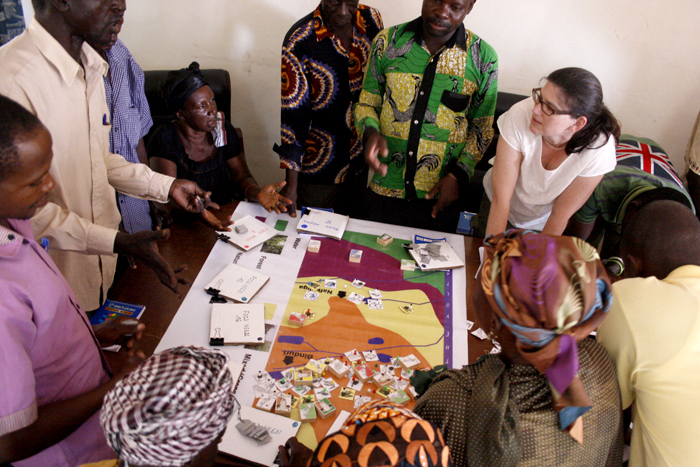
Each player got a set of pins and tokens, depending on the size of their families (for farmers) or their political, social or economic capital (for the other participants). During the rounds, these could be used to buy seed, animals (for farmers) or an intervention (for the other participants). They were then placed somewhere on the board in accordance with where they would do these activities in real life. After every round, the game facilitator (in the picture above, Kate) gave new tokens to the farmer participants based on where they had placed their activities. The number of tokens were then compared with the size of each family, to see if it was enough to feed them.

The marker used to symbolize different activities in the village landscape.
Board games are generally fun in themselves, but the main reason for this specific one was to create a base around which the participants could start talking. Partly, so that the game facilitators (us researchers) could find out how the farmers were thinking about their farming practices (almost like having unstructured focus group interviews with the game as a discussion starter), their reasoning behind the decisions that they make and how they relate to other involved actors, but also as a way to get farmers and decision makers to talk to each other. It became clear that it is not always the case that the extension workers and politicians actually talk that much with the farmers, which leads to their interventions sometimes being misunderstood or just not successful.
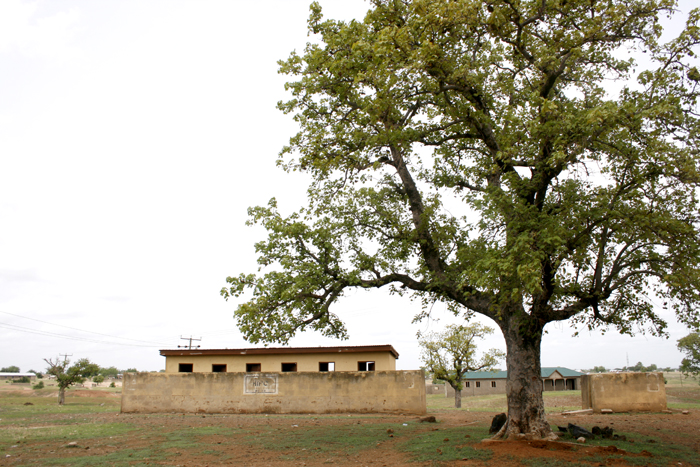
It was a pretty messy affair, and since I had been given the task to photograph the activities, I think the confusion on my part became even bigger from going from table to table, taking photos, and never really sitting down to figure out what was really going on. But by the end of the second day, things kind of clicked for me too. The participants seemed to be content with their experience. It seemed like everyone had learned new things about farming practices or the problem with erosion and siltation of the dams or contamination of water supplies from pesticides and fertilizers. It wasn’t only the external researchers, among them me, who had been given a chance to learn something new.
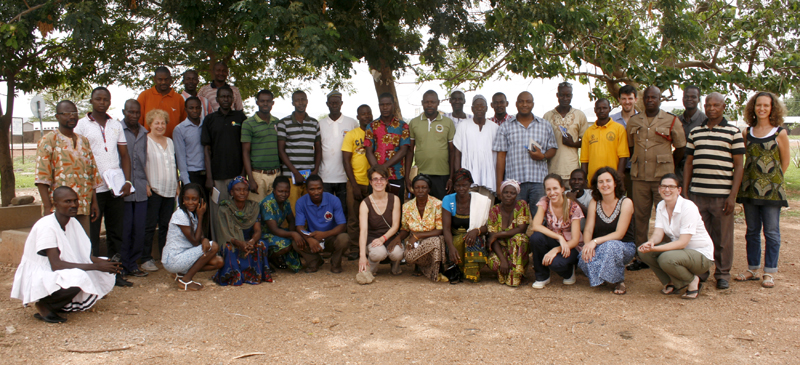
All workshop participants, including the research teams.
It was an interesting way to do research, this board game workshop setting. It is a lot bigger project to make happen, with all the getting hold of the right participants and the logistics, than what I’ve ever experienced before. It required social skills from the game facilitator that I don’t know if I would even be able to develop, and the planning, the rules and the framing of the questions that were to be asked, everything that had to be considered, just made my head spin. I don’t know if what the researchers eventually got out from the workshop was more valuable or informative than what they would have gotten from more downscaled focus group interviews, for example, with farmers in their own communities. However, the opportunity for communication between the farmers and other involved actors that this game facilitated gave an additional dimension to the method, something which would never have happened through the kind of research that I’ve done before.
My tasks in this project do not involve using these kinds of games, I’m focusing more on larger-scale statistics, so I will not be doing any more of them for now. However, it was really fascinating to witness, and a really good experience for possible future projects where this kind of participatory method could be useful.
 Katja Malmborg