The Asante culture is known for its long tradition of craftsmanship. In the past, many of the finer crafts were meant for the Asantehene and his family, and the making of the different crafts was centered in certain villages outside of Kumasi. Nowadays, the fabrics and pots are made for anyone who can pay for them, but the actual crafting is still done in special villages. It has become a popular tourist attraction, to go on a craft village tour in the Kumasi area and see how the things are actually being made and buy them for higher prices than the market value.
The son of the owners of our B&B offered to act as driver for us, so we did as everyone else and went on the craft village tour. Our first stop: Ahwiaa, the wood carving village.
We saw them making stools and painting a whole set of hugging figures, but we didn’t buy anything. The wooden animals can be found all over Sub-Saharan Africa, and I must admit I’ve seen prettier mahogany elephants from both Tanzania and Zimbabwe.
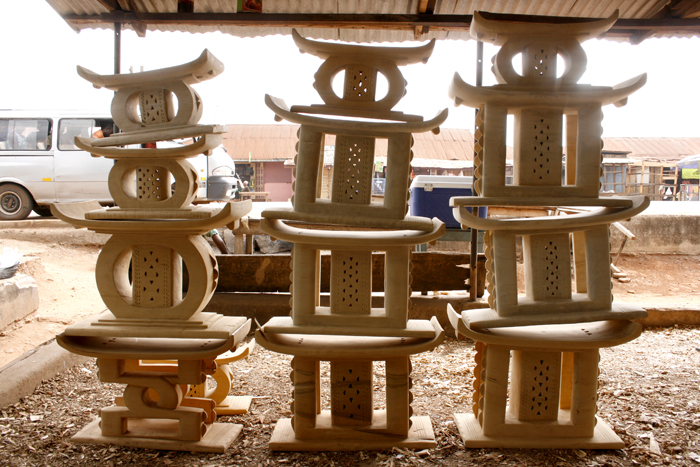
Traditional Asante stools, the feet symbolizing unity, leadership and strength.
Our guide, the B&B man, told us in his subtle Canadian accent that they even exported wood carvings from here, all the way down to South Africa. It wasn’t dominant, his accent, but then again it rarely is, the Canadian. From what I picked up of his stories, he had spent a big part of his life in Montreal and Toronto, so that’s where the accent came from. And I really enjoyed listening to him talk. Not really because of what he said, but because of how he said it. It made me feel safe and comfortable. I guess it’s all the nice associations. Ashley, of course, and Lorri at Whiskey Creek Farm. Jay the horse trainer. All of Frida’s nice friends in Edmonton. Canadians just have an unfair advantage when it comes to me.
 Katja Malmborg