Novi Beograd, or New Belgrade, is a part of the city that was built during the late 1940s. The Tito era, when Belgrade was the capital of economically booming Jugoslavia. It is an example of a modernist city that actually succeded with its ideas (as opposed to many modernist neighborhoods in western European and North American cities), according to Milena, an architect that I met in Belgrade through the e-mail introduction by my awesome Seattle Couchsurfing host Miles. I didn’t spend enough time in Novi Beograd myself to confidently have an opinion about it, but I do know that the modernist neighborhoods in Stockholm generally are the poorest, most marginalized and with the biggest structural problems.
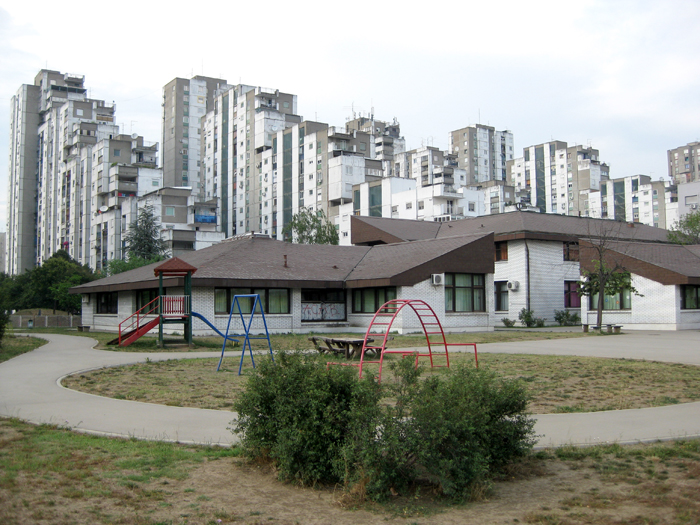
Be as it may with the socio-economic situation in Novi Beograd, the extreme urban landscape with enormous concrete buildings on rows upon rows, seemingly neverending, held a strange fascination on both me and Hanna. For Kirke too, in a purely aesthetic sense – but Hanna has a degree in urban planning and I’m a geographer. This was an example of what we’ve spent years of our lives studying at university: how people live. Here, it’s the concrete jungle
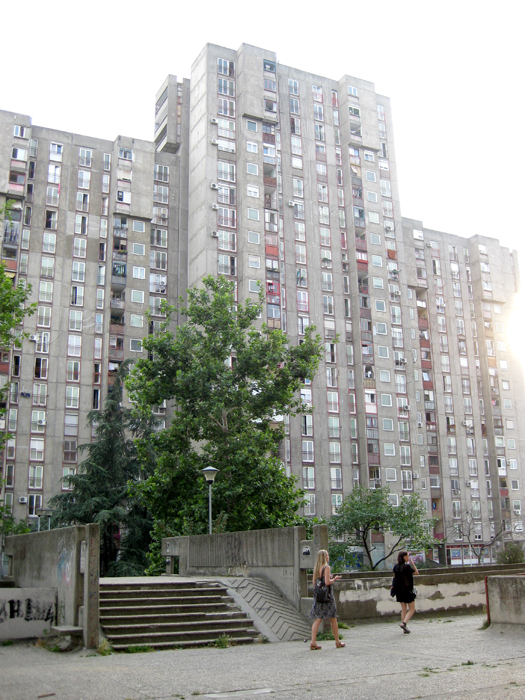
The house next to Ana’s – they all looked the same. So much grey. But I can’t say I think they’re ugly. There is a certain kind of harsh symmetry to them that I can’t help appreciating. They are not just big concrete boxes, built as fast and as cheap as possible. Someone has planned them, created these lines and the tiny colorful details. Yeah, there’s just something about them.

And then, in the middle of everything, someone has built this lovely little garden/fountain installation. Lovely, and such an odd thing to see, next to all these huge, tough, hard grey buildings.
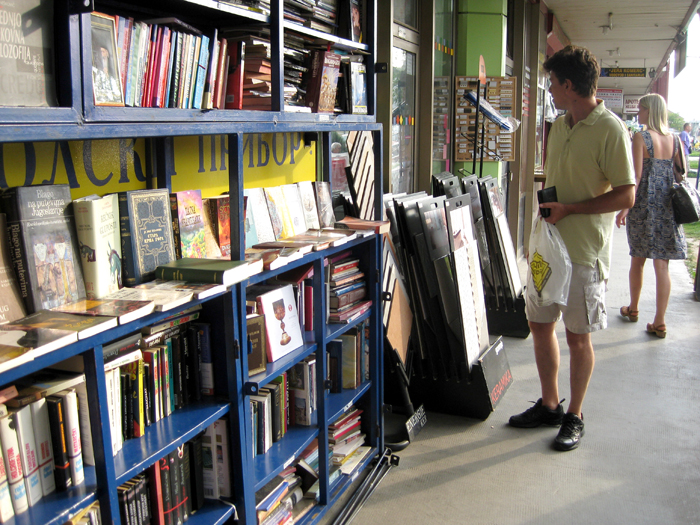
There was a mall, too, a small one. They sold used books. I would have loved to browse through them, but they were all filled with cryllic letters. Somehow, that feels even more inaccessible than if the books were written in Croatian – both languages (linguistically actually the same) are completely alien to me, but Croatian at least uses the Latin alphabet. With Serbian, I can’t even spell out the words.
 Katja Malmborg