After the tunnel tour, I still didn’t feel quite done with the day, so I decided to take a walk.

There are many bridges crossing the Miljacka River, one of which is this new construction in front of the Art School (I think).
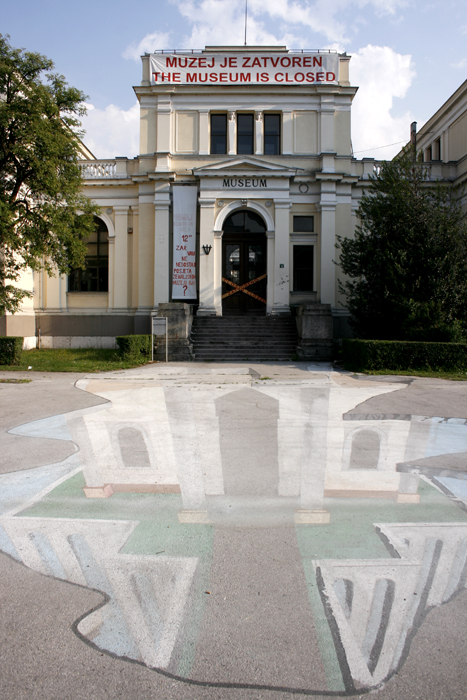
There aren’t really any museums to speak of in Sarajevo – most of them are closed. This is the Bosnian National Museum, supposed to have many interesting artefacts to show. But, due to lack of funding, it can’t keep open.
After the conglomeration of closed or only partially opened museums, the residential areas took over. Our guide during the tunnel tour explained that Sarajevo can be divided into three different circles: the inner circle, consisting of the old town center from the Ottoman period, the downtown circle surrounding the old town, consisting of 18th and 19th century buildings from the Habsburg era, and then all the rest, built during the glory days if President Tito. This last circle the guide called the communist city, and it mainly consists of huge concrete slabs, high and wide and standing in rows. I find them fascinating.
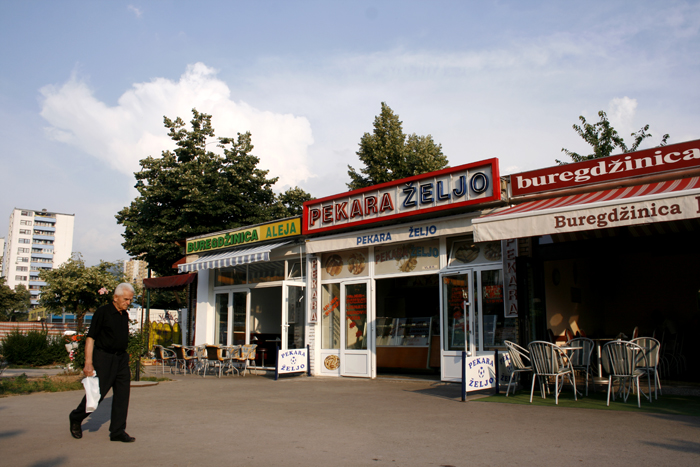
There, across the river, I found a small bakery. I bought a pastry filled with cherries for about the equivalent of 40 cents (€) and sat down on a bench by the river, watching people walk by in the afternoon sun.
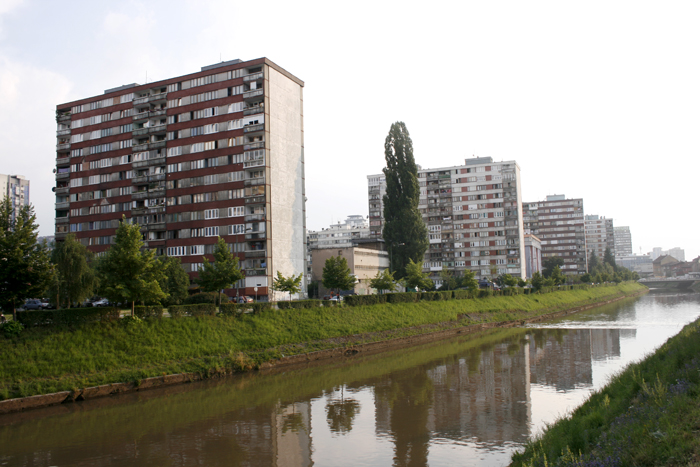
It was a delicious pastry, sweet and flaky, and people seemed to be enjoying themselves, couples walking by hand in hand, children on bikes, old men sitting on the benches next to mine. The laid back feeling that I had gotten in downtown Sarajevo earlier that day followed me out into the suburbs. It was a sunny summer afternoon and people seemed very content with life.
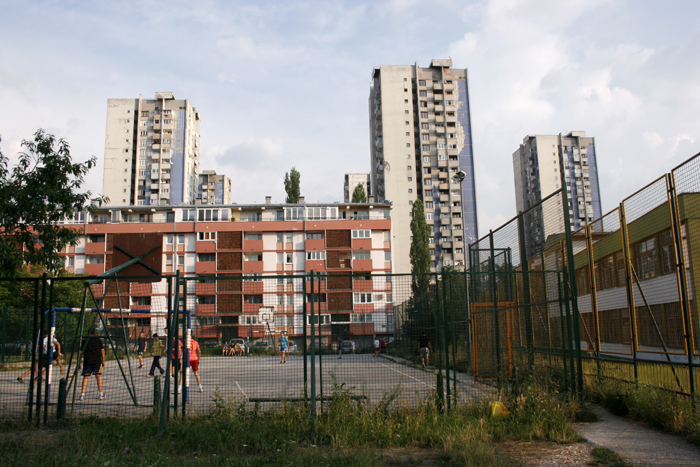
Boys were playing basketball on a field behind one of the big buildings, and right next to them, a couple of others were spraypainting things on a wall.

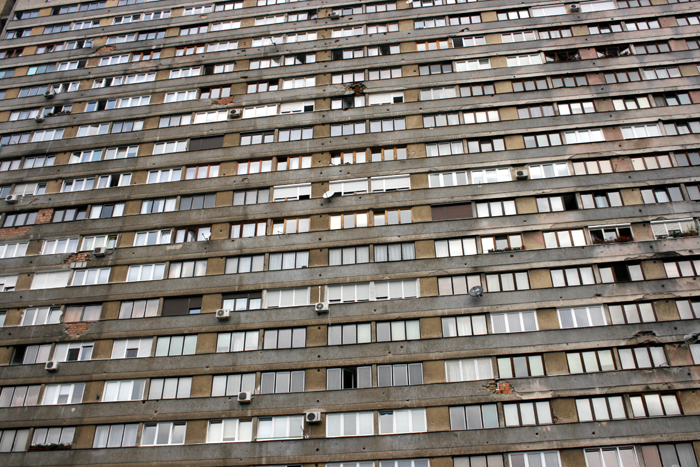
There was an odd mixture of houses in this part of town, the enormous concrete apartment houses with bullet holes in them, next to completely new, shiny examples of modern architecture. Some signs on the new buildings made me think that the money came from investors rich from Middle Eastern oil, but I don’t know. Nonetheless, it was intriguing and I would have loved to be invited into one of those concrete monsters. To see them from the inside. Maybe when I come back, in a year or several, Couchsurfing will have become bigger in Bosnia and I’ll find a suitable host to stay with in Sarajevo.

And while I was walking there, I listened to podcasts from the Swedish radio. Suddenly, my dad’s storyteller voice came on – I was listening to the Vetenskapsradion (Science radio) programs my dad did about Japanese humanoid robots. His voice, soft and quite different from many other radio journalists’s on Vetenskapsradion – perfect for reading Astrid Lindgren and Narnia outloud at bedtime when I was little. It felt kind of odd, walking around in this strange environment, taking photos of buildings with bullet holes in them, while my dad told me about humanoid robots through my earphones. How past and present, memories and futures constantly connect. Right there, the connection became so obvious and planin.
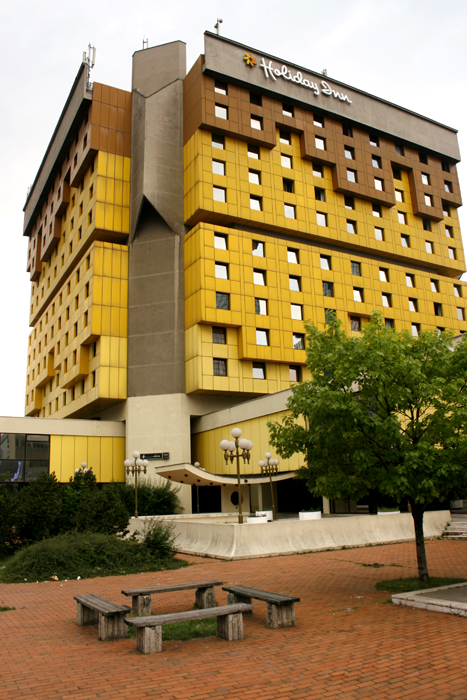
The Holiday Inn, the hotel where most of the reporters stayed during the war. It might look weird like this, in a single photo, but when in the context of its surrounding houses, it didn’t stick out much at all. For some reason, the outskirts of Sarajevo is a place where weird architecture thrives.

On my way back, I found this strange park, where young Sarajevans with black dyed hair sat on the mechanic sculptures. Thunder had been slowly building up its strength during my walk back into town, with heavy mountains gathering around the mountain tops, and here the first drops of rain started falling on my forehead. Luckily, it started slowly. I made it back to my hostel before the really heavy stuff started pouring down, aggressively, to the roar of thunder. Weather can change quickly, in the Dinaric Alps.
 Katja Malmborg