Between 1992 and 1995, Sarajevo was under seige by the Serbian army. The traces of the seige are still visible everywhere in the city: bullet holes in some of the house facades, abandoned buildings, memorials surrounded by flowers and lighted candles. And many of the most popular tourist attractions relate to the Balkan war in some way.
During the seige, the only contact to the outside world that the Sarajevans had was an 800 meters long tunnel that ran under the airport. Through that tunnel, the Sarajevans were supplied with food and arms throughout the three year seige. Most of the tunnel has collapsed since then, but about 20 meters are still there and around the entrances, a small museum has been opened, displaying photos, soldier clothes, samples of UN relief packages and a film. The hostel where I was staying arranged guided tours to the tunnel museum, so I went on one.
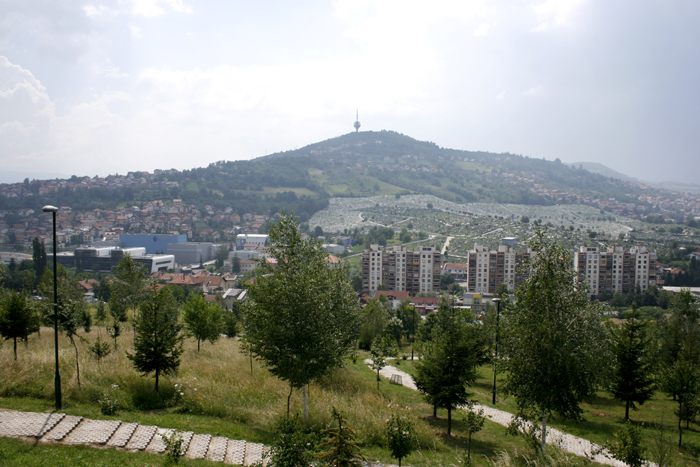
The guide started by taking us to this vista point, where the enormous Muslim cemetary with its white stones was visible on the opposite hill. 10 500 Sarajevans were killed during the seige, so there are wartime cemetaries all over the hillsides of Sarajevo.
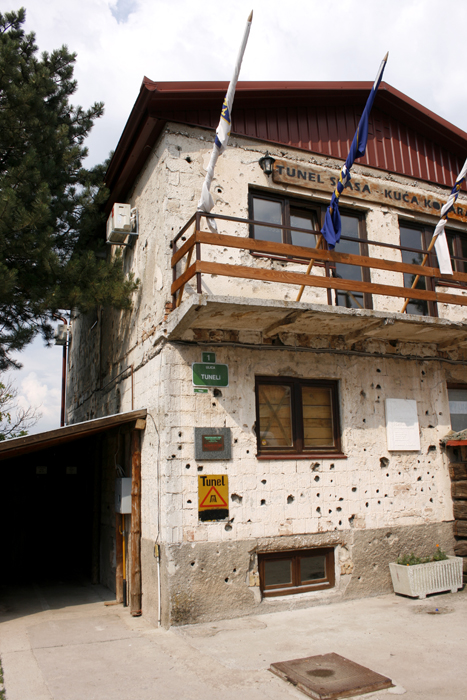
The entrance to the airport tunnel was through this building. The Serbs knew it was there, and going in and out of the tunnel was always extremely risky, from both sides. The building now housed the Tunnel Museum, where one of the things being shown was a film. A very strange kind of film, only consisting of footage from the seige. People transporting things through the tunnel, buildings being bombed, people running to take cover in the streets. The aesthetic was kind of similar to that of a Youtube film, showing several home video clips of people doing funny things. Except this time, the film didn’t show people for example being woken up by a foghorn and falling out of bed, but different buildings being bombed and falling apart. I found it very surreal and unsettling, not because what it showed per se, but how it had been made. Like an orgie in war footage, pornography for some morbid war enthusiast.
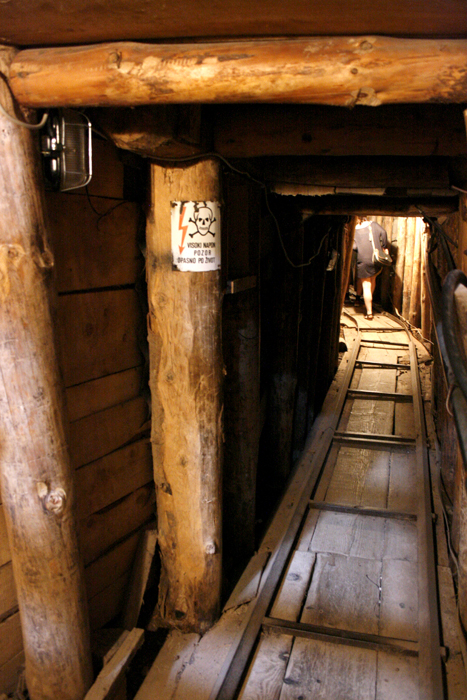
The tunnel itself wasn’t big. But it wasn’t the most narrow tunnel I’ve been in either. The war tunnels in Vietnam were pretty tight, and the tunnels in the Potosí mine in Bolivia were dark, wet and claustrophobic. Not that I’m prone to claustrophobia. I like tight spaces. I just want to brag about all the places that I’ve been to, I guess.
It is weird, with Sarajevo and the seige. It is there, ever present, in the house facades and in what people talk about. I guess the ethnic cleansing might be one reason, to suddenly wake up in a world where your neighbor suddenly wants to kill you just because you happen to have a Muslim surname instead of a Christian Orthodox one. And the fact that the Dayton Agreement has made
wartime divisions between the religious groups further complicate decision making, instead of letting the country move on. As I was told, Bosnia used to be a place where people mixed freely with each other, Bosniaks (Muslims), Serbs (Christian Orthodox) and Croats (Catholics), intermarried and were Bosnians, rather than identifying with the religion that they belong to. But then the war came, people were killed and when the peace agreement was brokered, the UN wanted to make sure that all three groups got equal say in the ruling of the country. So Bosnia got three presidents – three presidents that all have to agree before a decision is made. Which is almost impossible, according to the people I talked with, which in turn leads to nothing happening in the country. Everything just stands there, still, in indecision, putting Bosniak against Serb against Croat.
The war is always there, in a very tangible way. And I compare this to Liberia, where the civil war ended ten years later than the war in Bosnia – a civil war that also lasted for much longer. But still, the war is not as present in Libera as it is in Sarajevo. Of course, there were all the abandoned buildings and young men, former child soldiers, hanging out in groups in outdoor bars by their motorcycles, giving off an air of hostility. But the reminders weren’t everywhere to be seen, and I got the feeling that people in general felt that it wasn’t really relevant anymore. A very important and terrible part of their history, yes, but now they want to move on.
In Sarajevo, the war lingers. And I don’t really know why.
 Katja Malmborg