I don’t remember why, maybe we were studying the Second World War, but when I was 14 or 15 we saw a movie called “Good night, Mr. Wallenberg” in school. It was about Raoul Wallenberg, played by Stellan Skarskård, and took place in Budapest during WWII. The real Wallenberg was the Swedish special envoy in Budapest in 1944 and rescued tens of thousands of lives by issuing protective passports and sheltering Jews in buildings that were designated as Swedish territory. In 1945, he was detained by Soviet authorities and was never seen again, believed to have died in a Russian prison in 1947.
All of that was shown in the movie. It is a really gripping fate. But what I remember most of the movie was what happened right in the beginning. Wallenberg is in the closed off ghetto with his leather briefcase, discretely trying to hand out protective passports, when a truck with a tank filled with milk is let in through the heavily guarded ghetto gate. People gather, starved and hollow eyed, and for some reason the soldiers shoot holes into the tank. Milk starts pouring out. Children run to the truck and start drinking the milk, pushing each other to get to the precious drops. And then the soldiers start shooting again. The tank gets hit, more milk starts pouring out, the children spread out, and then they start falling. One by one, they get hit by the bullets, until the only thing left by the milk truck is a pile of malnourished bodies. And the milk keeps on pouring out, hitting the dead children, mixing with the blood flowing on the cobble stones.
I couldn’t really take anything in after that. Of the movie, I mean. It is probably one of the most disturbing movie experiences I’ve ever had. The milk hitting those bodies. God, it makes me cry even now, just thinking about it.
Anyway. That is probably the first time I learned something about Budapest history. And he is still remembered there.
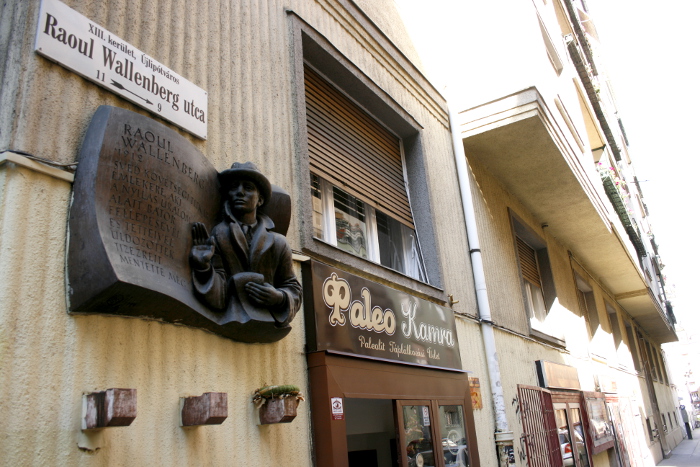
Now that I was in Budapest, it felt like a very nice thing, seeing his name in places. His bust at the Great Synagogue. Or here, a plaque at the head of the street named after him. And that there still was someone who had left a wreath for him there. The world needs good people. He was one of them.
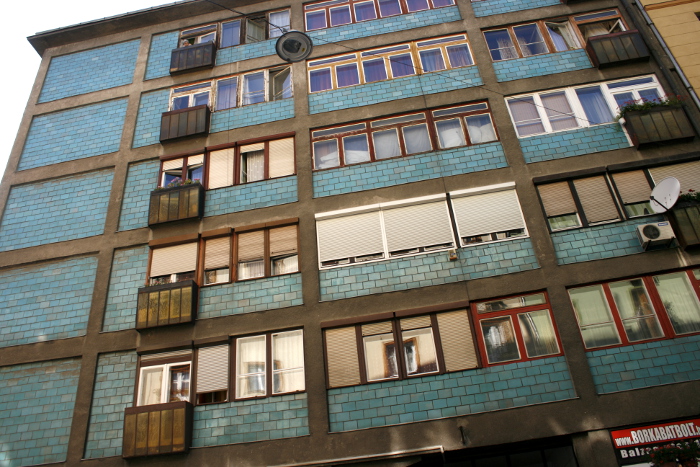
Pretty house, isn’t it? And exactly the same colors as that beautiful wall at the Ducor Hotel in Monrovia. I like it!

I thought this was hilarious when I saw it. Probably just proves that a day of walking in sunshine and 35 degree heat can make you just a teensy bit soft in the head. (Bajsa means ‘to poop’ in Swedish. When I was 14, all the girly girls would exchange all their s’s with z’s and mix lOwEr AnD uPpEr CaSe LeTtErZ on their internet community profiles. Utca just means street in Hungarian. Poop street. Girly 14-year-old giggles.)
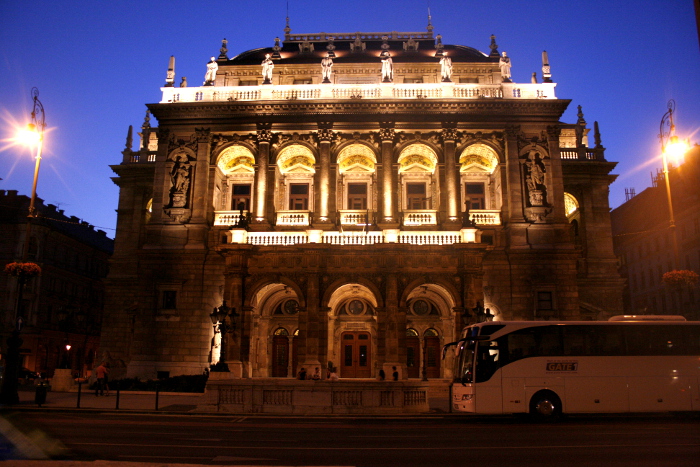
I think this might be the opera. Or the ballet. I’m not sure. I was too tired after all the eating and walking and bathing to look it up. So, look! Another pretty Budapest house!
 Katja Malmborg