When talking to dad about my trip, he said that while I was in Vienna, I should go and see the Hundertwasserhaus. When I told Max that my next stop after Münich would be Vienna, he also said that Hundertwasserhaus was worth a visit. When two persons with such good taste tell me to go somewhere, well, I would be stupid not to.
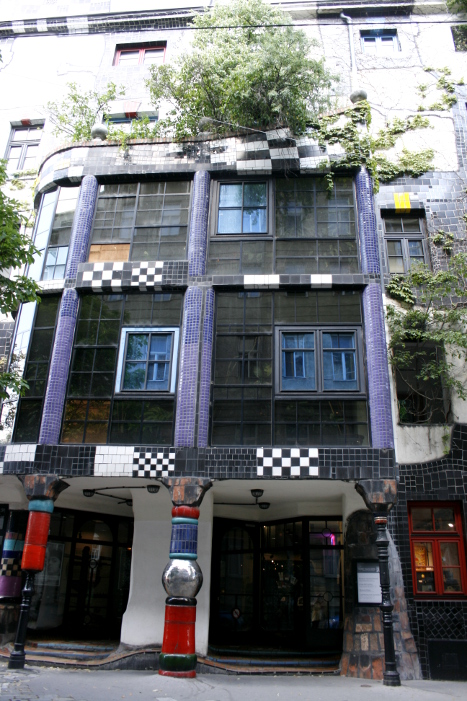
First, I went to the Kunsthaus Wien, the artist and architect Hundertwasser’s museum. There, the floor was uneven (because, according to a plaque, Hundertwasser had said that straight lines and flat surfaces are human creations and bores the brain – in nature, everything is changeable and uneven, and this keeps us awake and inspires us).
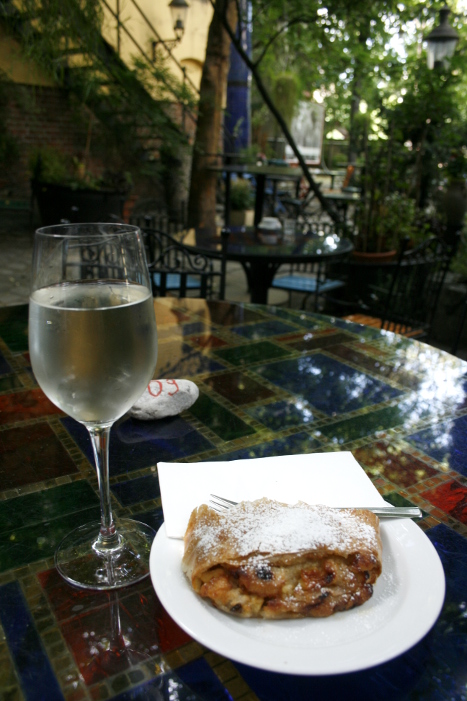
I didn’t feel like going to another art exhibition after Belvedere, so instead I went to the Kunsthaus café, where every table looked different and the trees offered a wonderful coolness. I ordered an apfelstrudel and a spritzer, because the guide book had said that those were typical Viennese things to order in a café. And they were good, I guess. Even though I don’t really see the point with mixing white wine with sparkling water, when you could drink them separately and get so much more taste out of it.
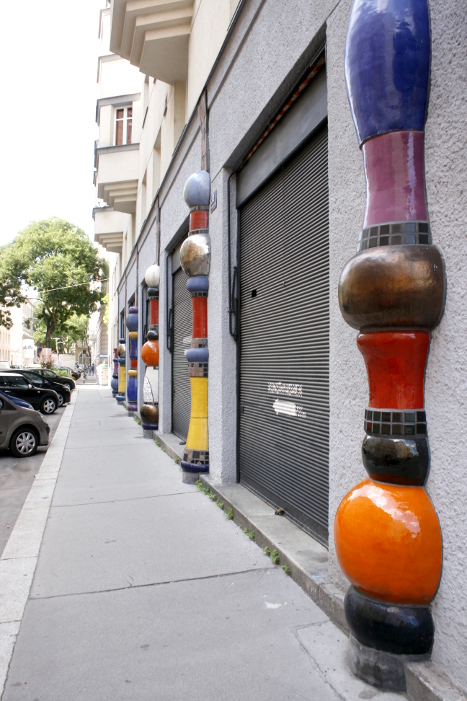
On the way from the Kunsthaus to Hundertwasserhaus, some of the other buildings were also colorfully decorated.
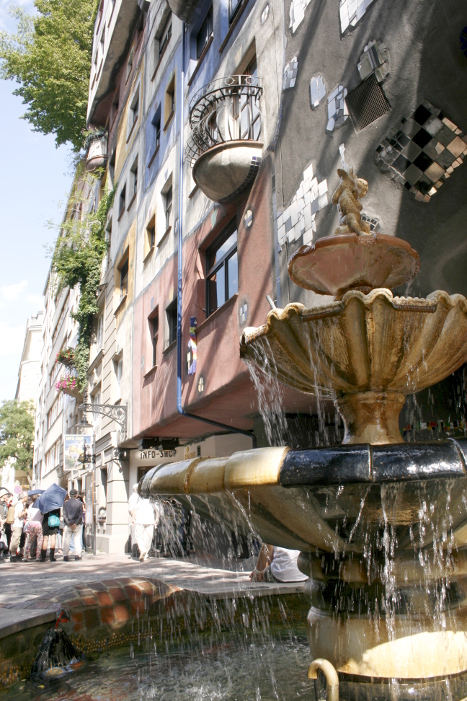
At the Hundertwasserhaus, a municipal apartment building created by the architect Pelikan based on the ideas of Hundertwasser, I was met by a crowd of tourists again. Apparently, tourists in general didn’t go to the Kunsthaus and they didn’t walk around on the streets surrounding the Hundertwasserhaus. They were just there, right in front of the colorful building, posing in front of the fountain. It’s fascinating, how they do it, the tourists (me included), and having to share the building watching with all these people almost ruined the experience for me.
And it’s still an ordinary apartment building, with people living in it. Imagine being one of them, having to make your way through the hordes of tourists every day. It can’t be easy. Luckily, the inhabitants of the building have access to a total of 1000 square meters of roof terraces where trees and bushes grow, so – maybe they don’t even feel the need to leave the building that often.

Despite all the tourists, it was a really cool building. I like the idea, of letting things stick out, color, different shapes. It activates the brain, in the urban environment that otherwise usually is so monotonous. In a way, the philosophy behind kind of reminded me of what the architects behind the neighborhood in Skarpnäck where I grew up said about not making everything look the same, creating places for kids to go on adventures. And you all know how much I love Skarpnäck.
 Katja Malmborg