When I was a kid, I remember us having a painting of a woman being kissed, all dressed in gold and flowers, on our wall. I loved that painting, it was so mysterious. It must have gotten lost during a move or something, because it disappeared before my teens, way before I was old enough to know who painted it. For me, it still has that childhood magic over it.
It was Gustav Klimt’s The Kiss, of course. And it is part of the Vienna art museum Belvedere’s permanent collection (by them advertised as “the most famous kiss in the world”). For the sake of the very young art enthusiast in me, I therefore took the u-bahn out to the Belvedere palace to see The Kiss in real life.

The Belvedere museum is located in an 18th century palace, the summer residence of Prince Eugen. The two palaces are surrounded by an open, geometrically do-not-touch kind of garden. French inspired, I would say, and very sterile. Personally, I prefer the English garden, but yeah, there is something intriguing with the straight lines and extreme extent to which nature has been subdued in a place like this too, I suppose.

The view from the back of the Upper Belvedere down to the Lower Belvedere, the smaller of the palaces.

The Upper Belvedere (the larger of the palaces) was surrounded by statues, and everything in screaming white. In the sunshine, it was almost impossible to keep your eyes open without sunglasses.
The actual museum, though, in the Upper Belvedere where the permanent collection is being showed, was kind of a disappointment. The entrance fee to the museum was the highest of all the museums that I visited on my trip, the collection of paintings was way smaller than in the Rijksmuseum in Amsterdam and less interesting than the Neue Pinakothek in Münich, and here you weren’t even allowed to take pictures! I think that’s just stingy.
The only part that I found remotely worthwhile was the 19th and early 20th century floor. There, they had a beautiful Finnish spring forest with birches by Akseli Gallén-Kallela, an uninteresting van Gogh and a decent Monet. And, of course, most of the museum’s Klimts – and they were quite a few. In so many different styles. He had a really wide repertoire, that Klimt.
The Kiss had the place of honor, occupying an entire wall in the innermost room. The room was dark, the wall black, and it was lighted in a way to made the gold in the painting seem like it was glowing. It is a huge painting, with so many details. And it is square, with gold-green empty space on both sides of the couple – space that is usually cut off in posters to fit the A-format. But seeing it like this, in the darkness, lighted up, in that massive wooden frame, it became obvious that the empty space around the couple is an essential part of creating the atmosphere in the painting. The fact that they’re standing on an edge. It makes the painting even more mysterious.
Down in the souvenir shop, they sold overpriced postcards and fridge magnets and umbrellas with the kissing couple, but I really didn’t feel like giving more money to this expensive museum. And also, a postcard felt so tiny and disrespectful, after seeing the real thing, huge and overwhelming. So I didn’t buy anything. Maybe, in the future when I have an entire wall to spare, I’ll buy the largest (square) poster of The Kiss that I can find, and hang it in my apartment. That will probably be a while, though. Quite a long while, I’m afraid.


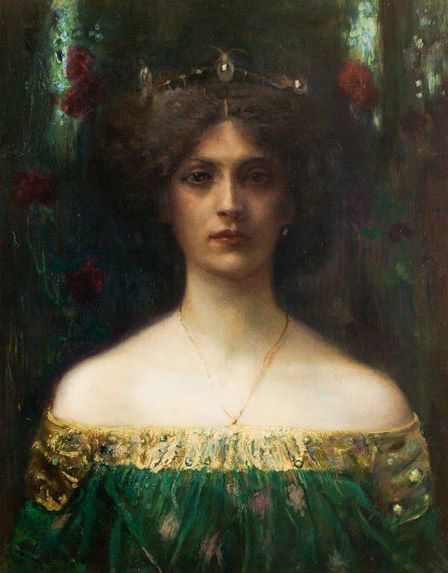
In the lower Belvedere, they have changing exhibitions. Right now, there is a show called Decadence – Aspects of Austrian Symbolism. Symbolism was an art movement around 1900, where artists often depicted fairy tale creatures as a way to symbolize different aspects of the human psyche. The paintings were all very suggestive and usually painted in dark colors and blurry edges, as if to create the feeling of being in a dream. Despite this being much smaller than the Upper Belvedere, I very much preferred this part of the museum and felt almost hypnotized by some of the paintings.
The painter of the paintings that I liked the most was called Eduard Veith. His paintings were dark and ominous, but extremely beautiful and full of mystery. Unfortunately, I couldn’t take any photos there either, so instead I found this on the internet:
 Katja Malmborg