We left Edinburgh on Sunday morning and boarded the tiny propeller plane that took us to Orkney, the group of islands just north of the Scottish mainland. That’s where the actual purpose of our trip was to be achieved: dad’s interviews. However, since it was Sunday, and no offices were open, we had the whole afternoon to acquaint ourselves with the very special Orkney surroundings.
The Mainland, as the largest island of the group is called, consists of an endlessly undulating landscape of grassy hills where cows and sheep wander around – until it suddenly stops in high, heart-in-your-throat-kind-of-steep cliffs or long white beaches.
The islands probably had more trees and the climate was a little warmer, but otherwise it was the same extreme place on the edge of the great ocean when people settled here and started building villages and places to worship more than five thousand years ago. What these neolithic peoples left behind has now become the Heart of Neolithic Orkney UNESCO World Heritage Site. It consists of four different sites, pretty close to each other in the center/west of the island, and we visited them all on this wonderfully sunny Sunday.

The neolithic village of Skara Brae is a five thousand year old village consisting of ten well preserved houses. And they look exactly like hobbit houses, don’t they, dug down in the ground like that. It was to protect them from the extreme weather on Orkney. Apparently, it is also the best preserved neolithic village in Europe. Pretty impressive.
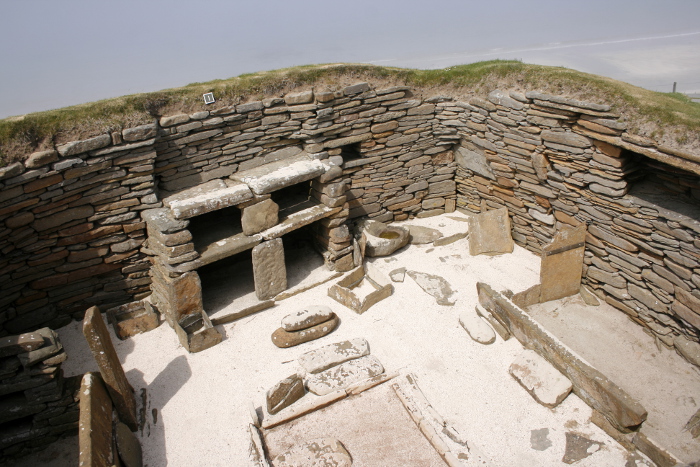
They even made furniture out of rocks: beds, tables, cabinets. Real stone age stuff.

And there were tunnels running between the houses. It must have been such a cozy place to live.
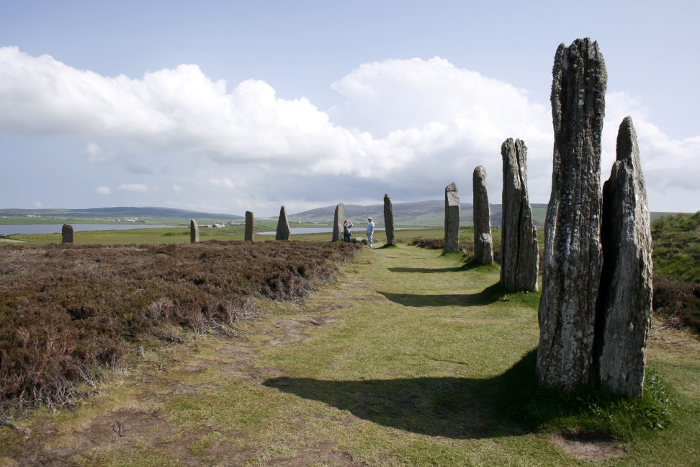
In the middle of the island, they raised what assumedly was their place of worship and celebration: the Ring of Brodgar. 27 stones standing in a circle 104 metres in diameter. There were originally 60 stones, but some have fallen, or been hit by lightning, or been felled by visiting vikings or raging local farmers.
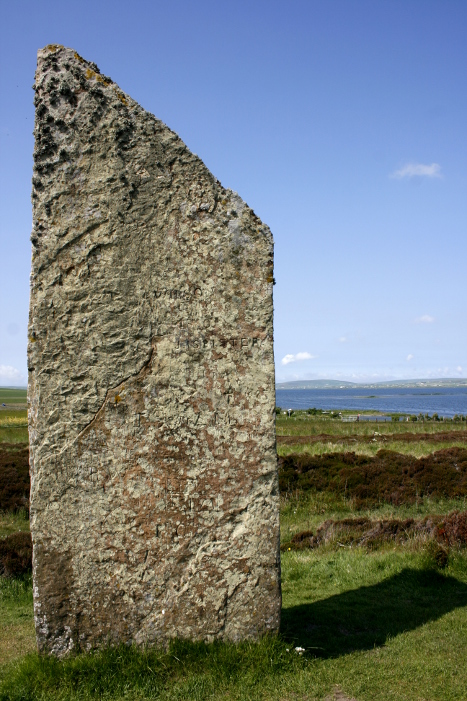
And they are seriously huge, the stones. And some even have viking grafitti on them. Those Vikings, they had no class.
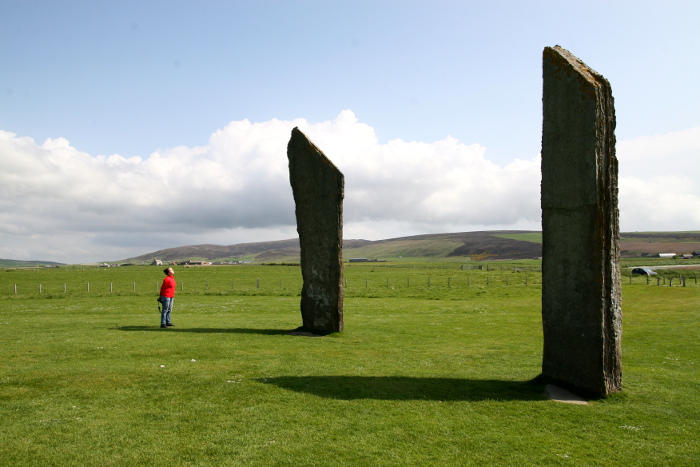
The other two sites are the Standing Stones of Stennes (pictured above, HUGE, by dad, with me as a reference) and Maes Howe, which is a burial chamber constructed as a perfectly round mound. It was built 5000 years ago, hundreds of years before the first pyramids in Egypt were being built. From the outside, Maes Howe just looks like an oddly evenly round hillock, but after crawling through the long, narrow tunnel into the inner chamber, the incredible construction skills of the long dead neolithic builders reveals itself. It is built out of immense slaps of rock, and the tunnel is constructed exactly so that the setting sun shines straight into the chamber and paints the back wall golden on the afternoon of the winter solstice.
It was used for burial ceremonies, but after a couple of hundred years, it was emptied, closed up and abandoned. Thousands years later, the Vikings came by and thought it would be a good idea to check if there was any treasure in it. It is believed to have been entered by several different raiding parties, one of which were trapped there by a violent storm that lasted for days. From these visits, the great stone slabs in the chamber are covered with runes. Messages such as Tryggr carved these runes or Thorni fucked. Helgi carved. They just had to leave their mark everywhere, those Vikings!
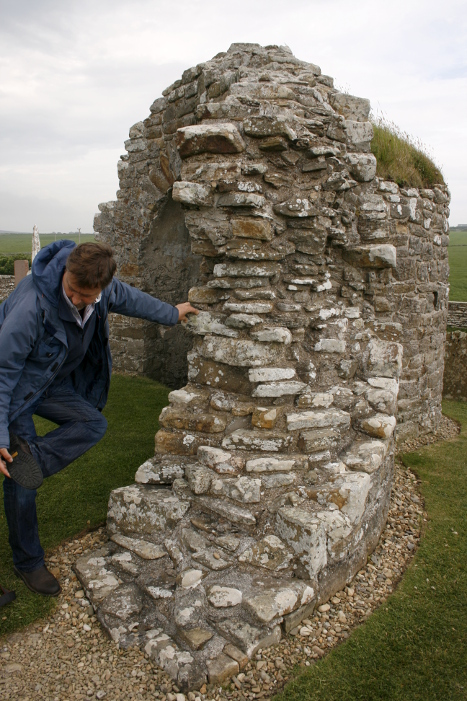
On the other side of the island, a small piece of wall of what used to be a perfectly round chuch stands just by the beach. It is called the Orphir Round Kirk, and is believed to have been built by Norse settlers in the late 11th century. Dad found it a suitable support when he checked his shoe soles for pebbles. Does he have a touch of that Viking respectlessness too, possibly?
Yeah, Orkney is a group of islands of grass, cliffs, wind and ocean, cows and sheep and very very old stones.
 Katja Malmborg