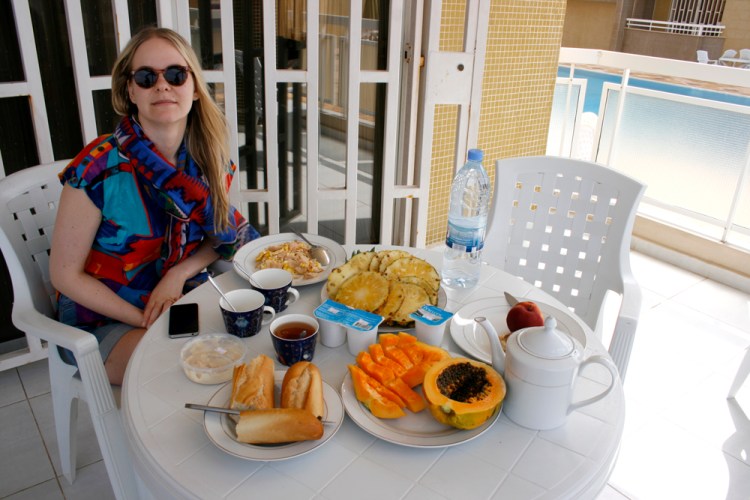
 The first morning in Monrovia, on mom’s balcony. Breakfast of papaya, pineapple, scrambled eggs and some humus – to the sound of the Atlantic crashing against the beach right on the other side of the wall. Pretty big change from the snow and ice we left behind in Stockholm.
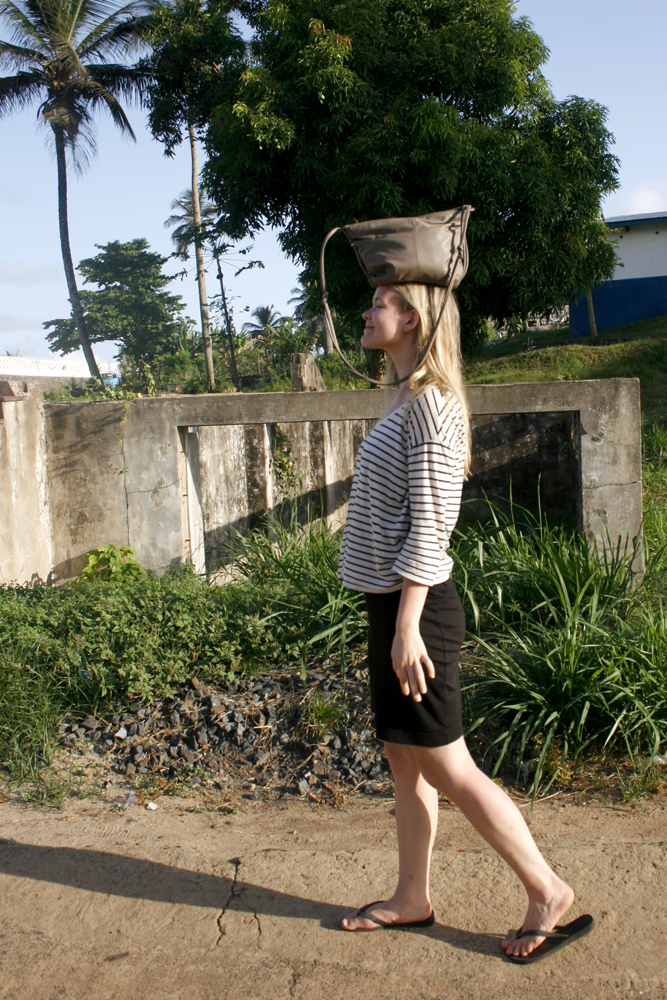 Hanna in Harper, trying out the way everyone carries around stuff in Liberia. It’s tricky, and god, how Morris and a couple of girls across the street were laughing while looking at Hanna’s efforts.
One afternoon in Harper, Hanna, Morris and I were looking at a monument of President Tubman’s mother, when we heard music coming from a newly built church nearby. It was choir practice and and I got the others to come in with me to listen.
The church was empty except for the choir standing in the front with the choir leader and a small electrical keyboard and a couple of chairs here and there in the big hall. But I think it was the emptiness that made the voices carry so well underneath the tin roof of the church. It was a simple hymn made up of chords for the different voices in the choir, with one voice changing note while the others stayed the same and then vice versa in a constant wave of changing harmonies. It wasn’t complicated, and in English too, so after hearing them singing it one time, I could easily follow them, singing under my breath. It was beautiful, though, in all its simplicity. So very different from the both traditional European and contemporary American hymns that I’ve been singing in the different church choirs that I’ve sung in over the years.
The singers in the choir were young, teenagers mainly, and they had no sheet music, only the choir leader giving the rhythm and their memories. It made me miss singing. Like so many things, singing is one that I’ve felt I had to give up for the time being due to lack of time.
But maybe it wasn’t the actual melody, in the end, that felt exotic to me. I think it was the way they sang. A straight forward timbre, the strength of the voice derived from the stomach rather than “coming out of your eyes”, as the vocal coach my old choir used to say. It gave a less clear and disciplined feel, but instead felt so much more sincere. And the rhythm, not the same as but kind of related to the Swedish folk songs that are to be sung with emphasis on the second and the fourth stroke.
I could have stayed there, listening to them for hours, while the lizards ran across the walls. But choir practice ended and we were due to eat dinner with mom and the deputy minister.
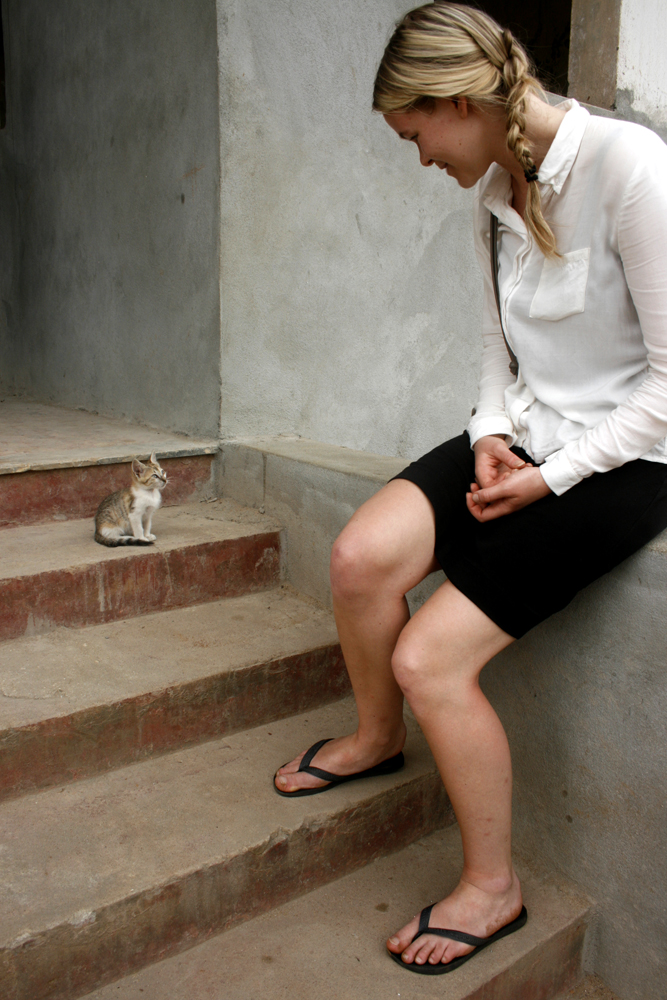 Hanna, making a new friend at the new county administrative building being built in Harper, with funding from the UNDP.
 Hanna, terrified while crossing the Hoffman river in a canoe.
The last night in Harper, we were offered to stay with the senator in his nearly finished house. Both mom, Hanna and the deputy minister had become sick from the mold at the guesthouse where we were staying, so we were more than happy to pack up our things and leave.
Later, way after sundown, the minister finally arrived, also to stay at the senator’s. We were already sitting in the big, empty entrance hall, and once the minister had settled in, the senator took out his bottles of palm wine. Finest quality. Because, in Liberia, as in most other countries in the world, traditional hospitality includes alcohol.
But Hanna was too tired and mom doesn’t really drink, so I ended up having to defend both Swedish and Finnish pride as nations of drunks with these Liberian high shots. And I didn’t disappoint. Palm wine is a very strong, very easy thing to drink.
So there was I, the former teetotaler, drinking shot after shot with a Liberian minister, senator and deputy minister, way after midnight, to the sound of the crickets and the generator, the night air barely even cool. Odd thing, indeed.
 Night-time visitor at the senator’s.
 Katja Malmborg