When it was decided that I would go to Liberia to visit my mom, I went online to the Stockholm University library catalogue and searched for books about Liberia. Excepting a big number of older litterature, from the days when Sweden had a considerable mining business going on down there, there was only one book in the library for me to borrow. Charles Tayor and Liberia by Colin M. Waugh. My plan was to finish it before I left, but ended up bringing it along and then finishing it more than a month later, several weeks after having come back to Sweden again.
It was a good book though. Liberia has an interesting modern history, to begin with quite different from most other Sub-Sahara African countries. Because, stricktly speaking, it never really became a colony to any of the big European powers. Instead, it started as a place where freed second or third generation slaves from North America came in the first half of the 1800’s and settled in a search for their ‘motherland’. What happened, though, was in many ways similar to what happened in many other African countries, only now it was the freed slaves from North America that became the lords, while the native population became marginalized and not allowed to enjoy the spoils of the development in the country.
The reason why the freed slaves could manage the settlement and final subjucation of the native population was that they had the support of both the United States government and England. The US, because the freed slaves (among them were illigitamate children of the plantation owners that simply were too embarassing to keep around) were starting to become a little too big of a power factor in the South, and England because they themselves hadn’t seriously started to colonize in this part of Africa yet, so they saw no use in antagonizing the US by claiming what became Liberia for themselves.
Well, so went the years, the freed slaves (locally called Americo-Liberians or Congos, depending on who you ask) became rich from rubber and iron and built big mansions by their plantations, while most of the native population stayed poor and were not allowed to take part in this economic development. Liberia was a republic, the first in Africa, but the only active party was the True Whig Party, with roots among the very first slave settlers in Liberia. The relationship with the United States was always strong and especially when the Cold War got going, the US found the very west-friendly state of Liberia useful in a region where most colonies were becoming independent and starting to lean more and more toward the east.
However, during the middle of the 20th century, while the liberation movements were strong all over colonized Africa, some of this African nationalism also spread to Liberia. And who knows, maybe the transition from a marginalizing one party state into a working democracy had gone smoothly if it had been left on its own in that crucial time in history. It’s impossible to say. Liberia was the richest country in West Africa and by far the most stable.
But, once the Liberian government had started showing its interests in seeking other African allies rather than helping the US, developments took place that strongly suggested that forces within the US government wanted a change in power in Liberia. The unrest, that already existed among the marginalized tribes in Liberia, was further fueled by support from abroad and in 1980, there was a military coup in Liberia. The president and several ministers were killed, shot standing in a line in front of a group of invited journalists from all over the world.
One of the leaders of the military coup, a man called Doe, became president. He was all for the US and promised that as soon as the country was stable again, he would give up his power and open up for democratic elections. Well, that didn’t happen. Still, for a very long time the US and most other countries in the world with the power to intervene just turned a blind eye to Does dictator behaviour, his persecution of other tribes than his own and governmental nepotism and favoritism.
However, eventually it became too much, the power started to go to Doe’s head and he made decisions that weren’t that well suited with the US’s interests. The US felt the need to get rid of him too. So, maybe not proven but still very likely, powers within the US government started supporting opposition groups within Liberia. These eventually became rebel groups that started gathering forces to overthrow the Doe regime. One of these rebel groups was led by Charles Taylor, who later would become one of the worst war criminals, responsible for more human suffering than any other person in West Africa in modern times.
So, starting from the first insurgent attack launched from Côte d’Ivore in 1989, the civil war began. Atrocities were commited both by the Doe regime and the insurgents, the looting was extensive, child soldiers were recruited, almost no part of the country was left untouched. And there are those who claim, among them Colin M. Waugh, that there were many times in the early parts of this conflict that a peace deal could have been brokered, if only the right motivations been present. Such as the definite pressure from the US. The plan was not for a war, but for a quick and forceful overthrow. However, now that the Cold War was over, the US didn’t see the need to support its alliances in Africa as much anymore, and all peace talks ended up crashing. There were periods of calm in between the fighting, and Charles Taylor even managed to win a by most international observers deemed pretty fair and open election and be president for a while, before a new group of insurgents attacked and the war started all over again.
Eventually, in 2003, Charles Taylor had to flee the country and after some time in Nigeria, was turned in to the IPCC in 2006 to stand trial for the war crimes he committed while his rebel group and allied local insurgents were active in the Sierra Leonean diamond fields. He was convicted of 11 charges of war crimes and crimes against humanity in 2012. Now, Liberia has a democratically chosen president, a Nobel Peace Prize laureate, and it seems like things are finally going in the right direction in again.
However, the devastation of the war is visible everywhere, even though the peace deal was signed ten years ago. The country is full of majestic ruins, left by the Americo-Liberians during the war. Their owners have stayed whereever they went, mostly to the US, and now some of the ruins are inhabited by squatters. Some are just empty.
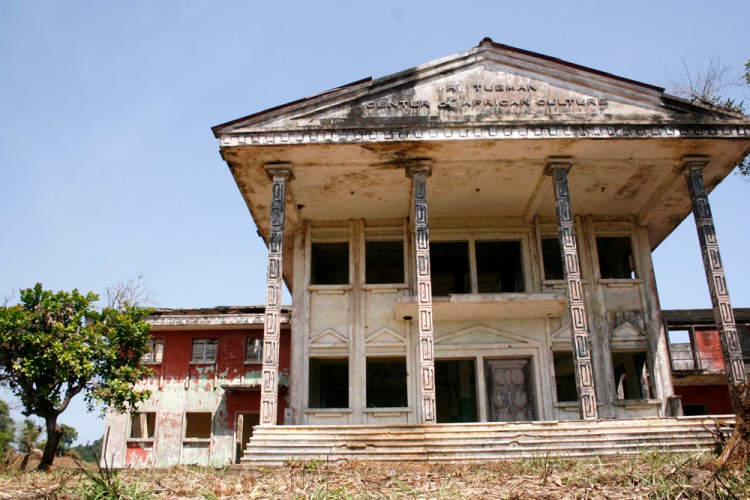 Ruin in Robertsport above, Harper below.
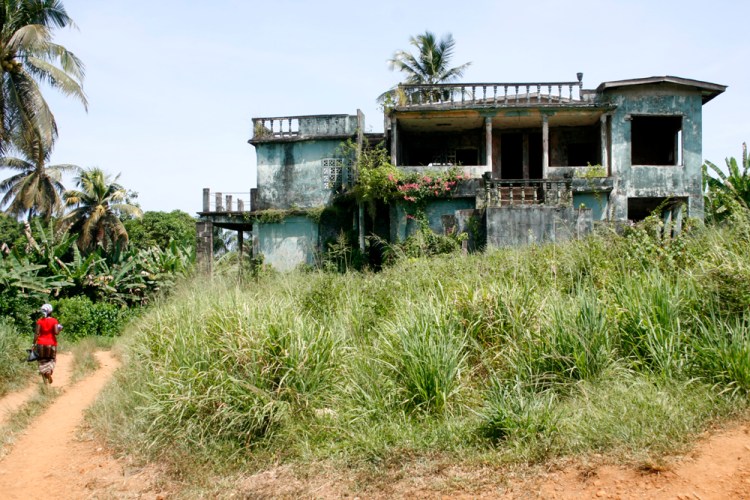 For me, there is something aesthetically intriguing with these ruins, and I couldn’t stop taking photos of them. This fascination is, however, mingled with guilt. Because, all these run down houses are a very concrete manifestation of the devastation that can be caused in a small country when it becomes a pawn in someone else’s game.
Of course it is making it too simple, just blaming everything on the interventions of the US, and of course individuals such as Doe and Charles Taylor were monsters in their own right, but still. It makes me so angry, when these big powers play their game without taking responsibility.
Liberia was a rich country, is a rich country, all the rubber tree plantations and the iron ore and the old mansions is evidence of that. But then someone big and powerful came and said that it wasn’t developing in the right direction – and chaos was let in.
Oh, yes, I know, I know! It’s wrong to make simplifications like that. But sometimes blaming someone makes confronting all that misery just a little bit easier to handle. And also, hope easier to muster. Because, then you could say it wasn’t Liberia. It was everyone else.
 Katja Malmborg