Now in the spring is the time when the hens want to have babies. But they are strangely communal about the egg laying process. They’ll find a spot that they like, build a little nest there and start laying eggs. When the original hen isn’t there, some other hen might lie in the nest for a while, leaving an egg as a gift of sorts. Some hens, on the other hand, are so greedy that they will steal eggs from another nest, carrying them underneath her wing. When there is an appropriate amount of eggs in the nest (the exact number varies greatly between different hens, some are greedier than others), she will start the actual laying process, keeping the eggs warm for three weeks.
The tricky thing about this is that in the beginning, the hen still leaves the nest for short periods of time to eat. Since another hen might come and lay a new egg in the nest during the laying hen’s absence, a couple of eggs in the nest might be behind the other eggs in maturity, so to speak. When it’s time to hatch, the first chick might start crawling out of it’s shell while the last still needs a day or two to mature in it’s egg. This leads to the hen getting off the nest when the oldest chicks are ready to leave, while there still might be a couple of eggs that are only half hatched. They can’t hatch on their own, they need the heat from the hen, so if the mother leaves, the half born chicks die.
But I was so excited about the hens lying on eggs, wanting to see the newly hatched chicks, so I checked on them often and managed to be on time to save seven chicks from freezing to death in their eggs. That was when the midwifing process started. Lori made it my responsibility to make sure the chicks were warm enough, possibly help them get out of their eggs and let them dry before I put them back underneath the hen-mother again. It’s alot harder than it sounds, though.
The first chick I midwifed was the only chick in the the batch that didn’t make it out on time. It had only just cracked through it’s shell, and was tweeting like only bird babies can. I could see the beak through the hole in the shell, but that was all.
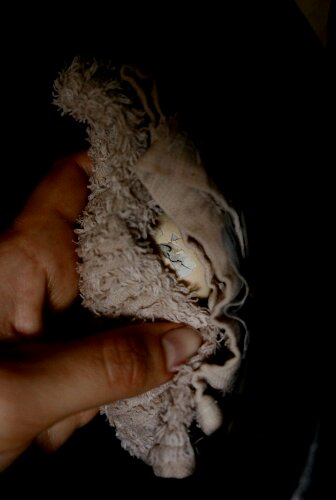
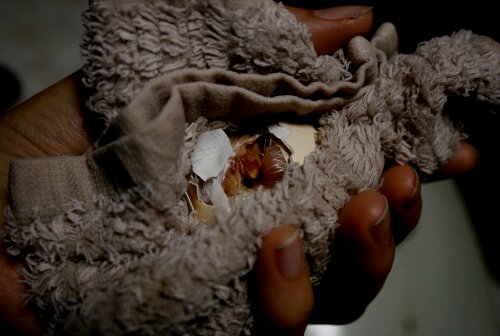
At first, I kept the egg warm with towels soaked in hot water. Lori was out working in the butcher shop, but on one of her visits in the kitchen, she showed me where the cooker that she used for making broth was. In that, I thought the egg might be warm enough. But the hatching was slow. Eventually I started helping the chick crack its shell, pealing off small pieces.
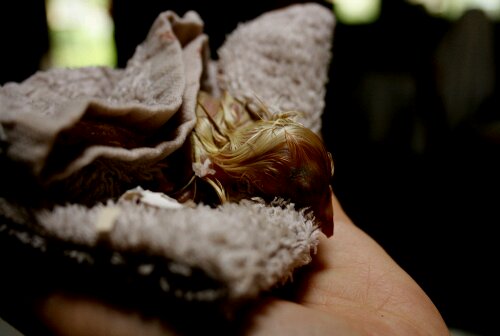
When it finally got out, it looked like a tiny alien. Seriously, if someone had showed me this creature out of context, all wet and still crooked from the egg, I might have believed a claim that it was a dinosaur baby. Now the heating got trickier, the wet towels prevented the chick from drying. I found a hair dryier, but using it seemed to scare the chick. It looked tired and weak and I didn’t have a clue how to give it the right, mother-hen belly temperature. At last, after more than two hours of midwifing, the chick died. I was holding it in my hand when it took it’s last breath.
Really, I’m not that sensitive, but still I felt kind of sad afterwards. The chick had gotten seriously cooled down before we found it, so it was weak – but if I had found a way to keep it warm and comfy for a long enough period for it to dry, it still might have survived. I think. My first try as a chick midwife was a huge failing. To lighten my mood, I had to go visit the chickbarn, where we kept all the newly hacked chicks and their mothers. It’s hard to be sad with those small, cute tweeting cottonballs running around you.
The next time I was more prepared. This hen had laid her eggs in the worst place imaginable, on top of the wood shavings pile, in the corner up against the tarp where the wall didn’t go all the way up to the roof. And she was protective of her eggs, so she wouldn’t let Lori move her into a cardboard box to make sure non of the eggs fell down from the shavings pile. To make matters worse, she had more than twenty eggs, far too many to be able to keep them all warm enough. So, when her eggs started hatching and the first bunch were strong enough to start moving, more than half of her eggs were still unhatched.
Luckily, I walked by just then, on my seach for the days catch of eggs. We quickly moved the hen and her chicks into the barn and found three half-hatched eggs that were still tweeting.
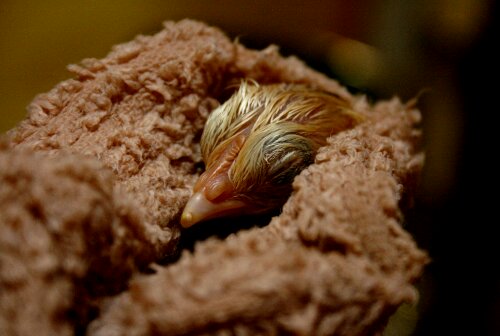
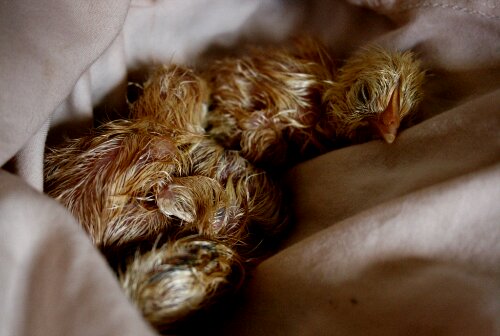
Now, I knew what to do. First, I helped all three chicks to get out of their eggs. Then I created a system where I wrapped all the mini dinosaur babies in towels soaked in hot water. I continually had to change the towels, before they cooled off, but all three chickens seemed to be doing fine. Then Lori got the idea to use the small heater in the living room to keep the chicks warm. So I built a nest of dry towels for the babies and placed it right underneath the hot air vent. There, the chicks could dry, and eventually all of them were lifting their heads and moving around. When they were all dry and fluffy, I took them to the chick barn and placed them underneath the vary mother-hen, hoping she would let them rest for long enough.
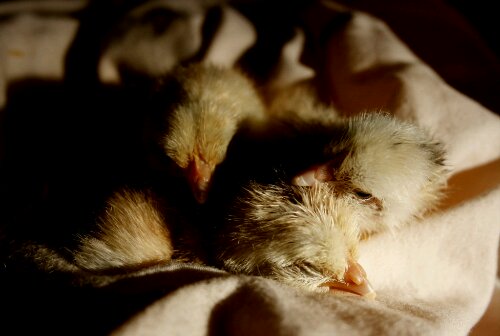

Just to make sure, Lori and I went back to get the unhatched eggs from the wood shavings pile. There, we found two more chicks, one all hatched, but lying at the bottom of the pile, bleeding from it’s stomach and barely breathing, and another one with barely a hole in it’s shell. These must have been really strong, to hatch completely without the mother-hen’s heat. So, I did the same procedure to them, with the hot towels and the heater, and when completely dry, put them back underneath the mom. They both seemed very much alive and strong.
The next morning, when I went to check on the chickens in the chick barn, I found two dead chicks in the nest where the newest hen had been lying that night. One was the chick with the wound on it’s belly. It had probably been caught by a raven from the top of the shavings pile just after hatching, but then dropped for some reason and fallen to the bottom of it. It might have had internal bleeding that was too severe for it to survive, even though it seemed extremely strong the night before. The other chick was yellow, maybe the one of the first three that had seemed more tired and groggy than the other ones.
But still, I managed to save three happy little chicks from freezing to death and making it through those first critical hours of life outside. That must be considered an accomplishment for a second time chicken midwife.
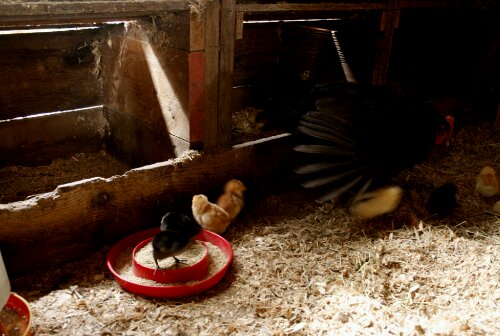
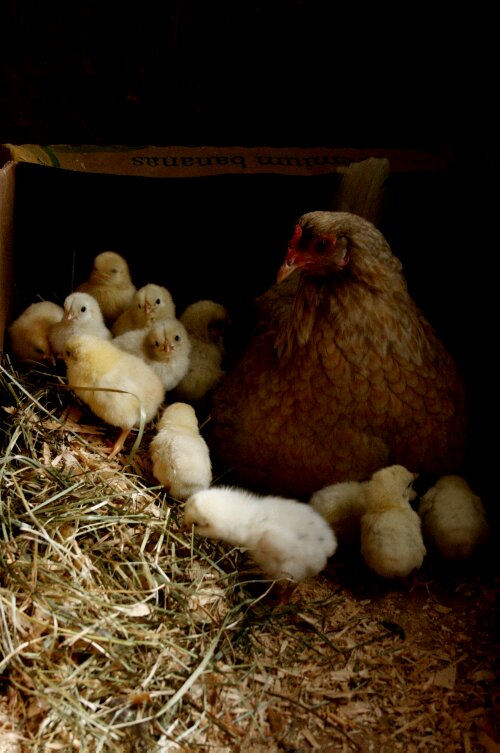
Protective mother-hen, letting the chicks under her wings.
 Katja Malmborg