Sunday (29/4), I woke up far too early, considering how late we came back from the BBQ the night before. But my days in Vancouver were rapidly running through my fingers, and I still had so many things I wanted to see. So I ate my bagel with cream cheese and walked down to Broadway to catch the 99 to UBC.
UBC, or University of British Columbia, resides on a kind of headland, with water on three sides, west of Kitsilano. The campus is big, with residential areas and different buildings for all the departments and a lot of gardens and parks surrounding it. For a tourist as myself, the Museum of Anthropology is the main attraction, but I couldn’t help taking a stroll around campus just to get a feeling for this huge university in this very hip North American city.
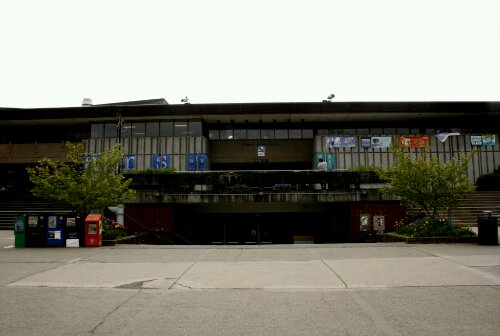
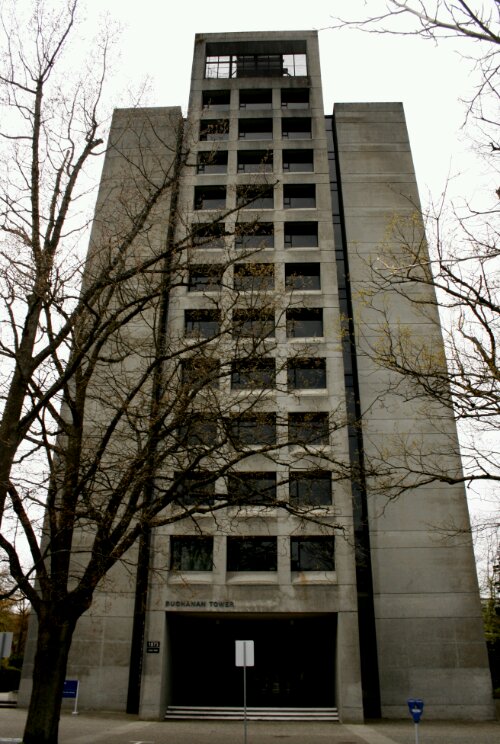
In many ways, the UBC campus and the Frescati campus of Stockholm University reminds me of one another. Most of the buildings are made out of concrete and were probably built in the sixties and seventies. Which means that they aren’t beautiful, but still have a rough kind of charm that I appreciate. The difference is that everything at UBC is comparatively new, while at Frescati, there are several smaller buildings that are considerably older than the main campus buildings. Take the Stockholm University student union building, the Nobel house. That’s an old brick building with crooked stairs and strange floor plan that just feels very cozy. And it gives a special kind of feeling, a sort of connectedness, to the campus, with these old and new buildings next to each other. At UBC, everything is new, and the student union building (above) might be the flatest, most uninspiring house I’ve ever seen.
But, as at Frescati, there is a lot of greenery around the UBC campus, and since the sun was just about to break through the clouds, I decided to go to the Nitobe Memorial garden before heading to the museum. It’s a traditional Japanese garden, tucked in between a few ugly buildings and a small piece of forest with huge Douglas firs. On a road nearby, there was quite a lot of traffic (people heading to a Sunday pic nic at the beach?), but the moment I walked in through the gate to the Nitobe garden, it was as if the rest of the world disappeared.
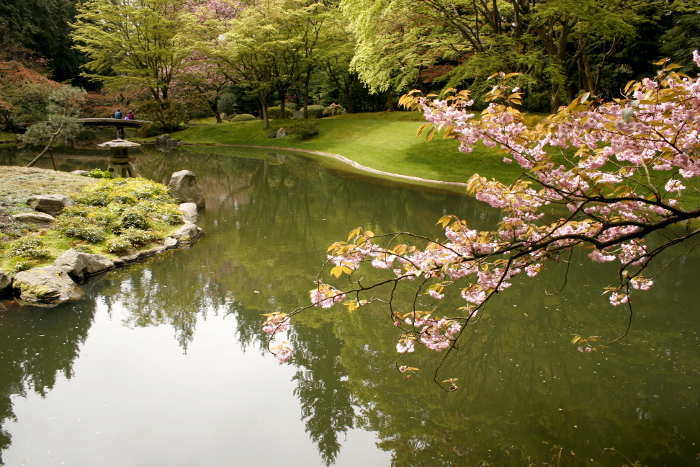
The cherry trees were blooming and the newly opened leaves were bright green. In the middle of the garden, there was a pond and the shelter of the trees blocked out all the noise and the wind, so that the surface of the water was calm and bright as a mirror.
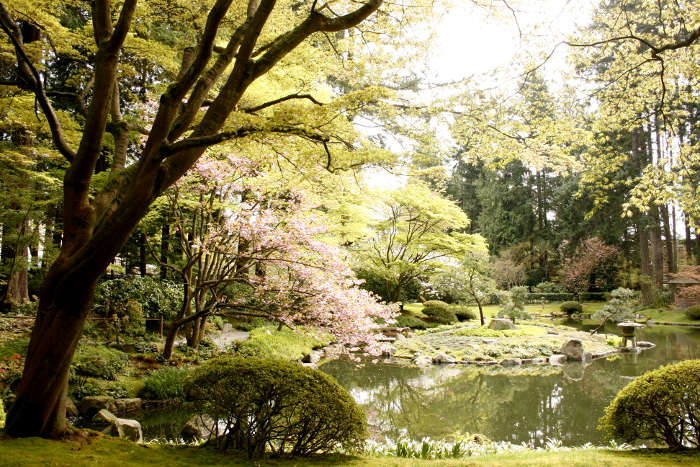
And just then, the sun broke through the clouds and made the fresh leaves of the trees shine. Oh, it was magical.
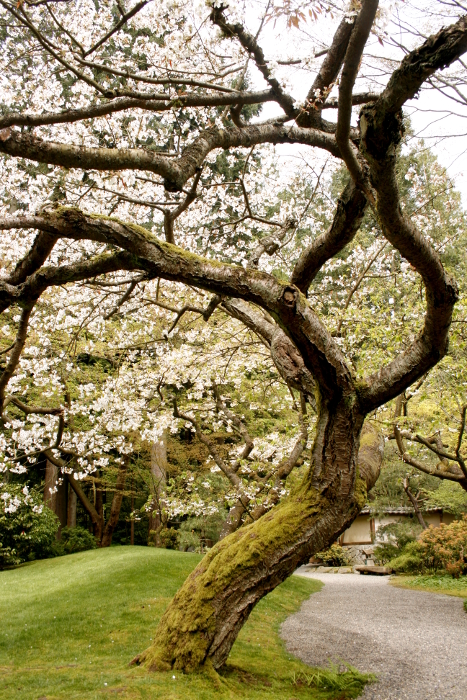
There was a short guide to the garden that was included in the entrance fee, where they explained the symbology of the Japanese garden and how different features of it might be interpreted. This particular garden could be seen as a symolical walk through life, with childhood, adolescence, marriage, adulthood and old age. Every plant, every tree and stone and piece of lawn, was meticulously pruned and cut and placed with extreme care and thought, and I guess that was why it was such a calming place. It was as if the trees themselves got my heartbeat to slow down and my breathing to become deeper.
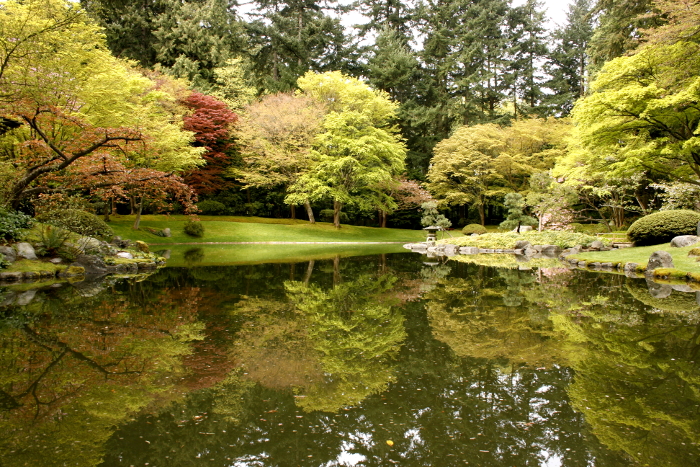
But, unfortunately, I couldn’t stay for very long. I would have liked to sit down on the bridge and look at the reflections in the pond and let the hours slowly flow by, but that’s not the kind of thing you can do as a tourist. Atleast if you’re as inquisitive as I am. So I had to leave the peace behind me, walk past the giant firs and cross the street. My next destination was the Museum of Anthropology.

The Museum of Anthropology at the University of British Columbia is in this massive concrete building, which was designed by a famous architect that I can’t remember the name of and has, according to the museum tour guide, won several prices. And sure, I guess I could see that. But for me, it wasn’t the building in itself that amazed me, but the way it exhibited the objects within it. And especially fascinating were the objects themselves.

The museum offers free of charge guided tours in the museum. The extremely well articulated guide told us about the use for totem poles. They were carved in different styles by the different nations, and were made for families. They always told a story about the family, something important in their heritage. For most of the poles, the researchers of today can only guess what these stories were. Most of them are secerets of the remaining family members, or forgotten. This totem depicts a bear, a frog and a wolf, all very important, symbolical animals of the west coast First Nations.
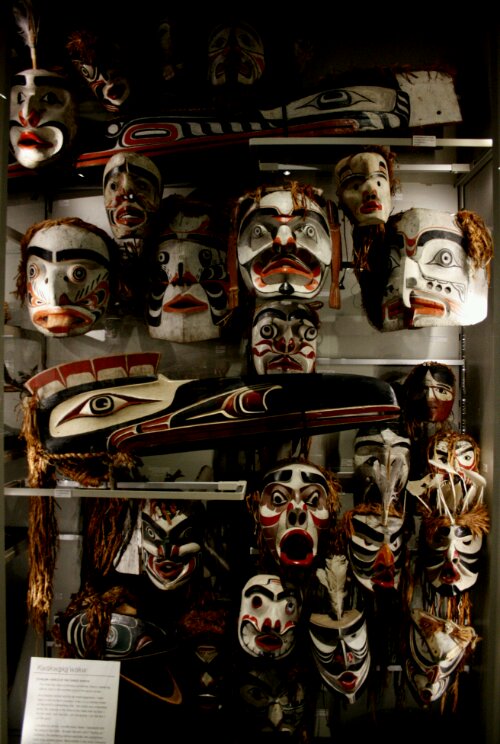
The museum was full of totem poles and masks and other carvings, mainly from the First Nations in British Columbia, but also quite a few things from other parts of the world. The museum was actually the archive of artifacts collected by the Department of Anthropology at UBC. The things that didn’t fit onto the shelves in the glass monters, were stored in chests of drawers that were open for the museum visitors to open and look at. There were an incredible amount of artifacts there, from baskets to cooking utensils. I could have spent days there, looking at all the handicraft, and still not seen everything. It’s really an incredible museum. Atleast if you’re into history or art or culture in general. I like carvings in wood. And imagining the lives of the people who made and used them.
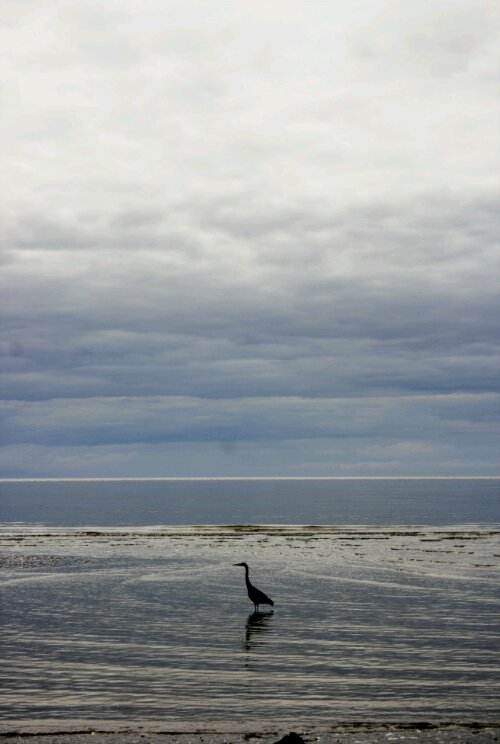
Just when I was about to leave the museum, I got a text from Scott. He was on his way to UBC with his beautiful old school Lumix camera. Together, we walked down to Wreck Beach – Vancouver’s best, according to both Elise, Jeremy and Scott. Turns out, it’s also Vancouver’s nudist beach. And there were actually a couple of them there. This afternoon. Completely naked. I was wearing my alpaca sweater, rain jacket and a scaf, and I wasn’t hot. And this guy was walking around completely naked down by the water. I’ve got nothing against nude people, gosh, I’m Swedish, but there must have been something wrong with the temperature feeling nerves in his skin.
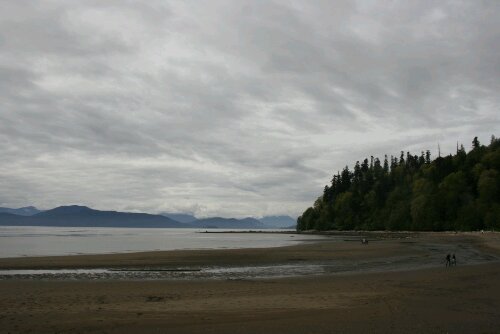
Well, excepting the naked guy, the beach was really beautiful. I can really see how it can be packed with people on a sunny summer’s day.
Over all, UBC was a nice place. I would gladly study there, if I got the chance. Maybe I should keep my eyes open for a position at the Ph.D programme when the time comes and I’m qualified. If I ever will be.
Or maybe not. Stockholm University is still where I like it best.
 Katja Malmborg