But Jay doesn’t really do western nor English. He looks like a proper cowboy, with the hat and the boots with long spurs and the sunburned face, but what he trains and teaches isn’t what any ordinary cowboy would teach.
Jay says that cowboys know animals, but don’t really care about riding well, and they can be really rough on their horses while riding. Other western riders are generally much lighter on their horses, but still have the same lack of theoretical knowledge as the cowboys. The English, on the other hand, can be really good riders and know everything about technique and movement, but they don’t know shit about how horses think. What Jay does is that he combines the two schools and also adds alot of his own knowledge and experience from a lifetime of working with horses.
What he teaches might seem simple at first. The main idea is to work on the horses terms, to cooperate instead of using force. It’s about being light and to train in a way so that you never have to be rough. And this is all possible, because horses are sensitive creatures and extremely aware of everything that happens around them. They notice everything, and if you train the horse to react to a word or a light touch in a specific way, they’ll eventually learn it as long as you’re consistent. The practice of pulling the reins hard and squeezing the sides of the horse very tightly with your legs that is common in English, but also to a degree in western riding, is desensiticing and sometimes even harmful, but most of all unnecessary. The horse can respond almost to a mere thought, if you have the ability to train it right.
The training of any horse should be based on two evolutionary facts: that horses are flock animals, and that horses are pray animals, while humans are predators. As flock animals, they respond to leaders. In the wild that would be a combinatin of a strong stallion and a dominant mare. In captivity, with people, the leadership issue tends to be much more confusing and sometimes even lead to dangerous conflicts. Any person working with horses should establish herself as the leader of the flock, but that is not just getting the horse to do the things you wish by force. The true leader has the respect of the horse and has been able to prove that it is strong and brave and trustworthy.
Being prey animals means that horses are very perceptive and aware of everything around them. Humans on the other hand are predators, which has given us an amazing capability to focus on one thing. While horses always are ready to flee, humans are always ready to attack. So, the training of any horse should be aimed at teaching the horse to focus, while the trainer or rider has to teach itself to be more perceptive and aware. And most importantly, not working with one thing for too long. Jay calls it thinking with horse logic, not people logic.
This is what Jay teaches, how to become the leader of your horse and how to think with horse logic. And once you are the leader and have the respect of your horse, training it to respond to lightness will be no problem at all, as long as the training is carried out with horse logic. The horse will WANT to do as you ask. That’s how evolution has made them – follow a good and strong leader, or perish. As long as the horse understands what you ask of it, it will do as you wish. It might take some time to get the horse to understand, but patience and calmness is essential to any kind of horse training.
The tricky thing is that the simplicity of the theory becomes quite difficult when put into practice. It’s all about reading the horse, and responding in a way that is both logical for the horse (but not necessarily for humans) AND establishes you as a strong leader. But the signs from the horse are sometimes so small, and the timing is of such essence, that the whole thing eventually feels impossible. It needs practice and practice and a horse that is willing and even then it takes even more time to teach the horse exactly what you want.
But Jay, he has it all in the tips of his fingers. Without seemingly moving at all, or only a step here or there, he can get a horse to run or stop, come to him, walk away from him or follow him. It’s amazing to see. I’ve spent hours just watching the horses melt like butter in his hands.
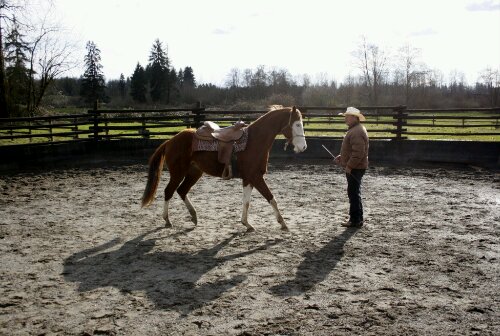
Jay working with Casper in the roundpen.
 Katja Malmborg
What a gift for you to work with this man.
Dad